
Robots as Social Bridges: Reimagining Inclusion in Mixed-Ability Classrooms
Community Based Robot Design for Classrooms with Mixed Visual Abilities Children
This paper introduces a community-based design approach for developing social robots tailored for classrooms with mixed-visual ability children. By conducting a four-month ethnographic and participatory study, the authors conceptualize robots not just as assistive tools, but as social mediators that foster academic and social inclusion for both visually impaired (VI) and sighted students.
TL;DR
In mainstream classrooms, visually impaired (VI) children often live in an "assistance bubble," physically present but socially isolated. This research moves beyond simple accessibility to social inclusion, using a four-month community-based design process to develop robots that act as social mediators. By involving children, parents, and educators in the design, the study reveals that the true value of a classroom robot lies not in its ability to "fix" a disability, but in its capacity to synchronize shared experiences through multi-sensory feedback and physical embodiment.
The Motivation: Beyond the "Assistance Bubble"
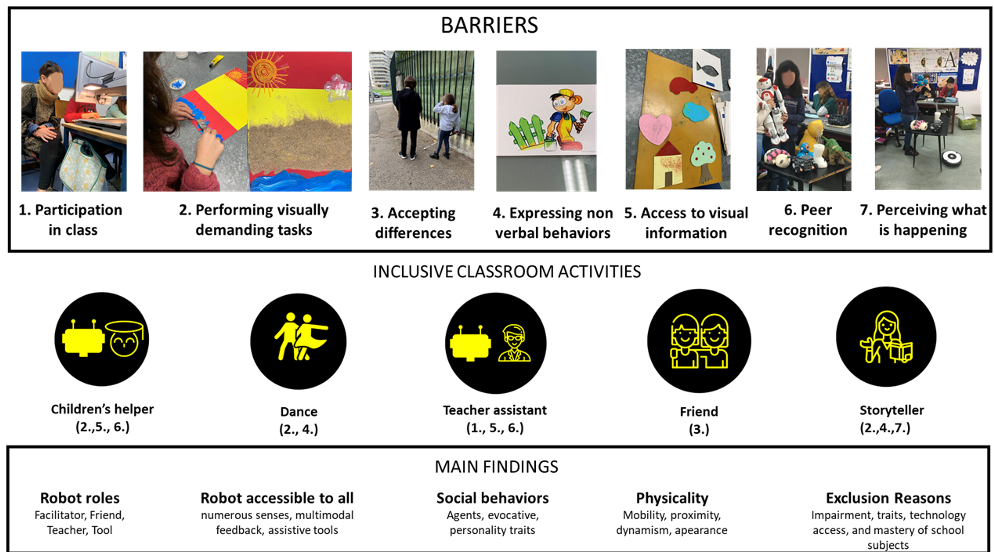
Why is inclusion so hard to achieve? The authors argue that current educational accommodations—like having a dedicated Teaching Assistant (TA)—often create a secondary barrier. While the TA helps the VI child keep up with the lesson, they unintentionally disconnect the child from the broader classroom's social rhythm.
The core insight of this paper is that visual information is the currency of social interaction. When a teacher uses a gesture or a peer makes a facial expression, a VI child loses more than just "data"; they lose a social connection. The researchers set out to see if a socially embodied robot could act as a translator for these fleeting, non-verbal cues.
Methodology: Co-Design as Curriculum
The researchers didn't just walk into a lab; they embedded themselves in a school for four months. The methodology is a masterclass in inclusive research:
- Community Engagement: Interviews with "expert stakeholders" (Braille teachers, mobility instructors, and parents) to define real-world barriers.
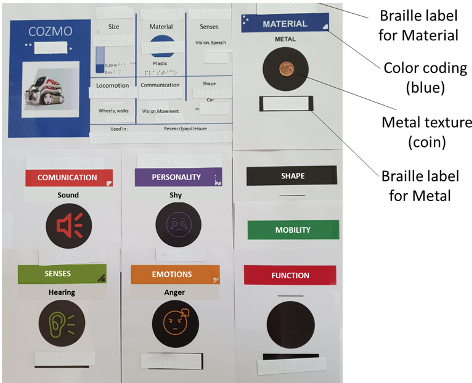
- Inclusive Prototyping Toolkit: To ensure VI children could participate as equal "creative agents," the researchers built a toolkit using Braille labels, tactile textures, and high-contrast color coding.
- The Five Roles: Children were assigned to design robots for specific scenarios: Helper, Dancer, Teacher Assistant, Friend, or Storyteller.
Key Findings: The Physicality of Inclusion
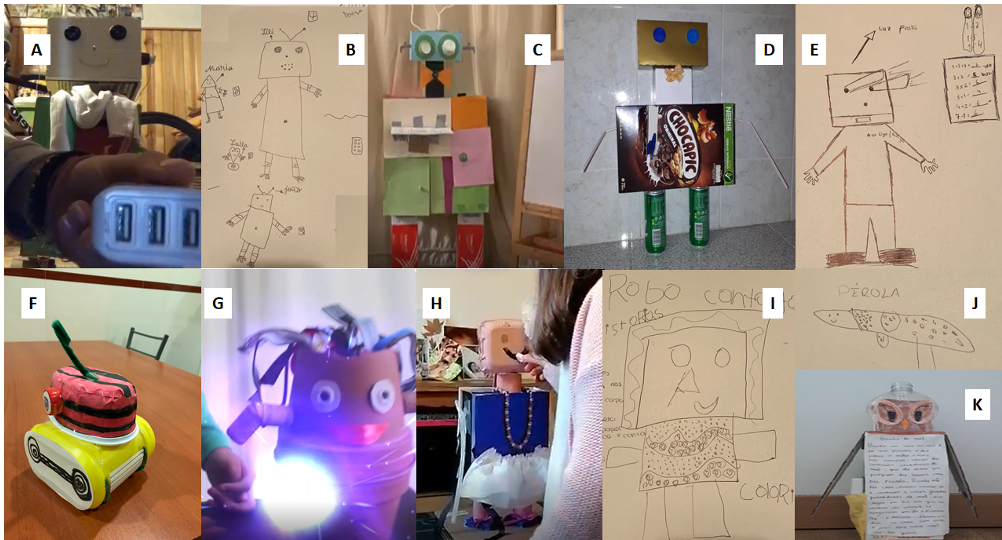
The "robots" designed by the children revealed a clear trend: Physicality > Intelligence.
- Multimodal Bridges: 72% of the designed robots used vision as a primary sensor but converted that data into sound, light, or touch. For example, a robot might "see" a teacher's gesture and mimic it physically, allowing the VI child to feel the movement.
- The Mobility Factor: Robots were envisioned as mobile entities that circulate. Unlike a tablet or a laptop, a robot can move toward a speaker in a group discussion, providing a spatial cue to the VI child about who is talking.
- Redefining Exclusion: Interestingly, younger children (Primary school) did not list "impairment" as the main cause of exclusion. They blamed shyness or bad tempers. This suggests that inclusive robots should focus on social-emotional regulation rather than just being "eyes" for the blind.
Critical Analysis & Conclusion
The paper successfully argues that social robots can "burst the assistance bubble" by providing a shared platform for interaction. However, as the authors note, there is a risk of information overload. If a robot is constantly vibrating, talking, and flashing lights to explain the environment, it may become a distraction rather than a help.
Takeaway for Future Research
The future of assistive robotics is not about "fixing" the user, but about "fixing" the bridge between users. This study proves that when we design for the most extreme needs, we often solve social problems—like loneliness and engagement—for every child in the room.
Limitations: The study was conducted in a private school environment, which may have higher technology literacy/support than public institutions. Future work must validate these social behaviors in long-term, autonomous deployments to see if the "novelty effect" of the robot eventually fades.