
CRP: Revolutionizing Vehicular Networks Through Social-Aware Routing
Community-Based Routing in Vehicular Social Networks
The paper introduces CRP (Community-based Routing Protocol), a novel routing strategy for Vehicular Social Networks (VSNs). It leverages the social attributes of drivers and passengers to define "Community Significance" for different data packets and uses a hybrid forwarding priority mechanism to optimize data dissemination.
TL;DR
The Community-based Routing Protocol (CRP) shifts the focus of vehicle-to-vehicle (V2V) communication from "whichever node is closest" to "whichever node belongs to the right social community." By introducing packet Significance Values and a dual-mode Forwarding Priority, it achieves a 94% delivery ratio in dense urban scenarios, outperforming traditional mobility-aware benchmarks.
Problem & Motivation: The Gap in traditional VANETs
Conventional routing protocols in Vehicular Ad hoc Networks (VANETs) operate on a purely physical layer—analyzing coordinates, velocities, and link stability. However, they ignore a crucial human factor: social relevance.
A teacher commuting to a university has different data needs and mobility patterns than a resident heading to a supermarket. In a Vehicular Social Network (VSN), vehicles with similar trajectories and interests form "communities." The primary challenge is that existing protocols treat all nodes as equal potential relays, leading to:
- Redundant transmissions to nodes that have no interest in the content.
- Missed opportunities where a potential relay (heading toward a target community) is ignored because it is currently far from the destination.
Methodology: The Core Architecture of CRP
CRP operates on the insight that routing should be proactive, looking at both the immediate local benefit and the future social potential.
1. Packet Significance Value
CRP assigns a Significance Value to each packet . This vector represents how much a specific community (e.g., Teachers, Workers, Residents) desires the data.
2. Forwarding Priority (FP) Calculation
The "secret sauce" of CRP is how it decides which neighbor should get a packet replica. It uses a weighted formula:
- Direct Forwarding Contribution (DFC): Measures how many valid neighbors (who haven't received the data) in high-significance communities are currently within range.
- Indirect Forwarding Contribution (IFC): Uses historical Contact Probabilities between communities. Even if a neighbor isn't in the target community now, its probability of meeting the target community later makes it a valuable relay.
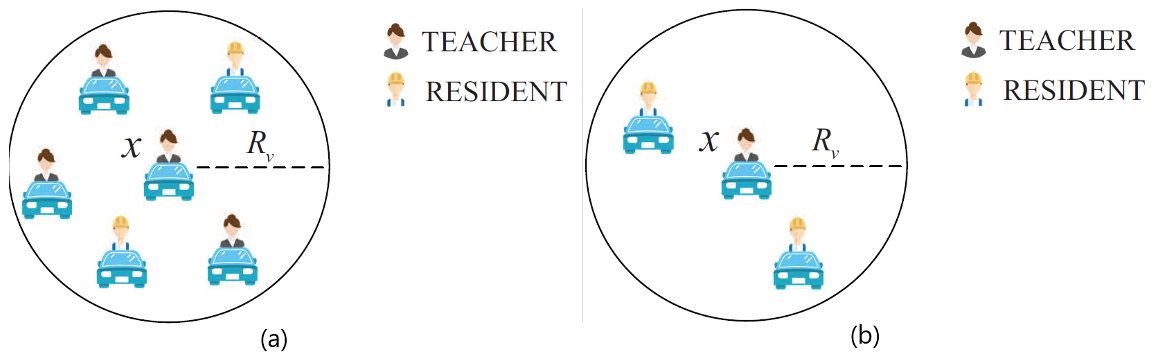 Figure 1: Comparison of high-density vs. sparse VSN scenarios and how priorities shift based on community presence.
Experiments & Results: Real-World Validation in Beijing
The authors validated CRP using a sophisticated stack (SUMO, Veins, and OMNeT++) on a real road map of the West 3rd Ring Road in Beijing.
Performance Metrics
- Community Delivery Ratio: CRP reached ~94% delivery, significantly higher than the Social Acquaintance-based Routing Protocol (SARP) and way ahead of Greedy (MRP) or Random (RRP) protocols.
- Latency: Despite the complex calculations, CRP maintained a short average delivery delay, proving its efficiency in time-sensitive urban environments.
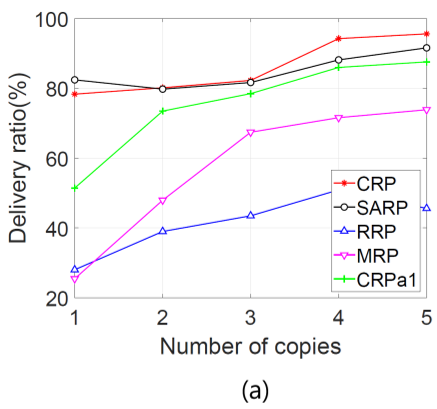 Figure 2: (a) CRP shows a superior delivery ratio over time; (b) CRP maintains low average delay compared to greedy methods.
The Impact of Replicas
The study also explored the trade-off between resource usage and delivery speed. While more replicas increase the delivery ratio, the benefit plateaus after 4 replicas, suggesting that social connectivity becomes the primary bottleneck rather than the number of packets in the air.
Critical Analysis & Conclusion
CRP provides a robust framework for data-centric networking in VSNs. Its greatest strength lies in the Inductive Bias that social behavior is a strong predictor of network utility.
Takeaway: By quantifying "social significance," we can transform vehicular networks from simple message-passing pipes into intelligent, interest-aware delivery systems.
Limitations:
- The protocol relies on historical mobility data to calculate contact probabilities, which might fail during unpredictable traffic anomalies (e.g., accidents or major road construction).
- The privacy implications of broadcasting community IDs and significance vectors were not deeply explored in this paper.
Future Outlook: Integrating real-time traffic flow prediction and direction-aware forwarding could further refine CRP's accuracy in super-dense urban clusters.
Keywords: Vehicular Social Networks (VSN), Routing Protocols, CRP, Community Detection, Smart Cities.