
Safeguarding P2P Social Networks: A Community-Based Trust Paradigm
Community-based trust mechanism in P2P social networks
This paper introduces a hierarchical, community-based trust mechanism for P2P social networks that combines semantic-based clustering with a dual-layer reputation system. By segregating trust into intra-community (local) and inter-community (global) calculations, the model significantly outperforms the classic EigenTrust algorithm in mitigating malicious behaviors like slandering and collusion.
TL;DR
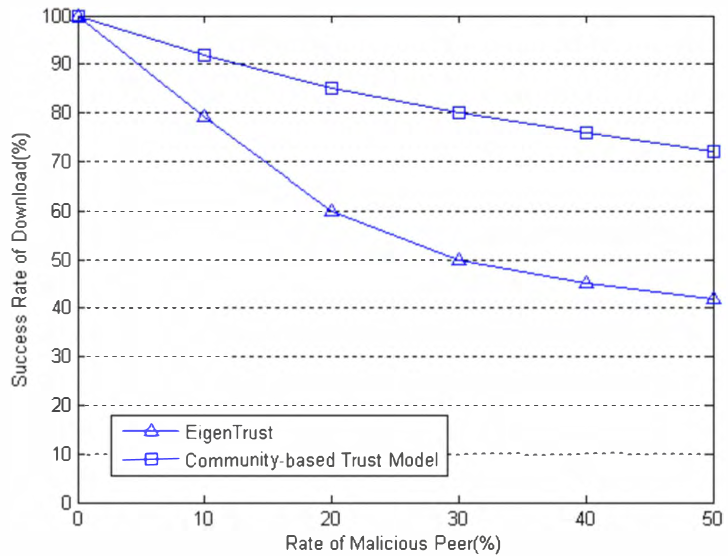
Peer-to-Peer (P2P) social networks are frequently plagued by malicious actors—namely "free-riders," slanders, and collusive groups. This paper proposes a Community-based Trust Mechanism that organizes peers into semantic clusters and utilizes a two-tier reputation system. By separating local "intra-community" trust from global "inter-community" trust (managed by Super Peers), the system achieves higher resilience against attacks, maintaining a 72% success rate even when half the network is malicious.
1. The Trust Gap in Decentralized Networks
Existing trust models generally fall into two categories: Centralized (PKI-based) or Fully Distributed (Query-based like EigenTrust). Centralized models are prone to Single Point of Failure, while distributed models often lack the context to handle Collusion or White-Washing (where malicious actors leave and rejoin the network with a fresh identity).
The authors' primary insight is that Social Networks are naturally semantic. People interact based on shared hobbies or interests. By leveraging this "semantic proximity," we can create smaller, more efficient trust circles where data is more reliable and broadcasting costs are lower.
2. Methodology: Dual-Layered Reputation
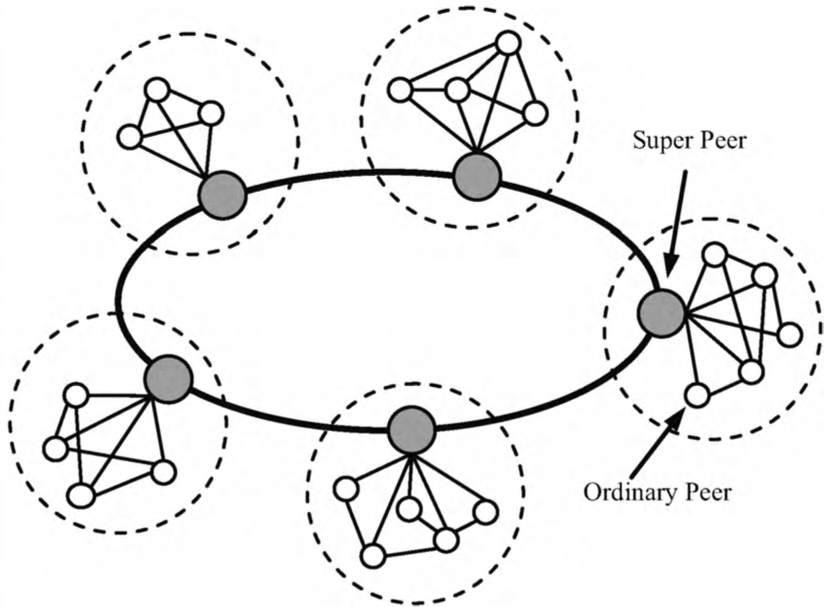
The architecture divides the network into a two-layer structure:
- Lower Layer (Ordinary Peers): Form unstructured communities based on semantic similarity (calculated via Vector Space Model).
- Upper Layer (Super Peers): Sophisticated nodes that form a structured DHT-based network to manage global interactions between different communities.
Intra-Community: The Local Trust
Within a community, reputation () is a weighted blend of Direct Reputation () and Indirect (Recommendation) Reputation (). To combat white-washing, the authors use a dynamic initial reputation formula. If a community is large, a new peer starts with a very low trust value (), forcing it to prove its worth through honest transactions.
Inter-Community: The Global Trust
When a peer needs a resource from a different community, the Super Peers intervene. They calculate the Global Reputation () of the target community. To prevent one community from falsely inflating the reputation of another, a Similarity Metric () is introduced. Communities with historically similar evaluation patterns are given more weight in the recommendation process, effectively neutralizing "collusion groups."
3. Experimental Validation
The authors compared their model against the benchmark EigenTrust algorithm under two primary attack vectors:
Single Malicious Behavior
Individual malicious nodes provide fake services and slander honest peers. As seen in the performance curves below, the community-based approach significantly mitigates the damage. Because the malicious behavior is confined within a semantic community, the local reputation drops rapidly, isolating the node.
Collusion Attack
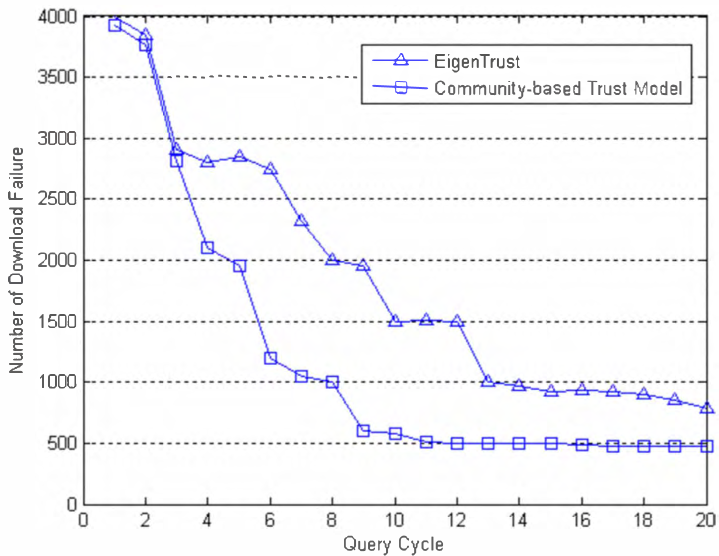
In a collusion attack, groups of malicious nodes give each other high ratings to deceive the system. While EigenTrust struggles to identify these "mutual admiration societies," the Super Peer layer in this model detects the lack of similarity between global reputation and local claims, dropping the failure rate to near-zero within 10 cycles.
4. Critical Perspective & Conclusion
The core value of this work lies in its hierarchical efficiency. By recognizing that "Global Trust" is an aggregation of "Neighborly Trust," the authors reduce the computational burden on ordinary nodes while maintaining a high-authority backbone via Super Peers.
Limitations: The paper assumes Super Peers are inherently more stable and honest. However, if a Super Peer is compromised, the entire inter-community trust for that cluster collapses. Future research could benefit from integrating Zero-Knowledge Proofs (ZKPs) to verify Super Peer evaluations without exposing sensitive transaction data.
In summary, by grounding P2P trust in semantic reality, this mechanism provides a robust blueprint for secure, decentralized social interaction.