
CBBPM: Boosting Link Prediction via Community Bridge Dynamics
A Community Bridge Boosting Social Network Link Prediction Model
2017-07-31
Summary
Problem
Method
Results
Takeaways
Abstract
The paper introduces the Community Bridge Boosting Prediction Model (CBBPM), a meta-framework designed to enhance traditional social network link prediction algorithms. By identifying and selectively boosting the similarity scores of "bridge nodes" that connect different communities, the method achieves superior prediction precision across diverse social datasets.
## TL;DR
CBBPM (Community Bridge Boosting Prediction Model) is a structural enhancement framework that proves not all nodes are created equal in social network evolution. By identifying and "boosting" the importance of bridge nodes—those connecting disparate communities—CBBPM improves the precision of classical link prediction methods (like Common Neighbors and Katz) by up to 16% in communication-based networks.
## Background: The Heterogeneity of Network Evolution
Most link prediction research operates under a localized assumption: "The friend of my friend is my friend." While this holds true for clusters, it fails to capture the dynamic growth at the fringes of communities. The authors of this paper argue that networks do not evolve via a single phenomenon. Instead, different parts of the network evolve differently. Specifically, nodes that act as "bridges" between communities are statistically more likely to facilitate new, diverse relationships.
## Motivation: Why Bridge Nodes Matter
Prior work often treats all nodes identically or focuses only on strengthening connections *within* a community. The authors identify a missed opportunity: bridge nodes. These are the "Type Two" nodes—cross-community actors. However, not all bridge nodes are equal. The paper filters out:
1. **Low-degree bridges**: Nodes with too few connections to influence new link formation.
2. **Dominant-community bridges**: Nodes that have one "token" connection to another group but remain 90% nested in their home community.
## Methodology: The CBBPM Framework
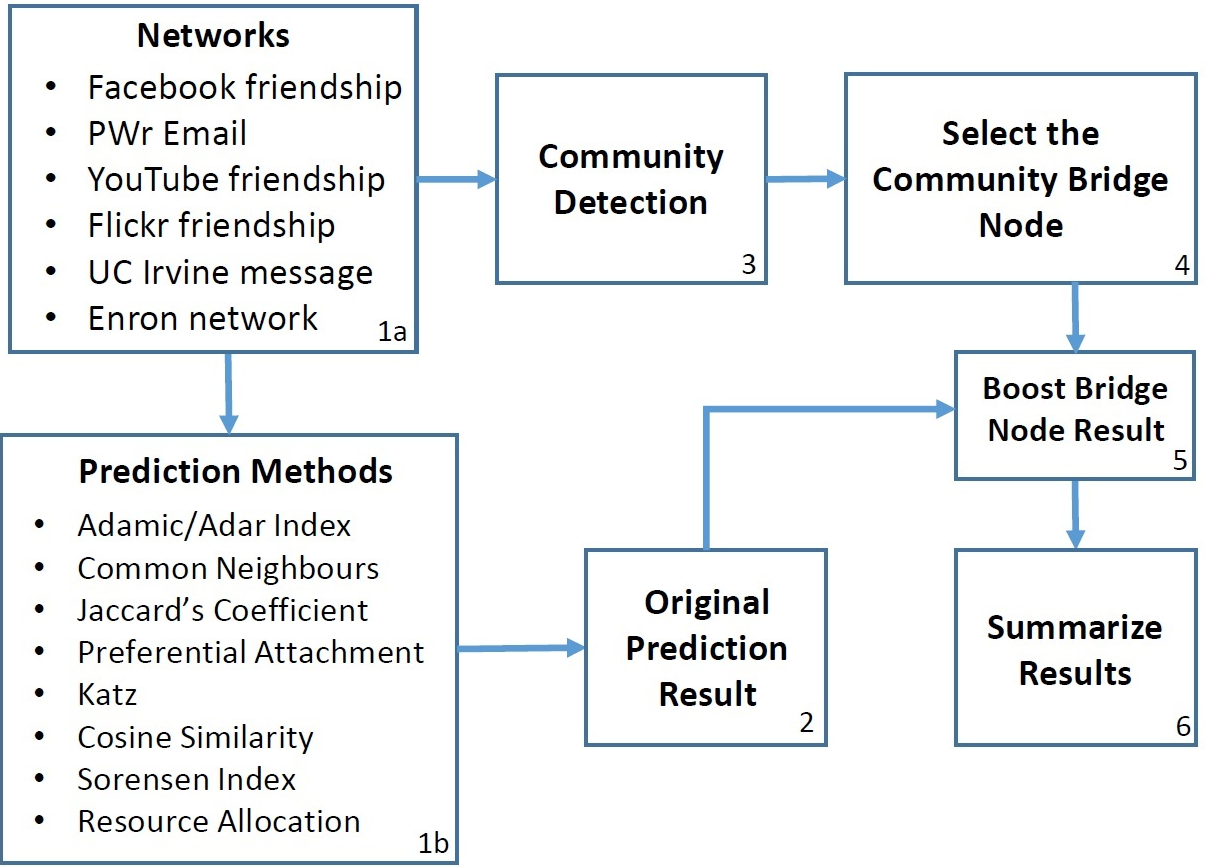
The CBBPM workflow is a surgical modification of the standard link prediction pipeline:
### 1. Community Detection & Bridge Identification
Using the Louvain method for modularity optimization, the network is partitioned. Nodes are then flagged as bridges if they possess links to more than one community.
### 2. Filtering via MCDR
To find truly influential bridges, the authors introduce **Max Community Dominant Rate (MCDR)**:
$$MCDR(x) = \frac{MAX(LinkNum(x)_{Com1}, \dots, LinkNum(x)_{ComM})}{LinkNum(x)_{All\_Com}}$$
A low MCDR suggests a node is balanced between multiple communities, making it a "powerful" bridge.
### 3. Score Boosting
The bridge node similarity score is doubled. This acts as an inductive bias, telling the model: "Predict links for these nodes more aggressively because their structural position promotes growth."
## Experiments: Where Boosting Works (and Where It Doesn't)
The authors tested CBBPM against 8 baseline metrics (Common Neighbors, Katz, Jaccard, etc.) across 6 datasets.
### Key Successes
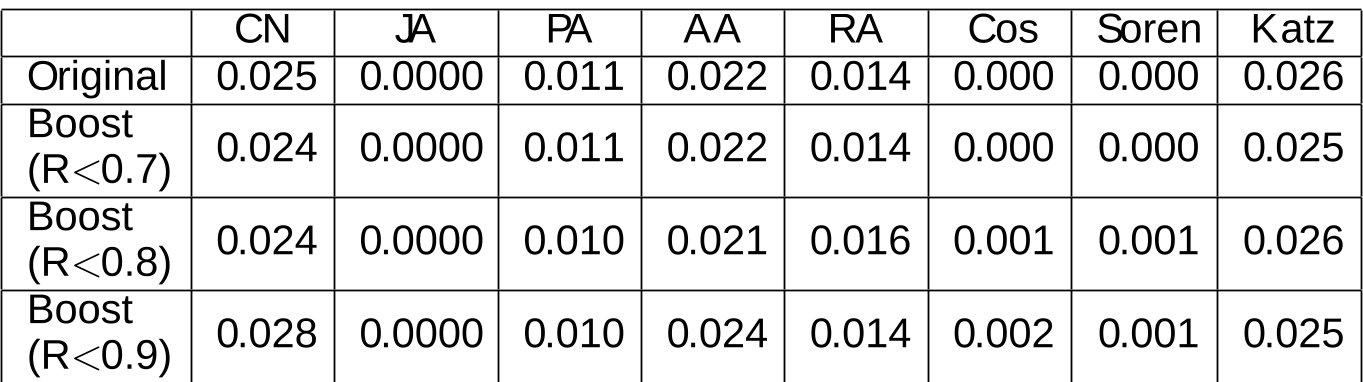
* **Enron & PWr Email**: Communication networks saw significant boosts. In Enron, Common Neighbors precision jumped from 0.025 to 0.028 (an 11% relative increase).
* **Facebook Wall Posts**: Adamic/Adar Index improved by 5% when using an MCDR threshold ($R < 0.9$).
### The Failure Modes
In **Flickr** and **YouTube**, the model failed to provide any boost. The authors provide a sharp insight here: these are *interest-driven* subscription networks. In these environments, user preferences are stagnant. A bridge node in a "Photography" community connecting to a "Cooking" community doesn't necessarily trigger a wave of new connections because interests don't pivot as rapidly as social interactions do.
## Critical Insights & Conclusion
CBBPM’s value lies in its **model-agnostic nature**. It can be "layered" on top of any existing similarity metric.
**Takeaways for Practitioners:**
* **Context is King**: Structural boosting is highly effective for communication networks (Email/Messages) but less effective for interest-based social media (YouTube).
* **The R-Value Variable**: There is no "universal" R-threshold. The optimal sensitivity to community dominance varies by network density and type.
**Limitations**: The study relies on a fixed 100% boost (doubling) and a manual threshold for $R$. Future research could benefit from learning these parameters dynamically using a supervised approach.
In conclusion, Gao et al. successfully demonstrate that by respecting the community-bridge architecture of a social graph, we can significantly push the boundaries of traditional link prediction.