
From Individuals to Communities: Reimagining User Engagement at Skype Scale
Community-centric analysis of user engagement in Skype social network
This paper presents a community-centric approach to predicting user engagement (video and chat activity) within the Skype social network. By moving from individual to group-level analysis and utilizing the HDEMON algorithm for overlapping community detection, the authors achieve superior predictive performance compared to traditional user-centric or modularity-based methods.
TL;DR
Predicting user behavior in a network of hundreds of millions is typically a "needle in a haystack" problem. This research shifts the focus from individual users to social communities. By analyzing Skype's global network, the authors demonstrate that overlapping micro-communities (detected via HDEMON) are far better predictors of engagement than individual profiles or large, modular clusters.
Context: Why "Better Together" Lowers Complexity
In the world of Big Data, focus is often the bottleneck. Traditional predictive analytics treat every user as an independent data point. However, this ignores Homophily—the sociological reality that "birds of a feather flock together." If your social circle starts using video calls daily, you likely will too.
The authors argue that moving from individuals to groups provides three critical advantages:
- Data Compression: Reducing millions of nodes into thousands of communities speeds up processing.
- Context Capture: Communities "compress" homophily into a single object.
- Feature Richness: Groups offer new metrics (diversity, density, expansion speed) that individuals simply don't have.
Methodology: The Search for the "Right" Community
Not all communities are created equal. The researchers compared four distinct philosophies of community detection:
- Louvain (Partitioning): A greedy approach focused on global modularity.
- HDEMON (Overlapping Bottom-Up): Focuses on local ego-networks and allows users to belong to multiple circles.
- Ego-nets: The simplest view—a user and their immediate neighbors.
- BFS: Randomly sampled connected components.
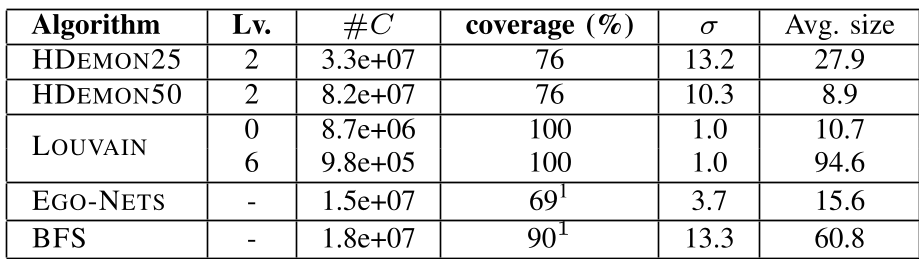
The core insight? Louvain failed. Because it tries to optimize global modularity, it often creates "giant components" that mix distinct social contexts, losing the predictive "signal." HDEMON, by contrast, captured the nuanced "micro-social" structure where actual engagement happens.
The "Why" behind Engagement: Structural and Geographic Insights
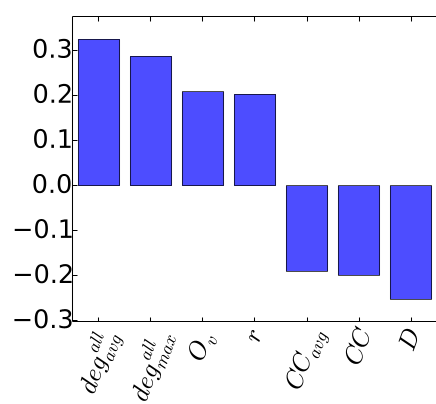
The study extracted 30+ features per community. Interestingly, the factors driving Video usage differed from Chat:
- Video Engagement: Highly correlated with Geographic Distance and Country Entropy. Communities that span different countries and cities are significantly more likely to use video calling—Skype's primary value proposition for connecting far-flung users.
- Chat Engagement: Driven by Structural Persistence. These are often dense, stable triangles where users have arrived over a longer period, suggesting long-term social circles that use IM for daily "social glue."
Performance: Small and Dense Wins
In both balanced and unbalanced scenarios, the "Micro" approach won.
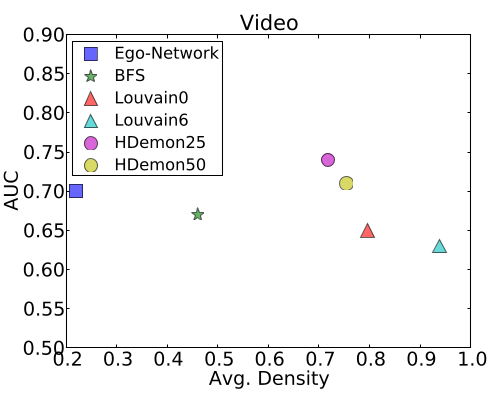
- HDEMON achieved an AUC of 0.84 for Chat and 0.74 for Video.
- The predictive power was highest when communities maintained high density and small-to-medium sizes.
Critical Analysis & Conclusion
The study proves that granularity matters. In social network analysis, "bigger" is not "better." If a community detection algorithm is too aggressive (like Louvain at level 6), the resulting group is too heterogeneous to predict anything accurately.
Limitations: The study is based on 2011 data. In the age of mobile-first social media (TikTok, WhatsApp), the definition of a "community" has shifted from stable contact lists to fleeting algorithmic interests.
Future Work: This framework could be revolutionary for targeted marketing. Instead of spending ad dollars on 1,000 individual users, a company could target one "high-engagement potential community" and let homophily do the rest of the work.