
Unified Weighting: Master the Trade-off Between Social Structure and Node Attributes
Community Detection in Attributed Social Networks: A Unified Weight-Based Model and Its Regimes
This paper proposes a unified weight-based model for community detection in node-attributed social networks, generalising previous hybrid methods through a normalized linear fusion of structural and attribute similarities. By evaluating the model on synthetic and real-world datasets using metrics like Modularity and a new Integrated Attribute Significance Coefficient (), the authors identify distinct operational regimes and a tunable transition zone for balancing link structure and node metadata.
TL;DR
Detecting communities in modern social networks requires a delicate balance between who you know (structure) and who you are (attributes). This paper introduces a unified weighting framework that normalizes these two dimensions into a single weighted graph. By tuning a fusion parameter , the authors reveal how the network's density determines whether you can actually find a meaningful "middle ground" between metadata and topology.
Background: The Limits of Topology
Classic algorithms like Louvain or Infomap are masters of the "link," but they are blind to the "content." In an attributed network, we want communities that are both topologically dense (high Modularity) and topologically homogeneous (similar attributes). Most prior works either ignore one side or fail to normalize the weights, leading to "attribute explosion" where a few common keywords drown out the actual social structure.
Methodology: The Unified Fusion Model
The authors propose a multi-step pipeline: Preprocessing Weighting Clusterisation Evaluation.
1. Attribute Significance Normalization
To prevent "mainstream" attributes (like "Music") from dominating specific ones (like "Quantum Physics"), they introduce a significance weight : This acts as a "de-biasing" mechanism similar to TF-IDF logic in NLP.
2. Linear Weight Fusion
The core of the methodology is the fusion of structural weight and attribute weight :
u)$$ Here, $\alpha$ is the steering wheel. $\alpha=1$ gives you a purely structural result, while $\alpha=0$ relies solely on node similarity. 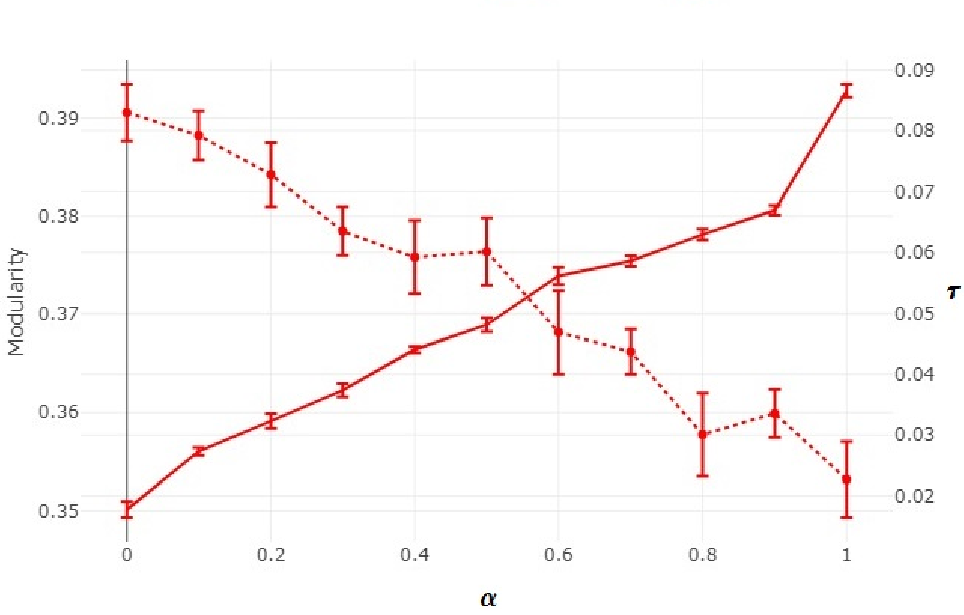 *Fig 1: As $\alpha$ increases, Modularity (structure) rises while $ au$ (attribute expression) falls, illustrating the fundamental trade-off.* ## Understanding the Three Regimes The paper’s most significant contribution is the identification of model **Regimes**: 1. **Attribute Saturation**: For low $\alpha$, attributes dictate the groups. However, if the graph is sparse, this can lead to fragmented clusters. 2. **Structural Saturation**: For high $\alpha$, the Louvain algorithm ignores the attributes, often resulting in communities with high internal disorder (entropy). 3. **The Transition Regime**: This is the "Goldilocks zone" where the model captures a mixture of both worlds. The authors discovered that the **length** of this transition regime depends on the **inter/intra-cluster density ratio**. If your clusters are already very well-separated in the raw graph, the transition is almost instantaneous (steep), leaving very little room for attribute-based tuning. 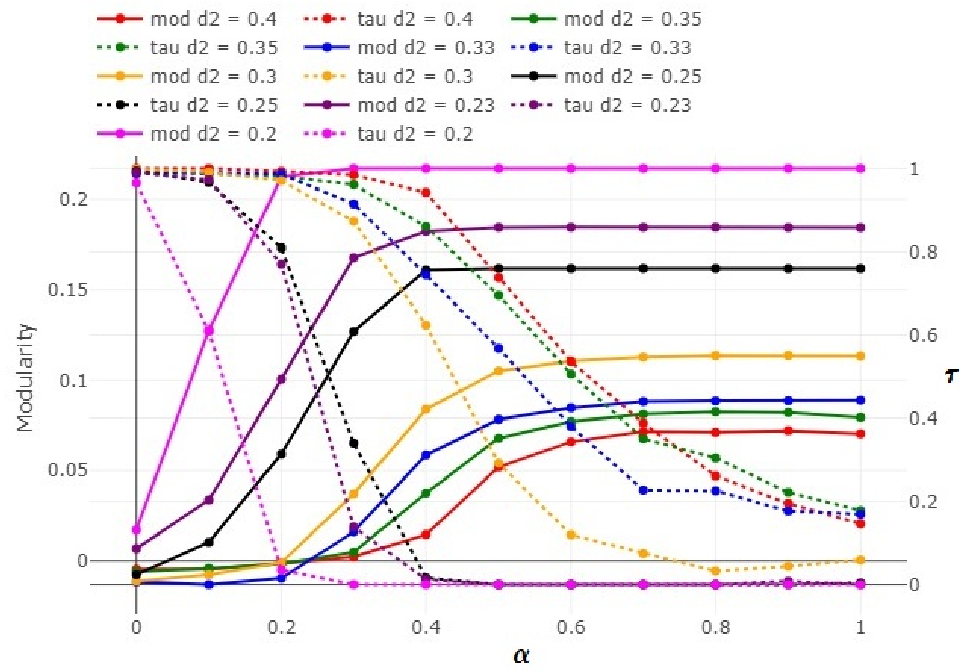 *Fig 2: Comparison of different intra-cluster densities. Notice how the saturation of Modularity happens much faster when the structure is stronger.* ## Real-World Insights The model was tested on datasets including **Bank Customers**, **WebKB**, and **Political Blogs**. * **Bank Customers**: Showed a very short transition. The social ties were so dominant that even a small $\alpha > 0$ caused the structure to override the attributes. * **Political Blogs**: Displayed a more robust transition, where intermediate $\alpha$ values produced clusters that respected both the link structure (who cites whom) and political leaning (liberal vs. conservative). ## Critical Analysis & Conclusion ### Takeaway This work formalizes the "weighting" approach in a way that allows practitioners to objectively measure the trade-off they are making. The introduction of the **Integrated Attribute Significance Coefficient ($ au$)** provides a much clearer signal than traditional Entropy, which often fails in sparse real-world data. ### Limitations * **Binary focus**: While the theory allows for continuous attributes, the experiments are heavily focused on binary metadata. * **Fixed Topology**: The model currently only weights *existing* edges. This means if two nodes are highly similar but not connected, they can never be put in the same community unless the model is extended to "add" edges based on attributes. ### Future Outlook The next step for this lineage of research is **Dynamic Attribute Fusion**, where the $\alpha$ parameter is not a global constant but is learned per-cluster or per-node to reflect local community characteristics.