
Link-Content Model: Bridging the Gap Between Who You Follow and What You Tweet
Community detection in content-sharing social networks
The paper introduces the Link-Content model, a generative probabilistic framework that jointly models user communities and content topics in microblogging platforms like Twitter. By leveraging both the social graph (follower-followee links) and user-generated text, it achieves state-of-the-art performance in community detection and link prediction.
TL;DR
Social networks like Twitter are not just graphs—they are living ecosystems of content. The Link-Content Model is a generative framework that proves we can detect far more accurate communities and predict future friendships better by looking at links and tweets simultaneously. By treating "communities" as the hidden bridge between social structure and topical interests, this work achieves superior scalability and accuracy on massive datasets (up to 27 million tweets).
Problem & Motivation: The Static Audience Paradox
A major limitation in previous academic research (specifically models designed for email networks like Enron) is the assumption that the "recipients" of information change with every message. In Twitter or Facebook, your "recipients" (followers) are largely fixed.
If you try to apply email-centric models to Twitter, you face two issues:
- Computational Bloat: Re-calculating the influence of thousands of followers for every single 140-character tweet is inefficient.
- Structural Bias: Modeling the same audience for every post leads to redundant evidence that confuses traditional topic models.
The authors observed that we don't just follow people randomly; we follow them for their content, and we post content based on the communities we belong to.
Methodology: Communities as First-Class Citizens
The core innovation is the generative process where a Community is the source for both links and topics.
The Generative Logic:
- For Links: A user picks a community from their preference distribution , then picks a friend from that community's user distribution .
- For Content: The same user picks a community , which then dictates a topic from , which finally generates the words in a tweet.
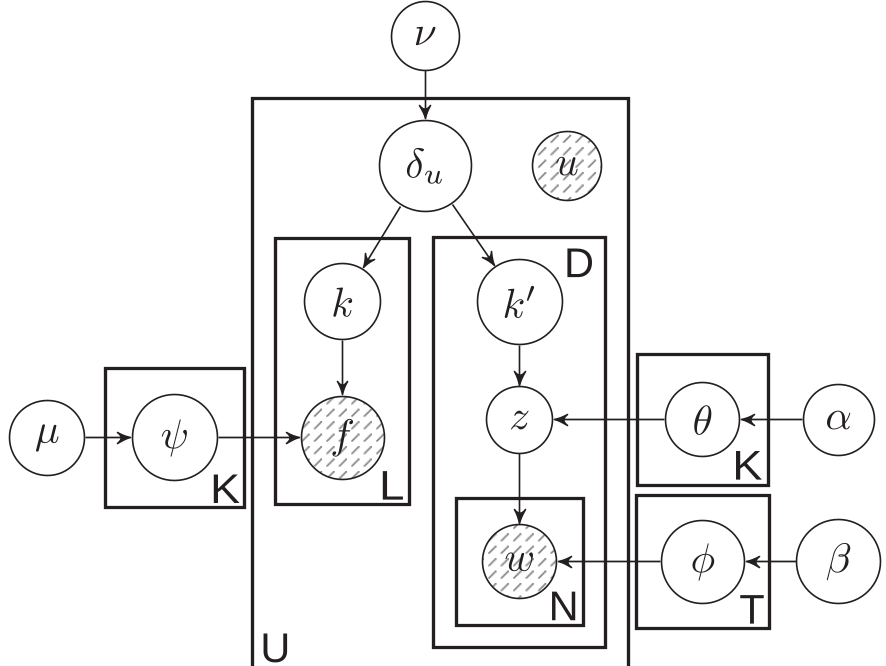 Figure 1: The Plate Notation for the Link-Content Model, showing how communities bridge the gap between links and words .
By using Gibbs Sampling, the model iteratively settles on the most likely community and topic assignments for every user and every word in the network.
Experiments: Beyond the "Blogger" Bias
The qualitative results are striking. Traditional models often suffer from "prolific user bias," where they only find communities of hyper-active bloggers. The Link-Content model, however, successfully isolated niche but coherent groups on Twitter:
- The Twilight Community: Users like Twilight Lexicon discussing actors and movie news.
- Health Professionals: Groups discussing welfare and medical topics.
- The Music Aficionados: Fans and celebrities like Lady Gaga and Katy Perry.
Quantitative Edge: Link Prediction
The true test of the model is its ability to predict hidden links (friendship recommendation).
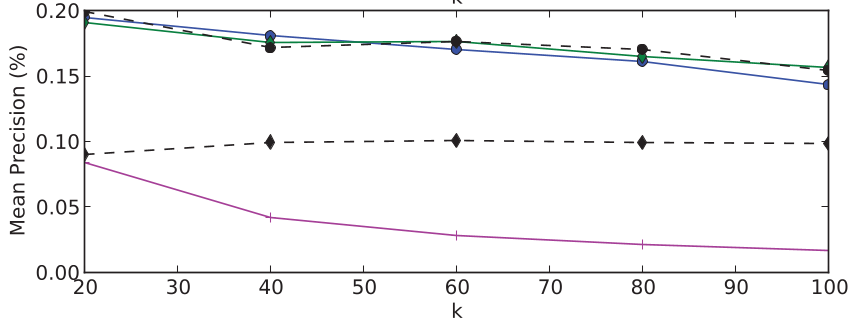 Figure 2: Performance on the LARGE dataset (0.7M users). The Link-Content Hybrid and Community-based methods significantly outperform the Katz baseline in recall.
As shown in the charts, the Community-based scoring method consistently achieves higher recall and precision than structural methods like Katz or content-only models. This is especially true for "sparse" users who have few friends—their content "rescues" the prediction by revealing their underlying interests.
Critical Analysis & Future Outlook
The Link-Content model is a masterpiece of "physical intuition" applied to social data. It recognizes that Homophily (the tendency of individuals to associate with similar others) is the primary driver of social networks.
Takeaway
For developers and researchers building recommendation systems: Don't treat the graph and the text as separate problems. The latent space shared between them (the "Community") is where the most valuable predictive signal resides.
Limitations
While highly effective, the model currently treats each tweet as having a single topic. In the modern era of "long-thread" tweets and complex multimedia posts, expanding this to multi-topic distributions (similar to original LDA) or integrating Graph Neural Networks (GNNs) for deeper structural embeddings could be the next logical step.
Key Achievement: Proving that even in a noisy, content-heavy network like Twitter, tightly knit communities exist—you just need the right lens to see them.