
D-GT: Modeling Community Evolution through the Lens of Strategic Games
Community Detection in Dynamic Social Networks: A Game-Theoretic Approach
This paper introduces D-GT (Dynamic Game Theory), a decentralized community detection framework for evolving social networks. It models individual nodes as rational agents that optimize their own utility functions to reach a Nash equilibrium, effectively identifying community structures across time-varying network snapshots.
TL;DR
Detecting communities in dynamic networks is often a trade-off between accuracy and temporal stability. D-GT (Dynamic Game Theory) reframes this as a multi-agent coordination game. By allowing each node to act as a "selfish agent" seeking to maximize its social utility, the network naturally organizes into robust communities. Compared to label propagation and merging heuristics, D-GT offers superior stability and higher modularity across thousands of network snapshots.
Problem & Motivation: The Stability Gap
Social networks are never static; they are "living" entities where edges dissolve and nodes migrate. Prior works typically fall into two traps:
- Static Re-computation: Running a static algorithm on each snapshot, which ignores historical context and leads to "community flickering."
- Rigid Heuristics: Methods like iLCD add and merge edges but often struggle when nodes are removed or when the network becomes sparse.
The authors' insight is grounded in Game Theory: communities aren't just statistical clusters; they are the result of individuals making strategic choices to associate with similar others while minimizing the "cost" of membership.
Methodology: The Nash Equilibrium of Friendship
D-GT converts the community detection task into an iterative game. Each node is an agent with a strategy (its community labels).
1. The Utility Function
The agent seeks to maximize :
- Gain (): Calculated using Neighborhood Similarity. It measures how much structural overlap the node has with its community members.
- Loss (): A linear penalty based on the number of communities a node belongs to, representing the "overhead" of maintaining social ties.
2. Strategic Actions
Agents can take four specific actions in each round:
- Join: Enter a new community.
- Leave: Exit a current community.
- Switch: Change from one community to another.
- No Operation: Stay put if utility is already maximized.
3. Temporal Propagation
Unlike static game-theoretic models, D-GT "warm-starts" each new snapshot with the Nash equilibrium results from . This propagation ensures that the community labels have "memory," leading to much more stable transitions as the graph evolves.
 Table 1: Definition of symbols and strategy profiles used in the D-GT framework.
Experiments & Results
The authors tested D-GT on two major datasets: AS-Internet Routers (733 snapshots) and AS-Oregon (9 snapshots).
Performance Gains
- Higher Modularity: In nearly every snapshot, D-GT outperformed LabelRankT and iLCD. Modularity in D-GT tends to increase or stabilize over time, whereas competitors show erratic performance.
- Fine-grained Communities: D-GT identified a more consistent number of communities. While iLCD sometimes found more clusters, they were often highly fragmented and disconnected (low modularity).
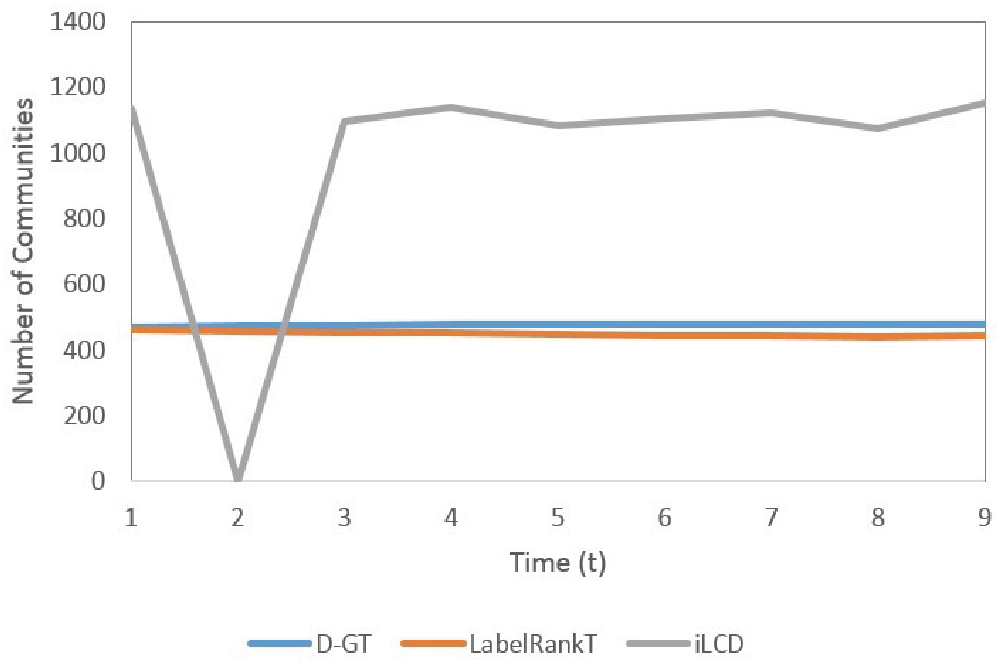 Figure 3: Modularity and community count comparison on the AS-Internet dataset. D-GT (blue) shows a clear advantage in stability and quality.
Critical Analysis & Conclusion
Takeaway
D-GT proves that local optimization by selfish agents can lead to a global optimum that is more resilient to network noise than global partitioning algorithms. The use of "label propagation" between snapshots is the secret sauce that prevents the algorithm from re-inventing the wheel every time a single edge changes.
Limitations & Future Work
The current model relies heavily on structural similarity (shared neighbors). However, in many modern social networks (like MMORPGs mentioned by the authors), nodes might be socially connected without sharing immediate neighbors. The authors suggest that moving toward Feature-based Similarity (using node attributes) and exploring Q-Learning for agent updates could further enhance the model's predictive power in sparse environments.
D-GT represents a significant step toward making community detection as dynamic and adaptive as the social networks it seeks to describe.