
Exploiting Community Detection: A Smarter Way to Handle Privacy in Decentralized Social Networks
Exploiting Community Detection to Recommend Privacy Policies in Decentralized Online Social Networks
This paper introduces a Privacy Policy Recommendation System (PPRS) designed for Decentralized Online Social Networks (DOSNs). It leverages the DEMON community detection algorithm and C4.5 decision trees to automatically suggest privacy policies based on users' social attributes and community structures, achieving high classification accuracy on real-world datasets.
TL;DR
Managing who sees your posts in a decentralized social network (DOSN) is notoriously difficult. This paper proposes a Privacy Policy Recommendation System (PPRS) that uses community detection and decision trees to automatically group your friends and recommend the best privacy settings. By analyzing attributes like age, location, and relationship strength, the system achieves an impressive 85.6% accuracy in identifying the right social circles for privacy enforcement.
The Privacy Paradox in Decentralized Networks
We’ve all seen the headlines about centralized giants like Facebook mishandling data. Decentralized Online Social Networks (DOSNs) promise a solution by letting users own their data. However, DOSNs introduce a "usability tax": without a central authority to manage settings, the user must manually define who sees what.
If you have 500 friends, you won't manually create 500 rules. Most users end up with "all or nothing" settings, which defeats the purpose of granular privacy. The authors identify that users naturally form communities based on homophily (the tendency to associate with similar others), and this is the key to automating privacy.
Methodology: From Graph Theory to Decision Trees
The authors propose a two-stage pipeline to turn a messy social graph into clean privacy policies.
1. Community Discovery
Instead of looking at the whole network, the system focuses on the Ego Network (you and your direct friends). Using the DEMON algorithm, it identifies dense clusters of friends—like your high school buddies, coworkers, or family—within your "ego-minus-ego" graph.
2. Decision Tree Learning
Once clusters are identified, the system treats each cluster as a "target label." It uses a C4.5 Decision Tree Learner to find which attributes (e.g., "Lives in Rome" + "Age > 25") best describe that community.
 Figure 1: Conceptual view of how social attributes are mapped via decision trees to specific communities.
The model considers several features:
- Demographics: Age and Gender.
- Proximity: Distance from Hometown and Current Location.
- Social Capital: Number of common friends.
- Relationship Depth: Dunbar’s Circles (categorizing friends by contact frequency, from "support clique" to "acquaintances").
Experimental Results
The researchers tested their approach on a massive dataset of 95,716 users across 205 ego networks.
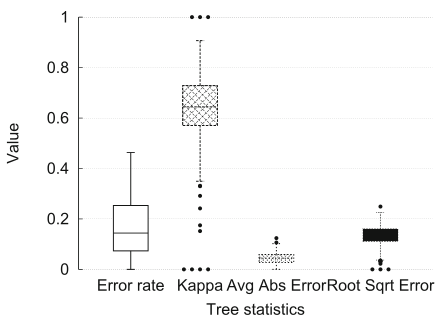 Figure 2: Performance metrics including Correct/Incorrect classification counts and tree size distributions.
Key Findings:
- High Precision: The system correctly classified over 85% of friends into their rightful social communities.
- Significant Agreement: A Kappa index of 0.64 confirms that the system isn't just "guessing"—it’s finding meaningful patterns in user attributes.
- Feature Importance: Interestingly, Current Location and Age were the most influential predictors, while the Dunbar Circle (frequency of contact) was less predictive for community membership than expected.
| Attribute | Importance (Rank) |
|---|---|
| Distance (Current) | 0.205 |
| Age | 0.200 |
| Sex | 0.191 |
| Common Friends | 0.165 |
Critical Insight: Why This Matters
The genius of this approach lies in its explainability. Because the system uses Decision Trees, the recommended privacy policy can be translated into a human-readable rule: "Only show this to friends who went to University of Pisa and live in Florence."
In many AI-driven systems, the "Black Box" nature makes users distrust automated privacy settings. By using attribute-based logic, this PPRS offers a path toward transparent automation, where the user remains the ultimate gatekeeper of their data without doing all the manual labor.
Conclusion & Future Work
The paper successfully demonstrates that privacy isn't just a technical problem; it’s a social one. By bridging community detection with machine learning, the authors provide a viable blueprint for more user-friendly decentralized platforms.
The next frontier? Overlapping communities. In real life, your "Work Friend" might also be your "Gym Buddy." Handling these overlaps effectively will be crucial for the next generation of privacy-preserving social media.