
ACDC: Bridging the Gap Between Graph Structure and Node Semantics via Formal Concept Analysis
Community Detection in Social Network with Node Attributes Based on Formal Concept Analysis
The paper introduces ACDC (Attributed Community Detection based on Concepts), a hybrid approach for community detection in social networks that integrates both network topology and node attributes. By combining Formal Concept Analysis (FCA) with maximal clique theory, ACDC identifies overlapping, semantically rich communities that achieve SOTA performance in clustering density and F-measure across real-world datasets like Political Blogs and Zachary's Karate Club.
TL;DR
Community detection usually chooses between "who knows whom" (topology) and "who is like whom" (attributes). ACDC (Attributed Community Detection based on Concepts) unifies these two perspectives. By leveraging Formal Concept Analysis (FCA) and Maximal Cliques, ACDC identifies overlapping communities that are both densely connected and semantically homogeneous, outperforming traditional structural methods in quality and interpretation.
Problem & Motivation: The Homophily Blind Spot
In the real world, communities are driven by homophily—the principle that "birds of a feather flock together." However, most classic algorithms (like GN or CPM) focus strictly on the "edges" of the graph. This creates two problems:
- Lack of Meaning: We might find a cluster of nodes, but we don't know why they are a group.
- Weak Robustness: Structural noise (random connections) can easily mislead algorithms that ignore the attributes (job, age, interests) of the individuals involved.
The authors recognize that a true community should be a Maximal Clique (where everyone knows everyone) that also shares a Common Intent (at least one shared attribute value).
Methodology: The ACDC Framework
The ACDC method follows a rigorous three-stage pipeline to merge graph theory with formal logic.
1. Homophilic Formal Concept Analysis
To handle real-world data, the authors use Conceptual Scaling. This transforms multi-valued attributes (e.g., Job: {Teacher, Student}) into binary "modalities." This allows the creation of a Galois Lattice, where every "concept" consists of an Extent (the set of people) and an Intent (the properties they share).
2. Structural Grounding via Maximal Cliques
To ensure the communities are structurally sound, the algorithm utilizes the Bron-Kerbosch algorithm to find maximal cliques. A maximal clique is a group where expansion is impossible without losing the "everyone-knows-everyone" property.
3. Filtering for Relevant Concepts
The core innovation lies in the "Relevant Concept" definition. ACDC filters the massive lattice of potential attribute-based groups to find only those that align with the maximal cliques in the physical network.
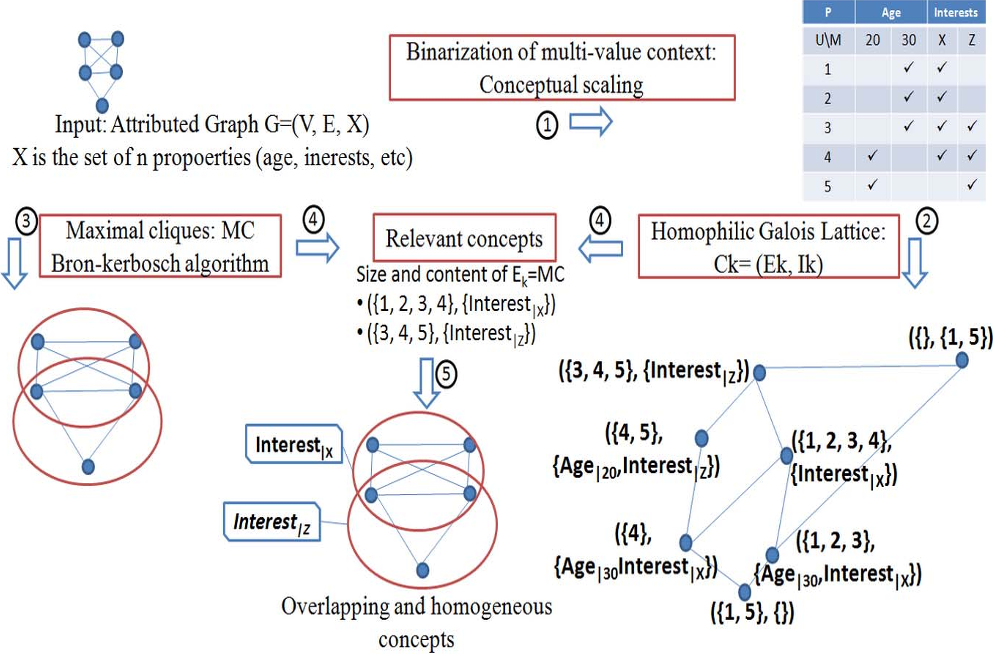 Figure 1: The ACDC workflow: from attributed graph to overlapping, homogeneous communities.
Experiments: Performance and Efficiency
The authors validated ACDC across several benchmark networks, including Zachary’s Karate Club and the Political Blogs dataset.
- Accuracy (F-Measure): ACDC consistently achieves higher F-measure scores compared to the FCA-based k-clique detection, proving that its communities more accurately reflect the underlying "ground truth" of social groupings.
- Density: With a density of 0.85 on the Political Blogs dataset, ACDC proves it can find communities that are nearly as dense as pure structural clusters while adding a layer of semantic meaning.
- Speed: Despite the complexity of lattice construction, the "Relevant Concept" filtering actually reduces execution time compared to previous FCA iterations.
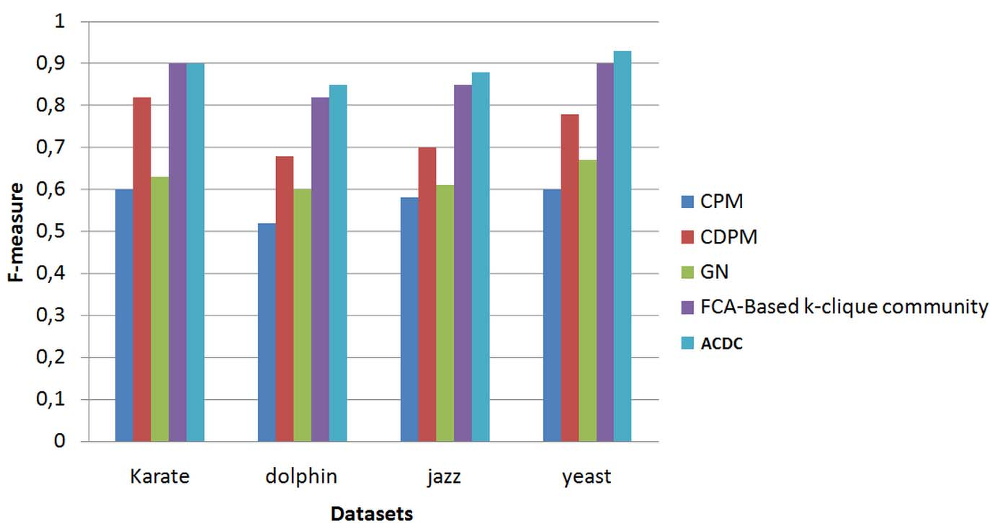 Figure 2: F-measure comparison showing ACDC's superior accuracy in identifying clique community structures.
Critical Insight: Why FCA Matters
The power of FCA in this context is its ability to handle overlapping communities naturally. In a lattice, a node (object) can belong to multiple concepts. This perfectly mirrors social reality—where a person is simultaneously a member of a "Teacher" community, a "Computing Interest" group, and a "Local City" circle.
By using Maximal Cliques as the anchor, ACDC avoids the "conceptual explosion" problem of FCA, where a simple dataset produces thousands of useless concepts. It only keeps the concepts that have a physical foot-print in the social graph.
Conclusion & Future Outlook
ACDC successfully demonstrates that combining the "Intent" of attributes with the "Structure" of cliques leads to more meaningful community detection.
Limitations: The algorithm's reliance on maximal cliques may be too restrictive for very sparse networks where "almost-cliques" are more common than perfect ones. Next Steps: Moving forward, the authors aim to apply this to massive oriented networks like Twitter and use the detected communities as the foundation for Recommendation Systems, where users are suggested items based on the shared "Intent" of their specific social community.