
Probabilistic Insight into Social Structures: Community Detection via Bayesian Networks and EM
Community detection in social networks by using Bayesian network and Expectation Maximization technique
This paper introduces a probabilistic framework for community detection in complex social networks using a Bayesian Network model and the Expectation-Maximization (EM) algorithm. The method treats nodes as random variables and community memberships as latent variables, achieving state-of-the-art results on several benchmark datasets including Zachary's Karate Club.
TL;DR
This research re-imagines community detection not as a graph partitioning problem, but as an inference problem. By modeling edge formation through a Bayesian Network and solving for latent variables via the Expectation-Maximization (EM) algorithm, the authors provide a robust framework that handles directed and weighted graphs with near-linear complexity.
Problem & Motivation: Beyond Edge Cutting
In the realm of complex network analysis, communities are defined as clusters where internal connections are significantly denser than external ones. Classic algorithms, such as Girvan-Newman, rely on "edge betweenness" to dismantle the network into components. However, these "physics-inspired" approaches often struggle with "soft" memberships—where a person belongs to multiple social circles—and frequently fail to account for edge weights or directions efficiently.
The authors' intuition is rooted in statistical inference: if we assume a network is a realization of a hidden statistical process, we can work backward from the observed edges to uncover the hidden "communities" that generated them.
Methodology: The Generative Logic
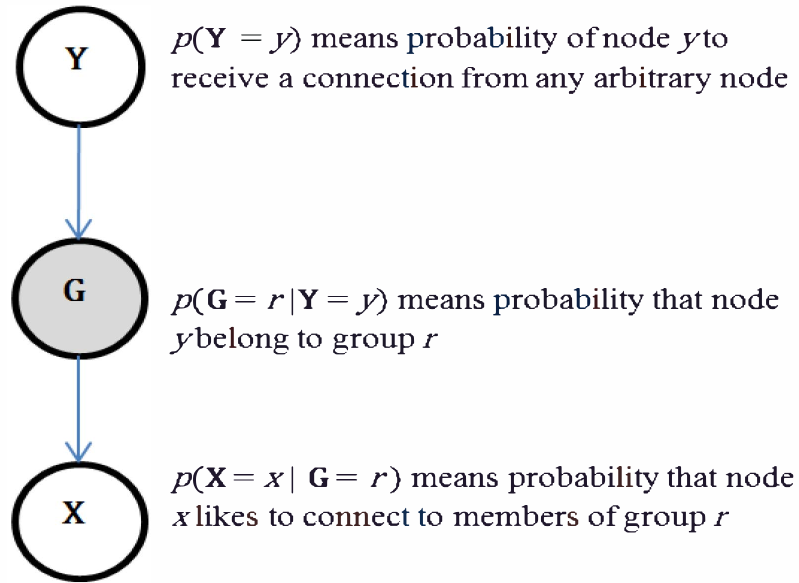
The core of the paper is a Bayesian Network that models how a directed edge (initiator receiver ) is formed.
1. The Generative Process
The model assumes a three-variable dependency:
- (Receiver): The target actor.
- (Group): The latent community belongs to.
- (Initiator): The actor who initiates the link based on their interest in group .
2. Parameter Estimation via EM
The parameters (probability node belongs to group ) and (probability node initiates to group ) are unknown. Since is a hidden variable, the authors employ the EM Algorithm:
- E-Step: Calculate the expectation of the hidden community assignments based on current parameters.
- M-Step: Update the parameters to maximize the likelihood of the observed edge list.
This iterative process continues until convergence, allowing for soft assignments where represents the degree of membership.
Experimental Validation
The authors tested the algorithm across diverse environments, from synthetic benchmarks to real-world datasets like the Zachary’s Karate Club and American College Football.
1. Synthetic Performance (GN Benchmark)
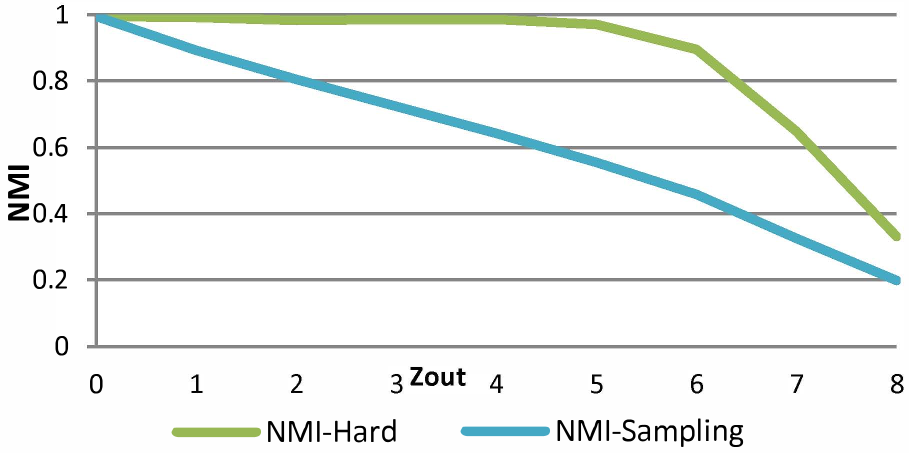
Using the Girvan-Newman benchmark, the algorithm maintained high Normalized Mutual Information (NMI) even as the "mixing parameter" () increased, showing resilience against noise and inter-community edges.
2. Real-World Robustness
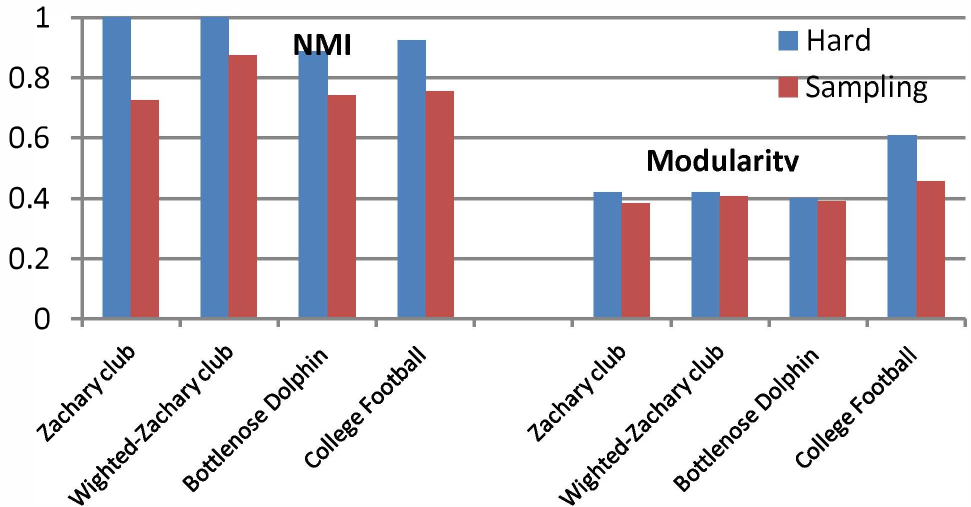
On the Karate Club network, the algorithm achieved a perfect NMI of 1.0. Interestingly, in the weighted version, the "certainty" of the model (measured by sampling NMI) increased, proving that the algorithm effectively utilizes edge weights to clarify community boundaries.
Case Study: Facebook Ego Networks
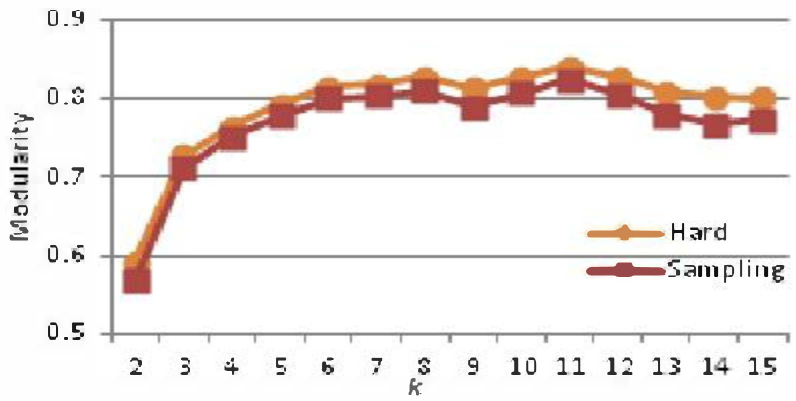
In a large-scale test on Facebook data (3,959 nodes), the authors used Modularity to determine the optimal group count. They found that even when (the number of groups) was set to 11, the network naturally coalesced into approximately 5 large "super-communities" and many smaller niches.
Critical Insight & Conclusion
Strengths
- Versatility: Unlike many modularity-maximization tools, this handles directed and weighted edges as first-class citizens.
- Complexity: is highly efficient for sparse real-world graphs.
Limitations
- Prior Knowledge: The algorithm requires a pre-defined (number of communities), which is rarely known in practice.
- Local Optima: Like all EM instances, it is sensitive to initialization and can get trapped in local maxima, necessitating multiple runs.
Final Takeaway: This work demonstrates that transitioning from "hard" graph cuts to "soft" probabilistic assignments provides a more nuanced and mathematically flexible view of social structures.