
GID: Reimagining Community Detection through Information Diffusion and Game Theory
Community Detection in Social Networks Using Information Diffusion
The paper introduces GID, a community detection framework that fuses Game Theory with a novel Information Diffusion Model (EGADM). By modeling nodes as selfish agents seeking to maximize information utility, the method identifies community structures as results of a local Nash Equilibrium.
TL;DR
The GID (Game-theory Information Diffusion) framework shifts the perspective of community detection from static graph partitioning to a dynamic behavioral game. By treating nodes as selfish agents who join groups to maximize their "information utility," GID identifies communities that represent local Nash Equilibria. It outperforms traditional structural methods across both synthetic and real-world benchmarks without requiring manual parameter tuning.
The Motivation: Why Do We Form Communities?
Most community detection algorithms (like Modularity maximization or Label Propagation) treat the problem as a mathematical optimization of graph topology. However, the authors argue that in real social networks, communities form because of human motivation.
The core insight is that individuals are "socially selfish"—they form connections and join groups because they seek valuable information. Current methods often ignore this "Information Diffusion" aspect, leading to partitions that might be structurally sound but sociologically meaningless.
Methodology: The Strategic Information Game
The GID framework operates through three main phases:
1. The Extended Information Diffusion Model (EGADM)
The authors build upon the Genetic Algorithm Diffusion Model (GADM) but introduce a mutation operator to better simulate the unpredictability of information spread. This results in an Information Matrix () that quantifies the potential utility shared between any two nodes.
2. Multi-Agent Game Formulation
Each node in the network is assigned as an "Agent." The "play" follows these rules:
- Utility Function: An agent's utility is the total information it receives from its community members.
- Operations: In each turn, a randomly selected agent can choose to Join a new community, Leave its current one, or Switch between groups.
- Selfish Maximization: The agent only moves if the operation increases its total utility.
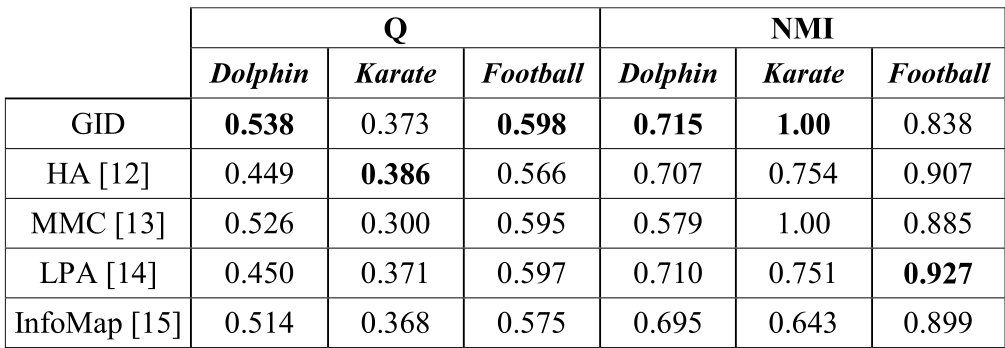 Table 1: Performance comparison showcasing GID's superior Modularity and NMI scores.
3. Reaching Nash Equilibrium
The algorithm iterates until no agent can further increase its utility by changing communities. This state is a local Nash Equilibrium, and the resulting clusters are the final detected communities.
Experimental Results: Robustness and Accuracy
The authors tested GID against four major baselines: HA (Hierarchical Algorithm), MMC (Markov Modularity), LPA (Label Propagation), and InfoMap.
Benchmarking with LFR Networks
In synthetic LFR networks (which simulate realistic social structures), GID demonstrated impressive resilience. As the mixing parameter increases (meaning communities become harder to distinguish), most algorithms fail rapidly. However, GID remained stable and accurate up to .
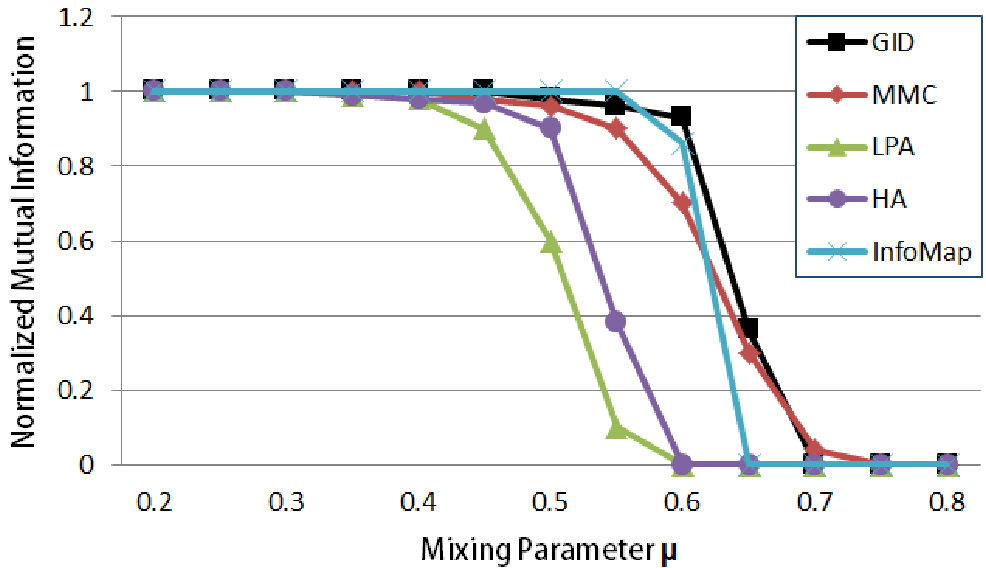 Fig 1: GID maintains higher NMI compared to LPA and HA as network noise increases.
Real-World Application
On datasets like the Zachary Karate Club and Flickr, GID successfully identified ground-truth communities with high NMI (Normalized Mutual Information). It achieved a perfect NMI of 1.00 on the Karate dataset, outperforming the structural-heavy HA and InfoMap approaches.
Critical Analysis & Conclusion
The GID framework is a significant step forward because it:
- Eliminates Parameter Tuning: It doesn't require the user to specify the number of communities or threshold values.
- Focuses on Utility: It captures the functional purpose of social groups (information sharing) rather than just the number of edges.
Limitations: While the approach is robust, reaching a Nash Equilibrium in extremely massive graphs (e.g., billions of nodes) may pose computational challenges. Future work could focus on accelerating the "Best Operation" selection through heuristic pruning.
Takeaway: If you want to understand why communities form, look at the value flowing between the nodes, not just the lines connecting them. GID proves that game theory provides a powerful lens for this discovery.