
Deep Topic Modeling: A New Frontier for Community Detection in Social Networks
Community Detection Through Topic Modeling in Social Networks
2017-01-01
Summary
Problem
Method
Results
Takeaways
Abstract
This paper proposes a multi-layer deep learning approach for community detection in social networks by leveraging shared content rather than just network topology. Utilizing Word2Vec for semantic representation and Deep Belief Networks (DBN) for unsupervised topic modeling, the method facilitates the discovery of overlapping communities based on users' shared interests.
## Executive Summary
**TL;DR**: This paper introduces a sophisticated multi-layer model designed to identify social communities not by who people know, but by what they talk about. By combining **Word2Vec** embeddings with **Deep Belief Networks (DBN)**, the authors move beyond simple graph links to capture the semantic essence of user interactions, effectively allowing for the detection of overlapping communities.
**Background**: Traditionally, community detection was a task for graph theorists focusing on "topology." This work positions itself as a bridge between **Natural Language Processing (NLP)** and **Social Network Analysis (SNA)**, asserting that content is the true driver of community formation in the modern digital age.
## The Motivation: Why Topology Isn't Enough
Most legacy algorithms treat social networks as cold graphs of nodes and edges. However, human communities are dynamic and rooted in shared interests. The authors argue that:
- Network topology alone misses the "why" behind a connection.
- Users often belong to multiple circles (Overlapping Communities), which rigid partitioning algorithms fail to catch.
- The sheer volume of unstructured data (images, text, videos) requires a deep learning approach to extract meaningful features.
## Methodology: From Raw Text to Latent Communities
The proposed pipeline is a rigorous three-stage process:
### 1. Data Preparation and "Textualization"
The model processes all shared content (likes, shares, images) into a unified textual format. It employs **Lemmatization** to ensure semantic consistency—transforming various word forms into their canonical lemma to avoid distorting the topic analysis.
### 2. Semantic Representation with Word2Vec
Rather than using simple word counts, the model utilizes **Word2Vec** (specifically trained on the 1-billion-word benchmark). This transforms user profiles into 300-dimensional vectors, ensuring that words with similar contexts are positioned closely in the vector space.
### 3. The Deep Belief Network (DBN) Engine
The core of the methodology is a DBN—a stack of **Restricted Boltzmann Machines (RBMs)**.
- **Visible Layer**: Takes the Word2Vec embeddings.
- **Hidden Layers**: These layers use the **Contrastive Divergence (CD)** algorithm to perform non-linear dimensionality reduction, capturing high-level correlations that represent "Topics."
- **Output**: The top layer groups these topics into semantic classes using cosine distance.
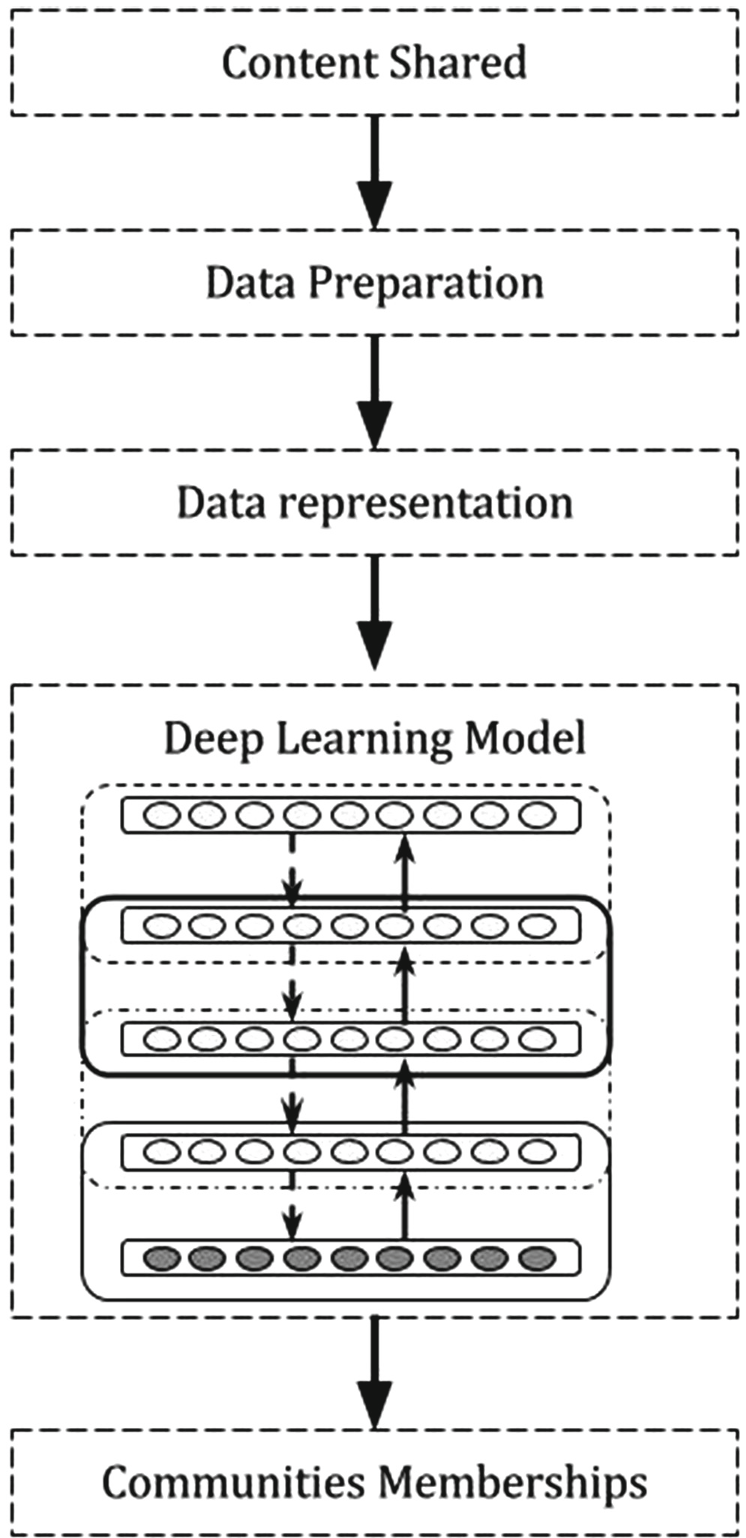
*Figure 1: The overarching approach from non-textual data transformation to community formation.*
## Physics of the Architecture: The Energy Function
The RBM layers work by minimizing an "Energy Function" $E(v, h)$, which measures the compatibility between the visible nodes (data) and hidden nodes (features).
$$E(v, h) = - \sum a_i v_i - \sum b_j h_j - \sum v_i h_j w_{ij}$$
By lowering this energy, the model learns the "weights" that best represent the latent topics of the social network.

*Figure 2: The structure of a Deep Belief Network consisting of stacked RBMs used for topic discovery.*
## Critical Analysis & Future Outlook
While this paper provides a robust theoretical framework for **content-centric community detection**, it serves as a "work in progress."
**Strengths**:
- **Semantic Depth**: By using DBNs instead of standard LDA (Latent Dirichlet Allocation), the model handles non-linear relationships much better.
- **Flexibility**: The inclusion of Word2Vec makes the model context-aware.
**Limitations**:
- **Computational Cost**: Training DBNs on massive social graphs (millions of nodes) can be resource-intensive.
- **Validation**: Quantitative results against standard SOTA datasets (like LFR benchmarks) are expected in the next phase of the research.
**Conclusion**: This work signals a shift toward "Intellectual Communities," where the similarity of ideas is considered just as important as the physical links between users. It paves the way for more intelligent recommendation engines and a deeper understanding of information diffusion.