
Beyond the Workshop: Building a Storytelling Cycle of Trust for Collective Intelligence
Community Digital Storytelling for Collective Intelligence: towards a Storytelling Cycle of Trust
This paper introduces the Community Digital Storytelling (CDST) method and the "Storytelling Cycle of Trust" framework, aiming to leverage individual lived experiences for collective intelligence. It bridges the gap between personal narrative production and large-scale social innovation by systemic integration of trust dimensions.
TL;DR
Digital storytelling has long been used for personal empowerment, but its impact often stops at the workshop door. This paper by Sarah Copeland and Aldo de Moor introduces Community Digital Storytelling (CDST) and the Storytelling Cycle of Trust, a framework designed to turn personal lived experiences into a "Storytelling Commons"—a shared resource that fuels social innovation and collective decision-making.
The Problem: Isolated Narratives in a Connected World
Current Digital Storytelling (DST) initiatives face a "scaling paradox." While the process of creating a 3-minute video about one's life is transformative for the individual, these stories rarely reach the "upstream" stakeholders (government, corporations, NGOs) who have the power to fix systemic issues.
The authors argue that the "Classic DST" model—pioneered by the StoryCenter—is often too rigid (requiring 3-day commitments) and focuses too much on the production of the artifact rather than its lifecycle as a tool for social change.
Methodology: The CDST Method & The Trust Cycle
To solve this, the authors propose a more flexible, five-phase CDST method that fits the messy reality of community life.
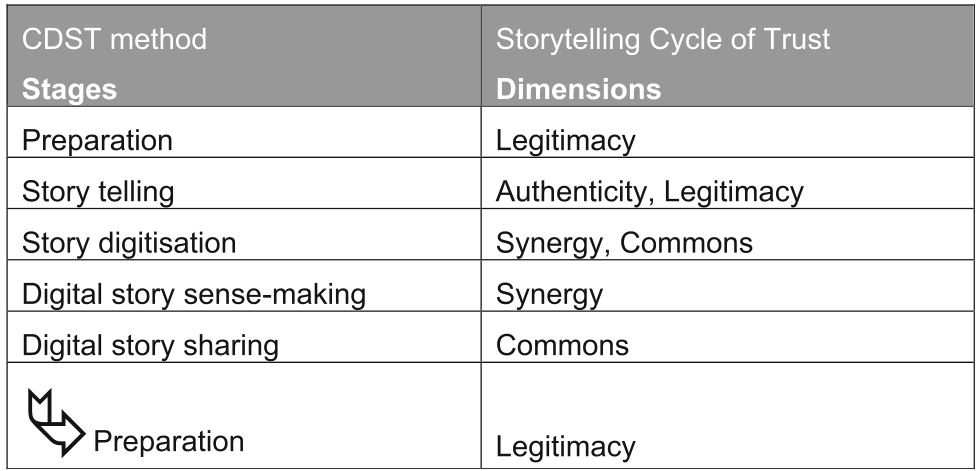
1. The Five Phases of CDST
- Preparation: Aligning topics and recruiting participants.
- Storytelling: The "Story Circle," where participants share narratives in a safe, non-judgmental space.
- Digitization: Turning oral stories into multi-media artifacts.
- Sense-making: Group screenings to reflect on collective issues.
- Sharing: Releasing stories into the public or stakeholder domain.
2. The Storytelling Cycle of Trust
The real innovation of this paper is the introduction of four trust dimensions that act as the "engine" for prolonged storytelling:
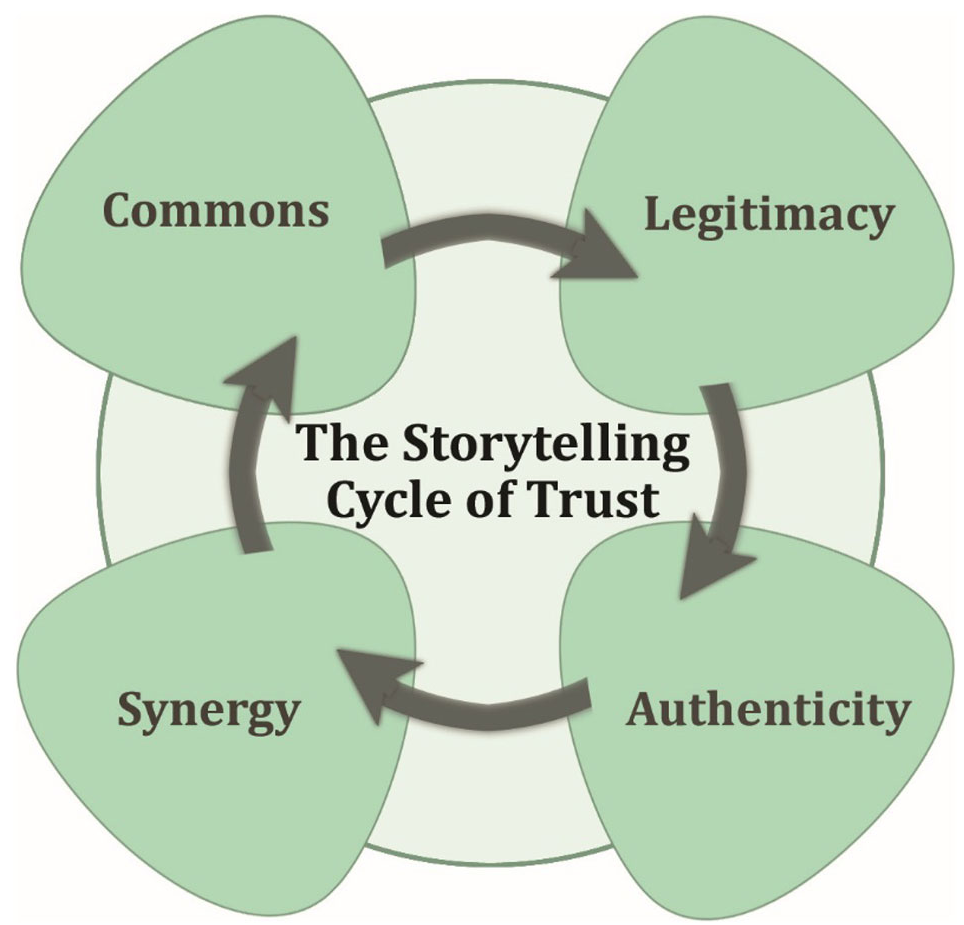
- Legitimacy: Do the stories represent the actual group?
- Authenticity: Is the voice genuine and un-manipulated?
- Synergy: Does the collection of stories tell a bigger, balanced community story?
- Commons: Is the knowledge accessible to others to inspire new cycles of change?
Comparative Case Studies: UK vs. Netherlands
The paper illustrates the framework using two very different case studies:
Case A: Rural Northern Britain
- Context: Villagers in the Yorkshire Dales sharing stories of rural life.
- Outcome: High Authenticity and Synergy. The "Story Circle" was deeply emotional and sparked local activism.
- Failure Point: Commons. Participants felt the stories were too personal for the web. The cycle "stalled" at the individual level.
Case B: Tilburg Social Innovation (Netherlands)
- Context: Students acting as "story hunters" to capture the successes of social innovation award winners.
- Outcome: High Legitimacy and Commons. Stories were hosted on a portal for future students and city marketers.
- Critique: Lower Authenticity, as the stories were "re-told" by students rather than the stakeholders directly.
Critical Insights: Stories as Boundary Objects
The paper posits that digital stories are most powerful when they act as boundary objects—media that can travel between different social worlds (e.g., from a farmer in rural Yorkshire to a national park policy-maker).
The "Cycle of Trust" provides a diagnostic tool for community organizers:
- If the project isn't influencing policy, check the Commons.
- If the community feels exploited, check the Authenticity.
- If the results are anecdotal and scattered, check the Synergy.
Conclusion & Future Outlook
Sarah Copeland and Aldo de Moor have provided a roadmap for moving digital storytelling from a "nice-to-have" hobby to a "must-have" pillar of Collective Intelligence.
Future Work: The authors suggest further research into "distributed story circles" and how to automate parts of the "storytelling commons" without losing the human trust that makes the narrative authentic. This work is essential for anyone interested in how "small data" (human stories) can influence "big decisions" (social policy).