
SRTST: Decoding the Multi-Dimensional Pulse of Urban Communities in LBSNs
Community Discovery Based on Social Relations and Temporal-Spatial Topics in LBSNs
The paper introduces SRTST (Social Relations and Temporal-Spatial Topics), a generative topic model designed for multidimensional community discovery in Location-Based Social Networks (LBSNs). By modeling user check-ins as a function of social interactions and spatio-temporal patterns, it effectively clusters users into communities that share high interaction frequency and consistent behavioral preferences.
TL;DR
In the era of Location-Based Social Networks (LBSNs), a "community" is no longer just a group of friends on a graph; it is a shared rhythm of time, space, and interests. The SRTST (Social Relations and Temporal-Spatial Topics) model addresses this by fusing dynamic social interactions with spatio-temporal check-in patterns. By modeling the generative process of "Who goes Where, When, and for What," SRTST outperforms state-of-the-art models in capturing the semantic and topological essence of human clusters.
Problem & Motivation: The Heterogeneity of LBSNs
In traditional social networks (like Facebook or Twitter), communities are often defined by static edges (links). However, in LBSNs (like Foursquare), the network is heterogeneous and sparse. A friend on a list might never interact with you, while a stranger you frequently see at the same jazz club at 8:00 PM on Fridays might be part of your "functional" community.
The authors argue that existing models fail because they don't distinguish between social interaction closeness and behavioral consistency. They propose that a true LBSN community should satisfy:
- Frequent User Interaction: Not just being "friends," but checking into the same venue at the same time.
- Consistent Spatio-Temporal Patterns: Sharing a common logic for when to go out and where to go.
Methodology: The Generative Logic of "Going Out"
The core of the SRTST model lies in its ability to split the human experience into two distinct generative processes based on check-in types:
- Social Check-ins (Type 1): You go out with friends. Here, the community influences the choice of friends , which then influences the topic (e.g., "Nightlife"), the region (e.g., "Manhattan"), and finally the specific venue .
- Solo Check-ins (Type 2): You go out alone. Here, the community context is bypassed, and the choice depends on the user’s individual topic preference and regional constraints.
Architecture of SRTST
The model uses a Bayesian graphical approach to tie these variables together. Unlike simpler LDA-based models, SRTST treats time as a windowed variable (168 hours in a week) to capture the cyclic nature of human behavior.
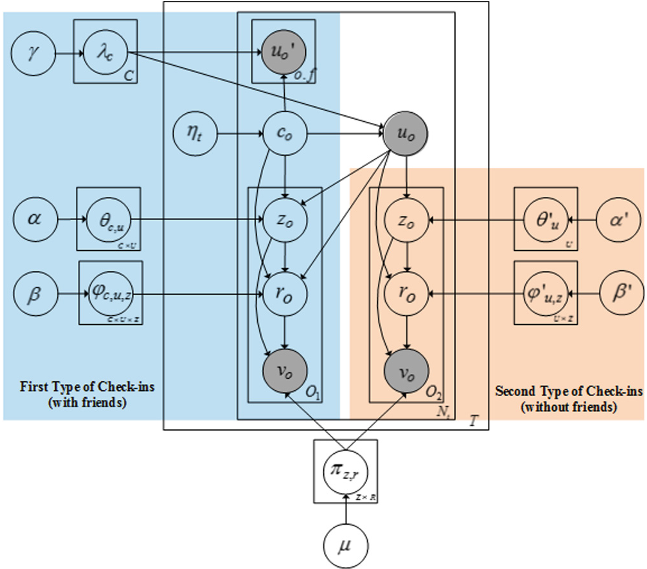 Figure: The Bayesian graphical model illustrating the dependencies between Community (c), User (u), Topic (z), and Region (r).
To solve this complex web of probabilities, the authors derive a Gibbs Sampling algorithm, which iteratively updates the parameters by sampling from posterior distributions.
Experiments & Results: Quantifying Community Quality
The authors validated SRTST using massive datasets from New York (Foursquare and Brightkite).
1. Topic Modeling Precision (Perplexity)
Perplexity measures how well the model predicts new data. As shown in the figure below, SRTST converges at a significantly lower perplexity than competitors like TURCM or W4, suggesting its generative process more accurately reflects real-world behavior.
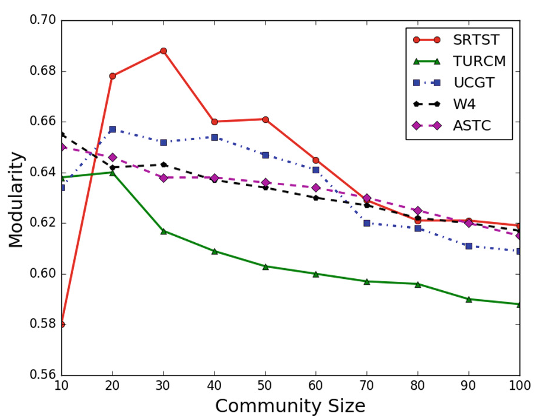 Figure: Perplexity comparison across different iterations. Lower is better.
2. Semantic Consistency
By visualizing the check-in heatmaps (WHO-WHEN-WHERE), the authors demonstrated that SRTST successfully identifies communities with high domain specificity:
- Community 1 (Nightlife): Peaks on weekends and late nights (18:00 - 23:00).
- Community 2 (Professionals): Peaks on weekdays during business hours (10:00 - 20:00).
- Community 3 (Entertainment): Peaks in the early evenings and weekend daytimes.
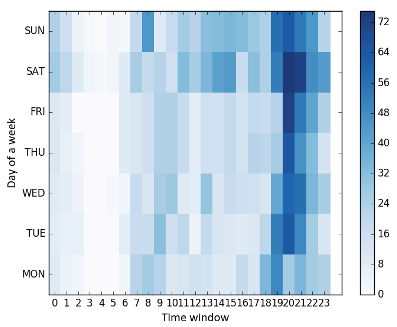 Figure: Heatmaps showing the distinct temporal signatures of different discovered communities.
Critical Insight: Why SRTST Works
The "secret sauce" of SRTST is its treatment of time. By mapping absolute time to a 168-hour weekly cycle, it captures the periodicity of human life—something that many point-process or linear-time models miss. Furthermore, by making "Region" () a latent variable between Topic () and Venue (), the model accounts for the first law of geography: things that are closer together are more related.
Conclusion & Future Outlook
SRTST is a robust framework for understanding the multi-modal nature of urban sociology. While it excels at discovery, the authors note that its current iteration is computationally intensive ().
Future Directions:
- Location Prediction: Using community-level behavioral signatures to predict where a user will go next.
- Scalability: Implementing parallel Gibbs Sampling for real-time processing of larger urban datasets.
Takeaway: Communities in the physical world are not just graphs—they are shared spatio-temporal experiences. SRTST provides the mathematical bridge to connect these worlds.