
Edukalibre: Applying the Libre Software Model to Collaborative Education
Towards Community-Driven Development of Educational Materials: The Edukalibre Approach
The paper introduces Edukalibre, a novel open-source platform that adapts the "libre software" (free/open-source) development model for the collaborative creation of educational materials. It features a document repository with version control (Subversion) and two distinct interfaces, COLLAB and ConDOR, to facilitate collective intelligence among teachers and students.
TL;DR
Edukalibre is a research project and platform that attempts to mirror the success of open-source software development (like Linux or Apache) in the creation of textbooks and learning materials. By utilizing version control systems (Subversion) and automated document conversion, it allows teachers and students to become "prosumers" of educational content. The study highlights that while the technology exists, the transition from "consumer" to "collaborator" requires specific pedagogical shifts.
Background: From Software Code to Learning Content
In the early 2000s, the "Libre Software" movement revolutionized the tech world. The authors of Edukalibre argue that educational materials share a similar DNA with software: they are modular, require frequent updates (early and often releases), and benefit from diverse peer review. However, educators aren't necessarily git-savvy developers. The goal was to build a bridge between robust version control and user-friendly educational interfaces.
Problem & Motivation: The Usability Gap
Prior to this work, collaborative authoring in academia was either:
- Technically dense: Using LaTeX and CVS, which alienated non-IT faculty.
- Feature-poor: Using early Wikis or shared folders that lacked rigorous versioning, "branching" for different grade levels, or high-quality PDF typesetting.
The authors hypothesized that by creating an "Open Architecture," they could support multiple interfaces (from basic web editors to advanced Python-driven tools) while maintaining a single, version-controlled source of truth.
Methodology: The Edukalibre Architecture
The system’s core is a repository built on Subversion (SVN). The brilliance of the design lies in its abstraction layer:
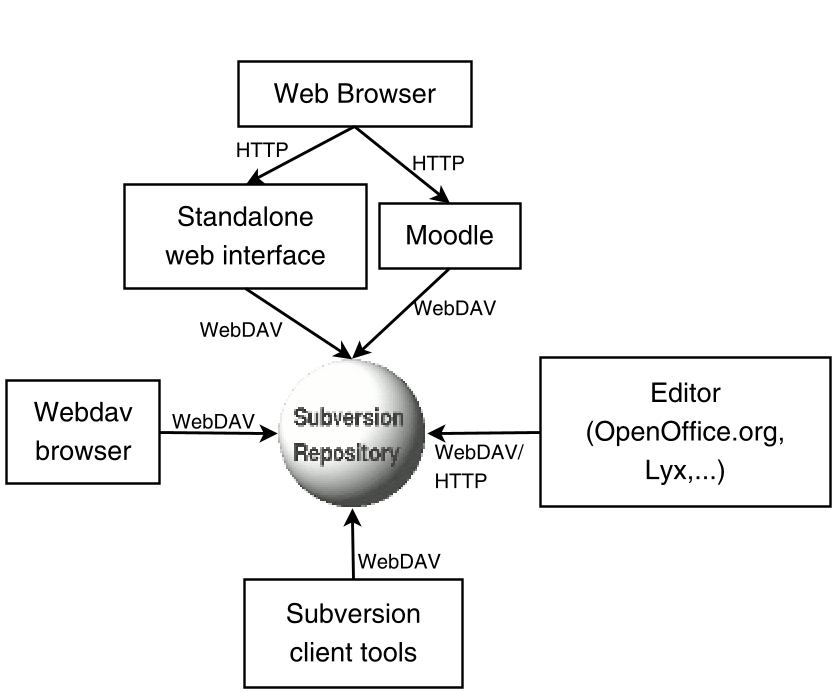
- Version Control: Tracks every change, allowing "branches" (e.g., adapting a university lecture for high school students).
- Format Conversion: Authors can write in DocBook/XML or LaTeX, and the system automatically generates HTML for browsing and PDF for printing using XSLT and Ghostscript.
- Dual Interfaces:
- COLLAB: A Python-based interface for power users who want to see deep history and RDF feeds.
- ConDOR: A PHP-based "explorer-style" interface integrated into the Moodle LMS, designed for students to share files and discuss them in one place.
Experiments & Results: Real-World Deployment
The team conducted four distinct user studies ranging from PhD students to undergraduates.
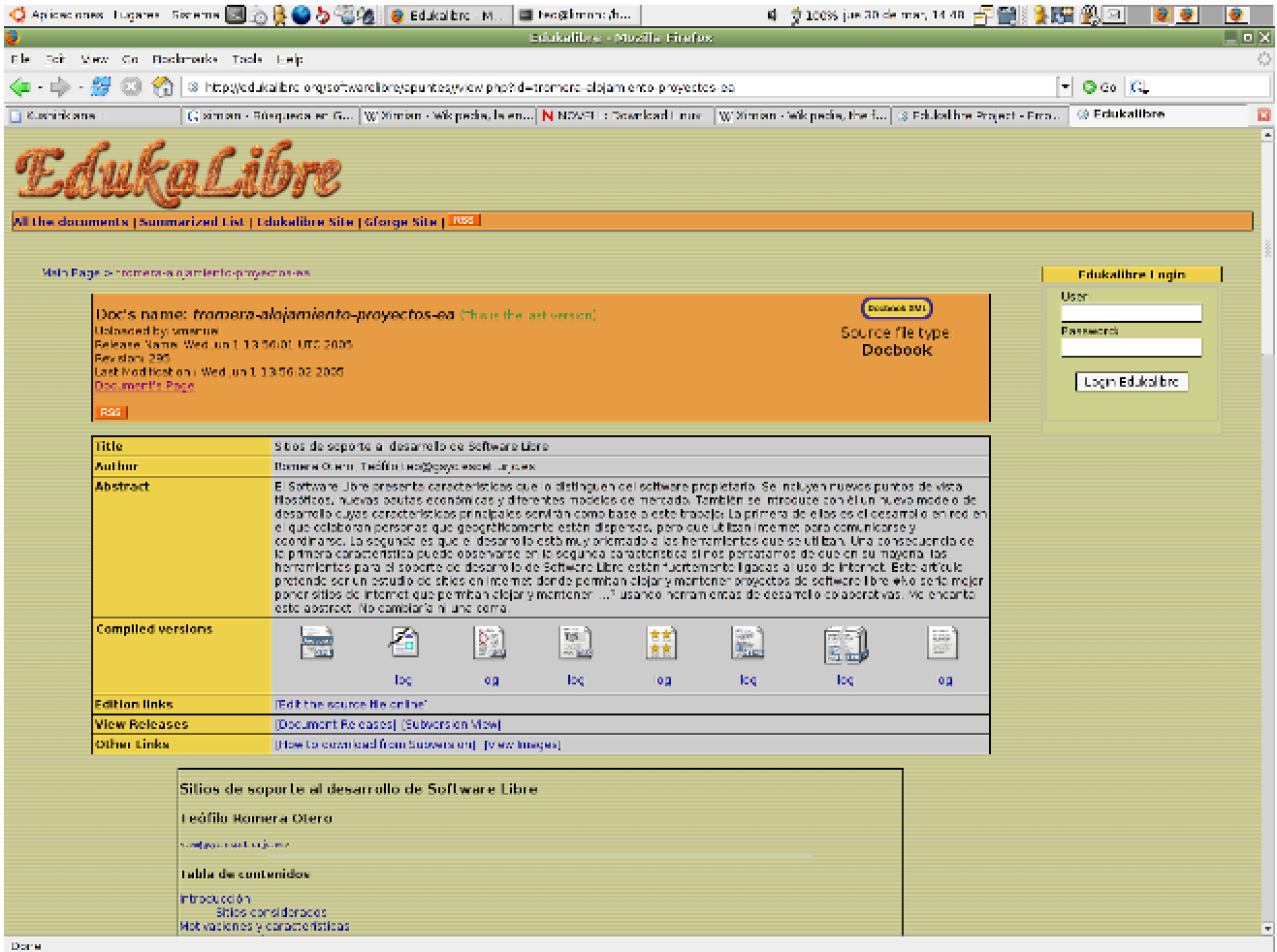 Above: The COLLAB interface used by technical PhD students. Below: The ConDOR interface integrated into Moodle.
Key Findings:
- Trust is a Barrier: Undergraduates were initially reluctant to have their work edited by others (64% disagreed with others changing their writing). This points to an "ownership" culture that contradicts the open-source ethos.
- The "Cognitive Central" Member: Consistent with software projects, the most successful student groups had one or two "lead developers" who set the structure and tone.
- Technical Friction: Non-IT students struggled with the "Download-Edit-Upload" cycle, suggesting that for mainstream adoption, a real-time "Google Docs" style editor integrated directly with version control is essential.
Critical Analysis & Conclusion
Edukalibre was a visionary precursor to modern platforms like Overleaf or GitHub-based documentation. Its contribution is twofold: First, it proved that the Web 2.0 tenets of "harnessing collective intelligence" are technically viable in education. Second, it uncovered a crucial pedagogical limitation: education is not just about the tools; it's about the social contract. For students to collaborate effectively, they need more than a repository; they need a "Community of Practice" where peer-editing is seen as a value, not a threat.
Limitations & Future
The study noted that while SVN was powerful, it was still a hurdle for undergraduate students. The future of this movement likely lies in "Invisible Version Control"—where the power of branching and merging is hidden behind an intuitive, collaborative interface. Furthermore, the transition of these materials into "Learning Objects" with rich metadata remains a challenge for the next generation of OER (Open Educational Resources) platforms.