
Emergence in Weighted Social Networks: How Local Friendship Reinforcement Scales to Global Communities
Model of Community Emergence in Weighted Social Networks
The paper introduces a computationally efficient microscopic model for weighted social networks, termed the "Kumpula-Onnela-Saramäki (KOS) model," which reproduces emergent community structures. It utilizes two distinct link formation mechanisms—cyclic closure and focal closure—to achieve State-of-the-Art alignment with empirical data from large-scale mobile communication networks.
TL;DR
Researchers have developed a simple yet powerful microscopic model to explain how communities form in large social networks. By simulating just two behaviors—"meeting friends of friends" (local search) and "meeting strangers" (global attachment)—and adding a reinforcement mechanism where frequent interactions strengthen ties, the model naturally produces the modular structures seen in real-world data like mobile phone logs.
Background Positioning
In the landscape of network science, this paper sits as a bridge between sociological theory (Granovetter’s "Strength of Weak Ties") and computational physics. It moves beyond unweighted models (like Barabási-Albert) to show that link weights are not just attributes but the primary drivers of community emergence.
Problem & Motivation: The Gap in Network Modeling
Why do social networks look the way they do? Empirical data shows "communities"—dense clusters of people with strong internal bonds. However, most generative models either focus on the global degree distribution (scale-free properties) or require pre-defined community structures. The authors identified a missing link: the co-evolution of topology and weights. They hypothesized that local reinforcing interactions are the engine behind the "Strength of Weak Ties" motif, where weak links act as bridges and strong links form the core of communities.
Methodology: The LA-GA Engine
The model relies on three fundamental processes:
- Local Search (LA - Cyclic Closure): A node looks for new friends by hopping to a neighbor's neighbor. The probability of choosing a path is proportional to the link's weight. If a new connection is made or an old one is revisited, the weight increases by a reinforcement factor .
- Global Attachment (GA - Focal Closure): Nodes occasionally form random links across the network, simulating meeting people through shared interests rather than mutual friends.
- Node Deletion (ND): To maintain a steady-state network size, nodes are randomly removed (simulating individuals leaving the system), which prunes old or inactive links.
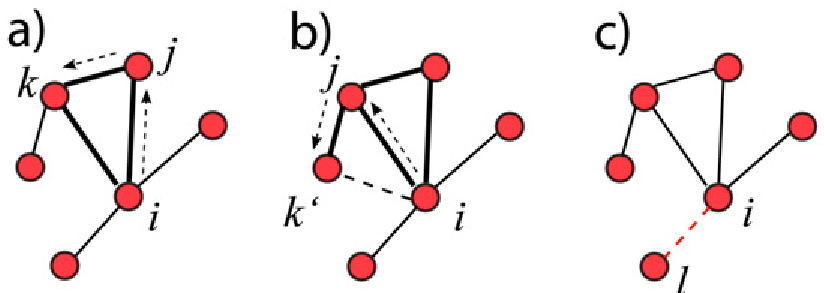 Figure 1: Illustration of (a-b) Local Search/reinforcement and (c) Random Global Attachment.
The key "insight" here is the parameter. When is high, the "rich-get-richer" effect applies to friendship strength, forcing the network to organize into tight-knit modules.
Experiments & Results: Validating the "Weak Ties"
Using Clique Percolation (searching for overlapping k-cliques), the authors proved that as increases, the network undergoes a structural transition. At low , the network is relatively homogeneous. As increases, communities "condense" and become distinct.
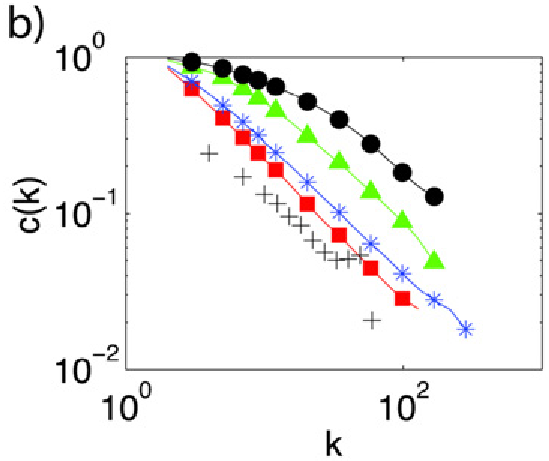 Figure 2: Visual impact of the reinforcement parameter . High (right) leads to clearly visible clusters connected by weak links.
Key Findings:
- Linear Scaling: The algorithm's CPU time increases linearly with network size (), making it suitable for simulating millions of nodes.
- Weight-Topology Correlation: The model perfectly matches the behavior of real-world mobile call networks. In percolation tests, removing weak links first causes the network to collapse much faster than removing strong links, confirming that weak ties are the "glue" of the global structure.
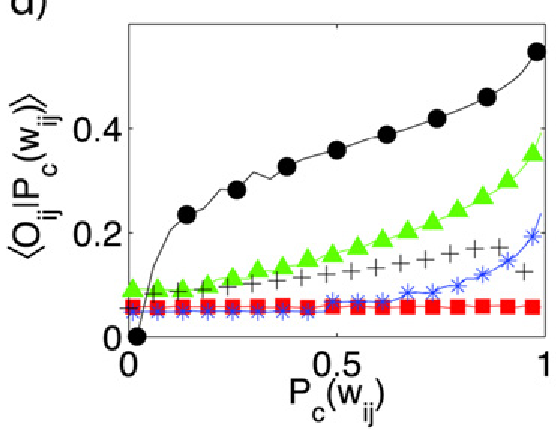 Figure 3: Comparison of the model's degree distribution and clustering vs. real mobile phone data ( markers).
Critical Insight & Conclusion
Takeaway
The genius of the KOS model is its simplicity. It proves that you don't need complex rules to create a modular world; you only need weighted local reinforcement. This has massive implications for understanding how rumors spread, how diseases propagate through localized clusters, and how social echo chambers form.
Limitations & Future Work
While the model is robust, it treats node removal as a purely random process. In reality, individuals often leave networks because their "communities" dissolve. Future iterations could explore correlated node deletion. Furthermore, applying this to multi-layer networks (e.g., combining different social media platforms) remains a promising frontier.