
Beyond Connectivity: Strategic Growth through Community Expansion
Community Expansion in Social Network
The paper introduces the "Community Expansion" problem, focusing on strategies to grow a target community through promotional activities. It proposes three strategy-driven models—Adopter, Benefit, and Combine—and a greedy algorithm called ETC (Expanding Target Community) to optimize member acquisition in social networks.
TL;DR
Expanding a social community is not just about finding more people; it is about finding the right people who will trigger a chain reaction of joins. This paper shifts the focus from passive community detection to active Community Expansion. By introducing the ETC Algorithm and three specialized models, the authors demonstrate how to double the effectiveness of marketing campaigns in social networks compared to traditional heuristic methods.
The "Strategy Gap" in Social Networks
Traditional social network analysis has a blind spot: it tells us what a community looks like (Community Detection) and how information flows (Influence Maximization), but it rarely discusses how an organization can systematically enlarge its borders over time under a limited budget.
The authors argue that existing Influence Maximization (IM) models (like IC or LT) are insufficient here. Why? Because in real-world marketing, we don't just "drop a seed" and watch. We intervene repeatedly, adjusting our targets based on how the community evolves. Furthermore, the internal structure of the community—how many friends a target has inside and how those friends are connected—drastically changes their likelihood of joining.
Methodology: The Three Pillars of Expansion
The researchers break down the decision-making process into three distinct models based on "Adoption Probability" and "Future Benefit."
1. The Adopter Model (The "Low-Hanging Fruit")
This model focuses on individuals who are most likely to say "yes." It uses a non-linear function (logarithmic) to represent the law of diminishing returns: having 5 friends in a community makes you much more likely to join than having 1, but having 50 instead of 45 offers little additional push.
2. The Benefit Model (The "Influencer Strategy")
This targets "celebrities" or bridge nodes. While these people might be harder to persuade, their entry into the community creates a gravitational pull on their remaining "potential customer" neighbors.
3. The Combine Model (The Optimized Hybrid)
This is the paper’s primary contribution. It balances ease of adoption with the potential for "Automatic Customers" (AC)—people who join for free because their social environment has shifted.
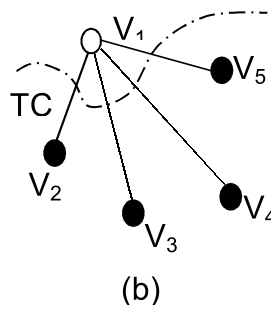 Fig 1: The model calculates din (internal density) to see if a candidate's friends are a tight-knit supportive group or scattered.
The ETC Algorithm: Greedy but Effective
The ETC (Expanding Target Community) algorithm works in three stages per time-step:
- Selection: Score potential targets in each salesman's list and pick the best.
- Conversion: Probabilistically determine if the "Mark Customer" joins.
- Cascade: Update the graph and check for "Automatic Customers" who join because their internal friend-threshold () was crossed.
Experimental Results: Strategy depends on Density
The authors tested their models across diverse datasets (Football teams, Email networks, ArXiv collaborations, and Facebook).
- In Dense Networks (Arenas Email/NetHEPT): The Combine Model (ETCC) was the clear winner. By balancing adoption and influence, it reached peak membership faster and more efficiently than baseline "Random" or "TABI" algorithms.
- In Sparse Networks (Facebook): Surprisingly, the Adopter Model (ETCA) performed better. In scattered networks, the "Influencer" effect is weaker because nodes aren't as tightly clustered, making "easy conversion" a more viable strategy.
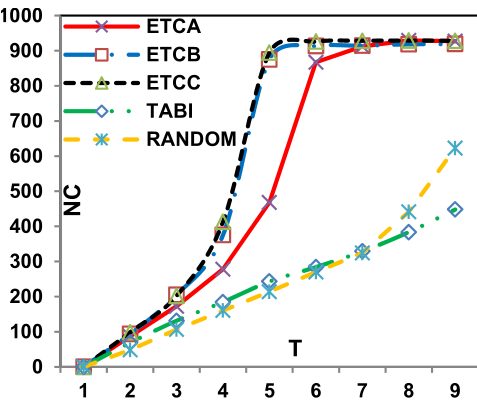 Fig 2: Growth of New Customers (NC) over time. ETCC (Solid square) reaches its peak significantly faster than others.
Critical Analysis & Conclusion
This work provides a robust framework for algorithmic marketing. It moves the needle from "Who is influential?" to "Who should we target next to grow our group?"
Takeaway: If your community is a tight-knit professional group, hunt for nodes that bridge your community to other clusters (Combine Model). If your network is a vast, sparsely connected platform like early Facebook, focus on high-probability adopters to build momentum (Adopter Model).
Limitations: The current model assumes a fixed cost for all promotions and ignores the possibility of "negative influence" or members leaving. Future research integrating Time-Varying Costs and Churn Rates would bridge the gap between academic network science and practical CRM (Customer Relationship Management) tools.