
chTrust: Refined Trust Prediction via Community Insights and Direct Homophily
Tapping Community Memberships and Devising a Novel Homophily Modeling Approach for Trust Prediction
This paper introduces chTrust, an unsupervised trust prediction framework that leverages community memberships and a novel homophily modeling approach. By integrating these social theories into a Non-negative Matrix Factorization (NMF) objective, it achieves state-of-the-art performance in predicting sparse trust relations.
TL;DR
Predicting who trusts whom in a social network is notoriously difficult due to extreme data sparsity. chTrust addresses this by mathematically encoding the intuition that users trust those within their communities more than outsiders and by refining how "homophily" (similarity) is baked into the model. It moves beyond simple propagation to a multi-faceted optimization framework that excels even for "low-degree" users with few existing connections.
Background: The Sparsity Wall
In modern social-ecommerce platforms like Epinions or Ciao, explicit trust links are the "gold" for filtering credible information. However, these links are rare. Most users have only a handful of trustors, creating a power-law distribution that renders traditional trust propagation (like PageRank variations) ineffective—if there is no path, there is no prediction.
The authors identify a gap in existing latent factor models: they either treat similarity as a side-constraint or ignore the "meso-scale" structure of the network—the Community.
Methodology: The Core Innovations
1. The Community Membership Hypothesis
The central pillar of this work is the Within-Community Trust Propensity. The authors argue that a user is statistically more likely to trust a peer within the same community than a stranger outside it.
They derived a mathematical factor that calculates the gap between average across-community trust and within-community trust: By minimizing this, the model is forced to learn latent representations () that respect the social boundary of communities.

2. Direct Homophily Modeling
Unlike previous works (like triMF) that merely keep similar users' latent vectors close, chTrust directly links similarity to the output trust likelihood. It applies a dual penalty:
- Dissimilar pairs are penalized if the model predicts high trust.
- Similar pairs (based on item ratings) are penalized if the model predicts low trust.
Experiments & Results
The framework was tested on the Ciao and Epinions datasets. The results demonstrate a clear "Information Gain" from using both community and rating similarity.
Performance Highlights:
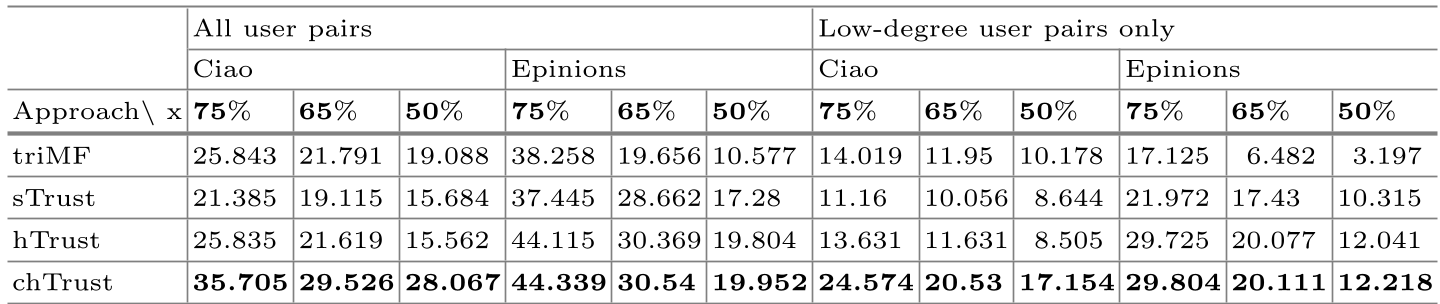
- All User Pairs: On Ciao, chTrust achieved 35.705% PA, a massive jump from the 25.8% seen in previous SOTA methods.
- Low-Degree Users: One of the biggest wins is in the "Cold-Start" scenario. For users with very few relations, the community logic provides the necessary Inductive Bias to make accurate guesses, outperforming baselines by nearly double in some Ciao subsets (24.5% vs 14.0%).
Ablation and Hyper-parameters
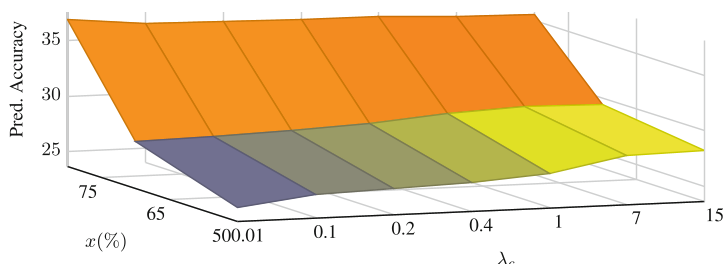
The authors analyzed the sensitivity of (community influence) and (homophily influence). The figures show that finding the "Sweet Spot" for community influence is critical; too little leads to standard MF performance, while too much can over-regularize the model.
Deep Insight & Conclusion
The true value of chTrust lies in its mathematical elegance. By transforming a social hypothesis ("we trust our own") into a differentiable term in an NMF objective, it provides a principled way to bridge the gap between Network Science (communities) and Representation Learning (latent factors).
Future Outlook: While this work uses static clustering for communities, a future extension could involve Joint Learning, where community detection and trust prediction are optimized simultaneously, potentially allowing the community structure to evolve as new trust links are predicted.