
Beyond Isolated Clusters: Mining the Connective Tissue of Social Networks
Community Mining and Cross-Community Discovery in Online Social Networks
This paper introduces a two-layer statistical framework for community mining and cross-community discovery in social networks using Latent Dirichlet Allocation (LDA). By modeling users as documents and interactions as topics, the system automatically identifies latent communities and employs a symmetric Kullback-Leibler (KL) divergence measure to quantify inter-community relationships and shared information.
TL;DR
The exponential growth of online social networks (OSNs) has turned "Community Mining" into a high-stakes challenge for recommendation engines and social scientists. While most research focuses on find-and-isolate clustering, this paper introduces an integrated framework that uses Latent Dirichlet Allocation (LDA) to discover communities and KL Divergence to map the relationships between them. It treats users as probability distributions, allowing for a more nuanced understanding of how information flows across social boundaries.
The "Similarity" Trap in Community Mining
Most prior works treat community detection as a hard clustering problem. You define a similarity measure (like Euclidean distance or Cosine similarity), and the algorithm groups users who are "close." However, the authors argue that these measures are often brittle and domain-specific.
Moreover, traditional methods suffer from "Silo Vision": they analyze what happens inside a group but ignore how Group A influences Group B. In the real world, communities are porous; users belong to multiple circles, and ideas jump between clusters. This "cross-community" discovery is the missing link in OSN analysis.
Methodology: Communities as Latent Topics
The brilliance of this approach lies in its methodological shift. Instead of seeing a social network as just a graph of nodes and edges, the authors view it through the lens of Probabilistic Topic Modeling.
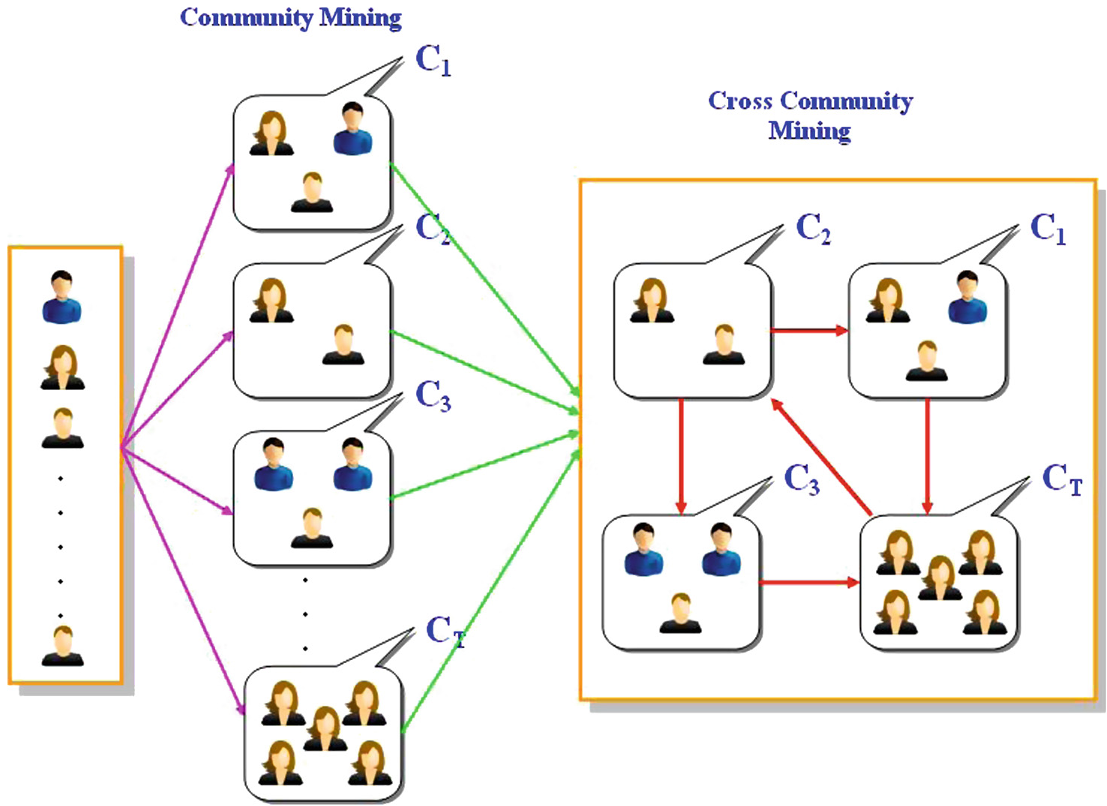
1. Unsupervised Discovery via LDA
In text mining, LDA assumes a document is a mixture of topics, and a topic is a mixture of words. Here, the authors perform a clever mapping:
- User = Document
- Interaction Pattern = Word
- Community = Latent Topic
This allows the model to identify communities based on the co-occurrence of interaction patterns. Because it’s a probabilistic model, a user isn't just "in" or "out" of a community; they have a certain probability of belonging to several, which naturally accounts for overlapping interests.
2. Quantifying Cross-Community Relationships
Once communities are extracted, the authors use the Kullback-Leibler (KL) Divergence to compare the interaction distributions () of different communities. To turn this into a usable similarity metric, they symmetrize the KL divergence:
This formula tells us how "far apart" two communities are in terms of their behavior and shared information.
Experimental Insights: The Tencent Weibo Case Study
The authors validated their model on the massive Tencent Weibo dataset (KDD Cup 2012), involving millions of users.
Identifying "Authorities"
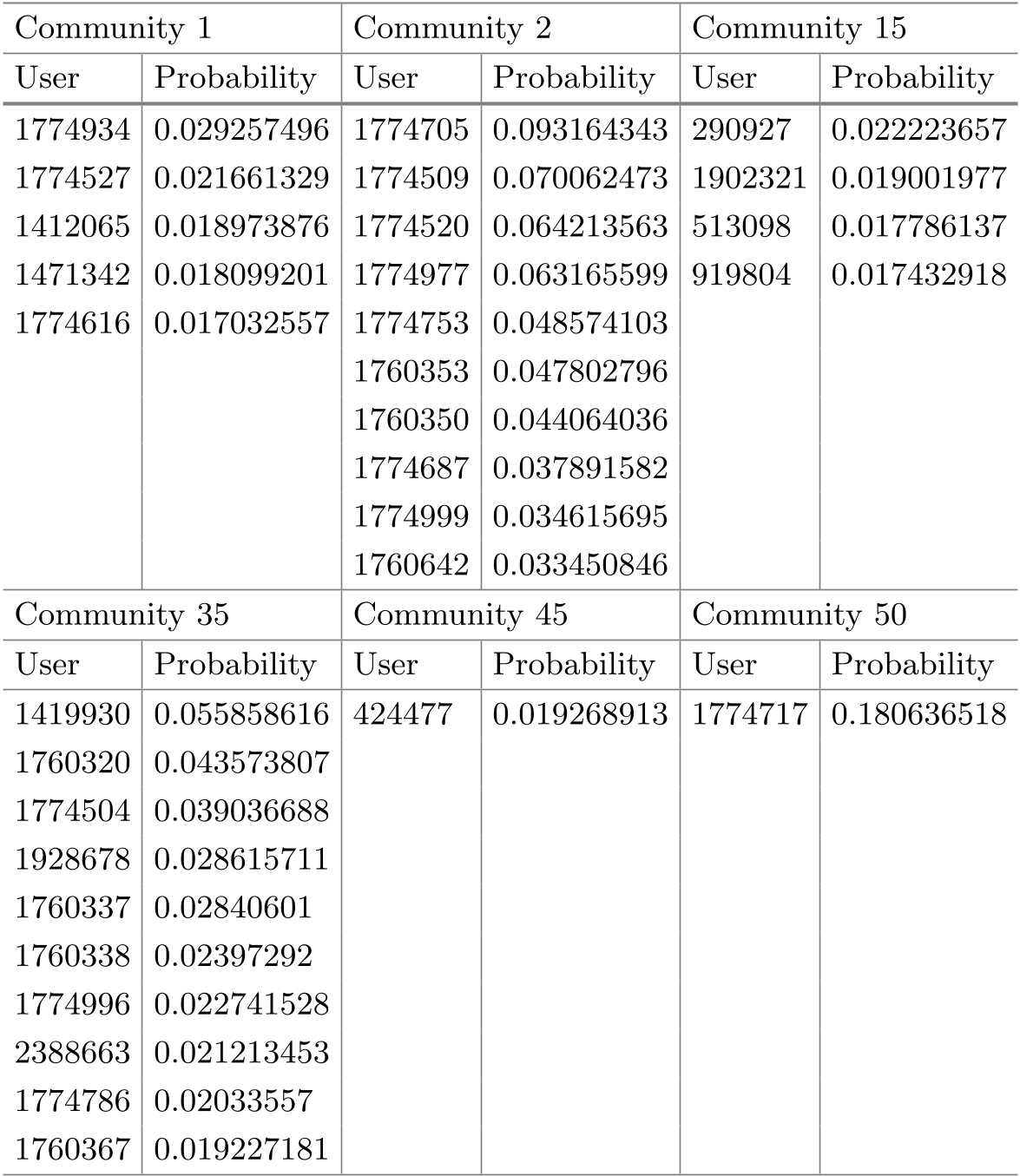
By looking at the probability weights within a community (), the model automatically surfaces Authoritative Users. These aren't just people with many followers; they are the individuals who define the "core" of a specific community's interest.
Visualizing the Social Manifold
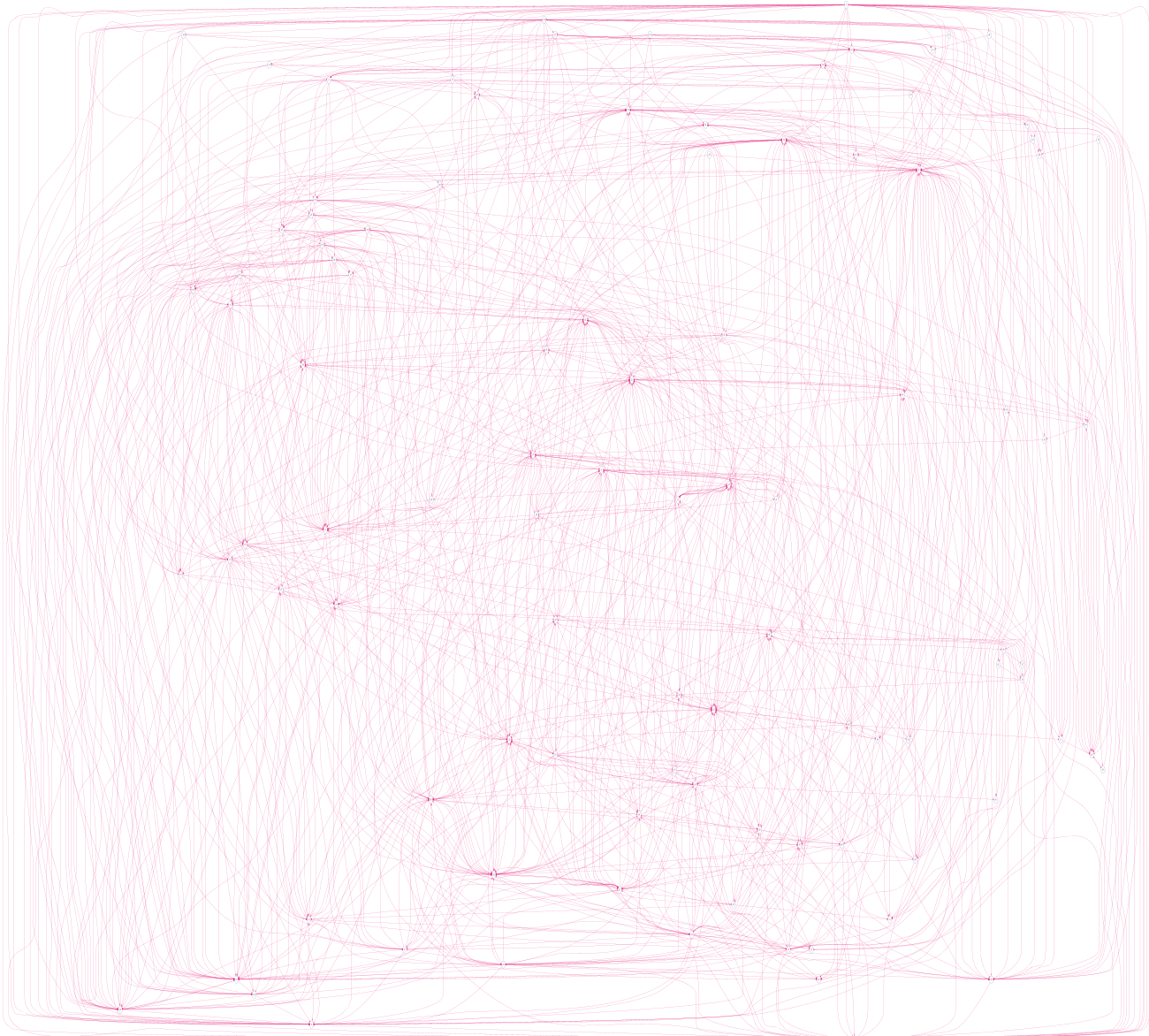
The cross-community discovery phase resulted in a fascinating "map" of the social network. When the number of communities reached 100, the visualization showed a dense web of connections, proving that communities in OSNs are highly interconnected.
Critical Analysis & Future Outlook
Contribution: The primary value of this work is the robust, unsupervised nature of the discovery process. By removing the need for "similarity engineering," the authors have created a scaleable pipeline for understanding complex social topologies.
Limitations: The model requires the number of communities () to be predefined, much like the in K-means. In a dynamic, ever-shifting social network, fixing this number can be a bottleneck.
Future Work: The logical next step—as hinted by the authors—is to incorporate semantic labels (tags and keywords) more deeply into the probabilistic framework to not only identify where the communities are but what they are talking about in real-time. This would move OSN analysis from structural discovery to deep semantic understanding.