
FEC: Reimagining Community Mining in Signed Social Networks via Agent-Based Heuristics
Community Mining from Signed Social Networks
The paper introduces FEC (Finding and Extracting Communities), a linear-time algorithm designed for community mining in signed social networks. Unlike traditional methods, FEC utilizes an agent-based random walk model and a novel "signed cut" criterion to simultaneously account for link signs and density, achieving SOTA accuracy on both signed and unsigned benchmark networks.
TL;DR
Most social network algorithms treat "friends of friends" as a unified group, but real-world systems are messy—they contain enemies, competitors, and hostile factions. This paper introduces FEC (Finding and Extracting Communities), an algorithm that finally bridges the gap between link density and link signs. By simulating a random walk (agent-based approach) and using a "signed cut" logic, FEC identifies communities in linear time without needing to know how many groups exist beforehand.
The "Sign" Problem: Why Traditional Clustering Fails
In a standard social network, a community is simply a "dense cluster." But in a Signed Social Network, we have:
- Positive Links (+): Friendship, alliance, trust.
- Negative Links (-): Hostility, opposition, distrust.
If you use a standard "Max-Flow" or "Louvain" method, you miss the vital information that negative links between groups are just as important as positive links within them. Conversely, previous signed-only methods (like Doreian-Mrvar) ignore density, failing when a network has high noise or overlaps.
Methodology: The FC and EC Phases
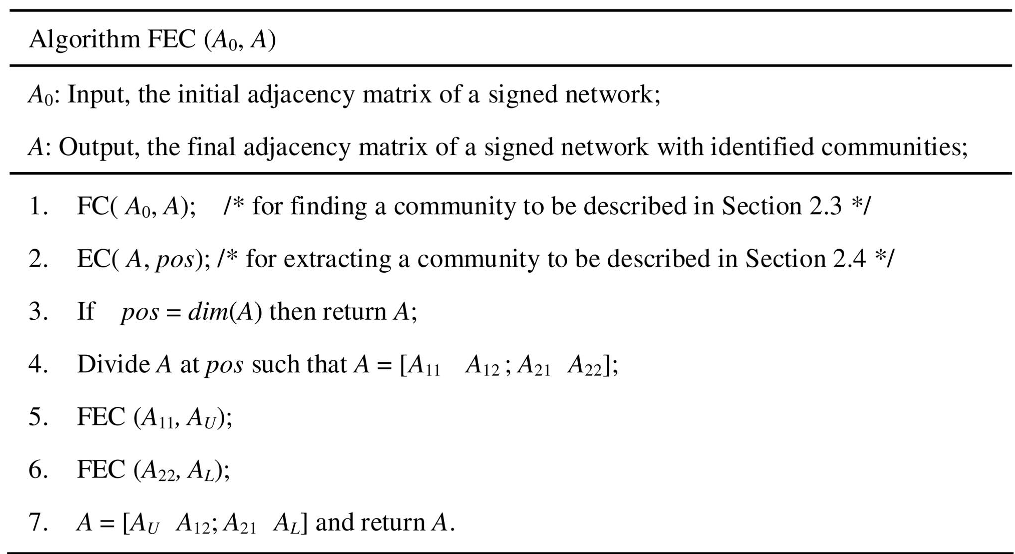
FEC operates through a recursive bisection strategy divided into two elegant phases:
1. The FC Phase (Finding Community)
Imagine an agent starting at a random node and walking only along positive links. Because a community has many internal positive links but few leading out, the agent is "trapped" in a local cluster. FEC calculates the probability that an agent starting at node reaches a "sink node" within steps.
- Intuition: Nodes within the same community will have high reachability (transition probability) to each other, while nodes outside will have nearly zero probability.
2. The EC Phase (Extracting Community)
Once nodes are ranked by probability, FEC must find the "cutoff" point. It proposes a Signed Cut Criterion (). A cut at position pos is valid if:
- For nodes inside the cut: Internal weight sum external weight sum.
- For nodes outside the cut: External weight sum internal weight sum.
This ensures that within the group, positive links are dense and negative links are sparse, while the opposite holds true for links connecting to the rest of the network.
Exceptional Efficiency and SOTA Results
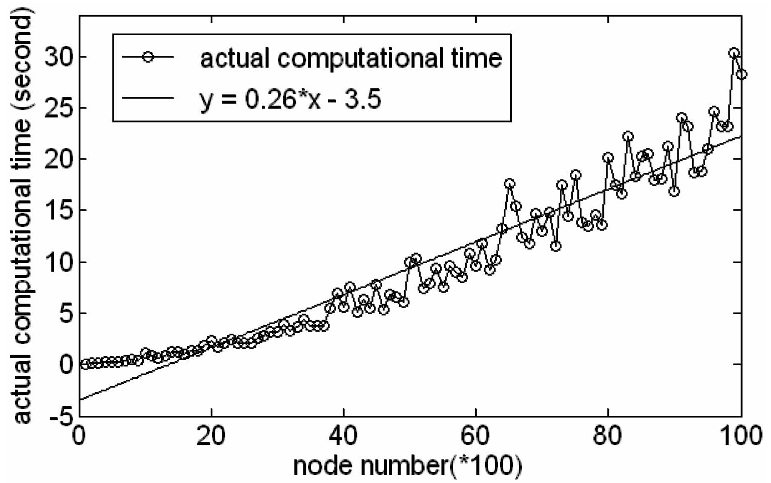
FEC’s most impressive feat is its speed. While spectral methods often require or complex eigen-calculations, FEC runs in linear time .
Benchmark Performance
The authors tested FEC on iconic datasets:
- Karate Club: Corrected identified the two-way split caused by the administrator-teacher feud.
- Slovenine Parliamentary Party: Accurately clustered parties based on similarity scores.
- Football Association: Identified conference structures with high precision.
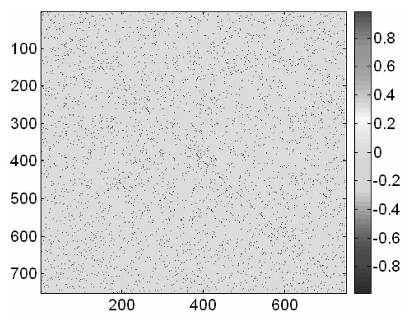 Figure: FEC shows remarkable robustness against noise (p+ and p-) compared to the traditional Doreian-Mrvar (DM) algorithm.
Performance on Large-Scale Data
The linear complexity isn't just theoretical. In tests on sparse networks with up to nodes, FEC maintained a linear growth in computation time, making it one of the few signed-network algorithms capable of scaling to modern web-scale data.
Critical Insight & Conclusion
FEC succeeds because it views community detection not just as a graph-cutting problem, but as a flow problem on a signed manifold. By restricting random walks to positive links while using negative links to define the boundaries (the "Cut"), it effectively captures the "Social Balance" of the system.
Takeaways for Researchers:
- No Priors Needed: You don't need to specify the number of clusters ().
- One Parameter: The only tweak is (walk length), usually stable between 10-20.
- Future Paths: This logic could be a game-changer for Web Mining (hostile site links) and Image Segmentation (where negative pixels signify boundaries).
Despite being a classic paper, the agent-based philosophy in FEC remains a precursor to modern Graph Neural Network (GNN) propagations, proving that simple physical intuition often leads to the most robust algorithms.