
Beyond Centrality: Discovering the Bridges and Gateways of Social Networks
Discovering Community-Oriented Roles of Nodes in a Social Network
The paper introduces a novel topological method to identify community-oriented roles—Bridges, Gateways, and Hubs—in social networks. Unlike traditional centrality metrics, this approach leverages local neighborhood density and transitivity to detect nodes that interconnect different communities without requiring prior knowledge of the global community structure.
TL;DR
While "influencers" are often identified by how many followers they have (Degree Centrality), the most strategically important people in a network are often those who connect different worlds. This paper proposes a method to identify Bridges, Gateways, and Hubs based on local topology, successfully finding critical "connector" nodes that traditional algorithms overlook.
Background: The Blind Spot of Centrality
In social network analysis, we often ask: "Who is the most important person?" Traditionally, we look at Centrality:
- Degree: Who has the most links?
- Betweenness: Who lies on the shortest paths?
- Closeness: Who is nearest to everyone else?
However, the authors argue that these metrics ignore Community Structure. A person might have a very high degree but only be popular within a single group (the "Big Fish in a small pond"). Conversely, a "Bridge" might have only two links but be the only connection between two massive nations. Previous state-of-the-art methods like rawComm attempted to fix this but relied too heavily on cliques (perfectly connected groups), failing to find bridges between more loosely coupled communities.
The Core Insight: Neighbor Similarity
The methodology is built on a simple, elegant intuition: You can judge a node by the company its neighbors keep.
If your friends don't know each other, you are likely a "Bridge" between different social circles. If your friends are all best friends with each other, you are likely the center of a dense "Community."
The authors formalize this using two key relations:
- CIN (Connected via Intermediate Node): Two neighbors share only the target node as an acquaintance.
- SC (Strongly Connected): Two neighbors share two or more acquaintances.
The Three Community Roles
- Bridges: Neighbors are not "loners" but have almost no connections to each other except through the bridge.
- Gateways: Acts as the "front door" to a community. Some neighbors are strongly connected to each other (the "room"), while another neighbor is an outsider.
- Hubs: A confluence point where multiple distinct, strongly connected groups meet.
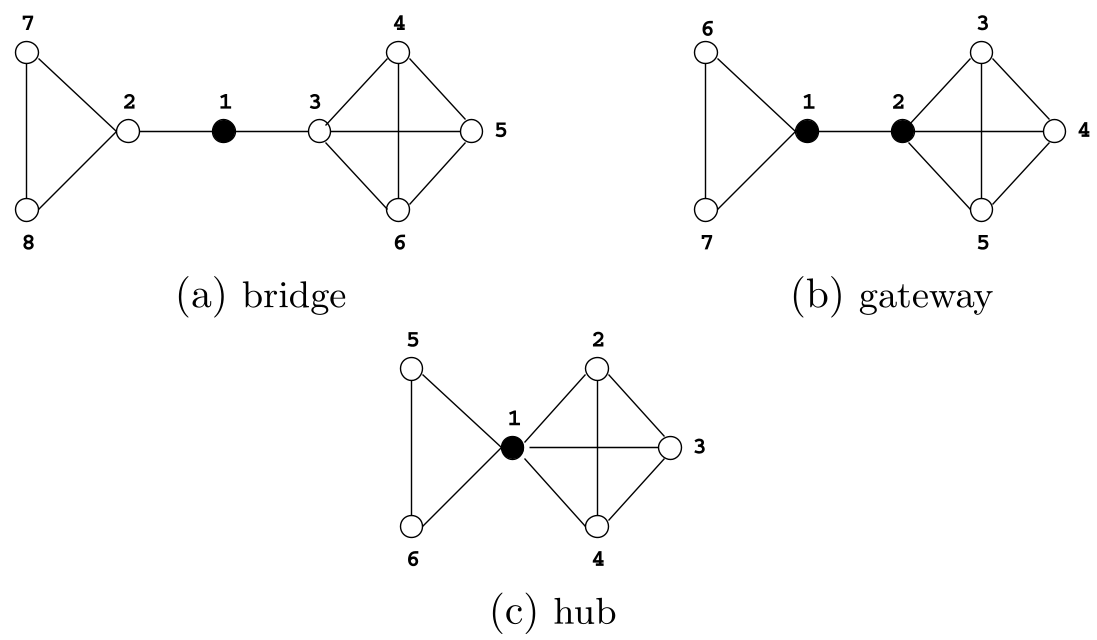 Figure: Visual representation of a Bridge (a), Gateway (b), and Hub (c) based on neighbor connectivity.
Methodology and Complexity
The algorithm is remarkably efficient. Since it only examines the neighborhood of each node, the complexity is (where is nodes and is the max degree). This makes it significantly faster and more scalable than global community detection algorithms that require iterative optimization.
The authors also establish a Discovery Priority:
- Bridges → 2. Gateways → 3. Hubs This hierarchy ensures that the most distinct "inter-community" links are identified first, preventing a gateway from being misclassified as a hub during the search process.
Experimental Proof: DBLP and Synthetic Data
The authors tested their method against a synthetic 21-node graph and a real-world DBLP co-authorship dataset (IJCAI 2005–2009).
Key Findings:
- Subjective Validity: In the synthetic test, the proposed method identified Node 1 as a Bridge, whereas traditional centrality ranked it lower than Node 6.
- Sensitivity: Unlike
rawComm, which requires a manually tuned threshold , this method is non-parametric and more robust. - Boundary Accuracy: By comparing results with Normalized Cut (a standard clustering method), the authors found that 99% of identified roles were indeed located at the boundaries of detected communities.
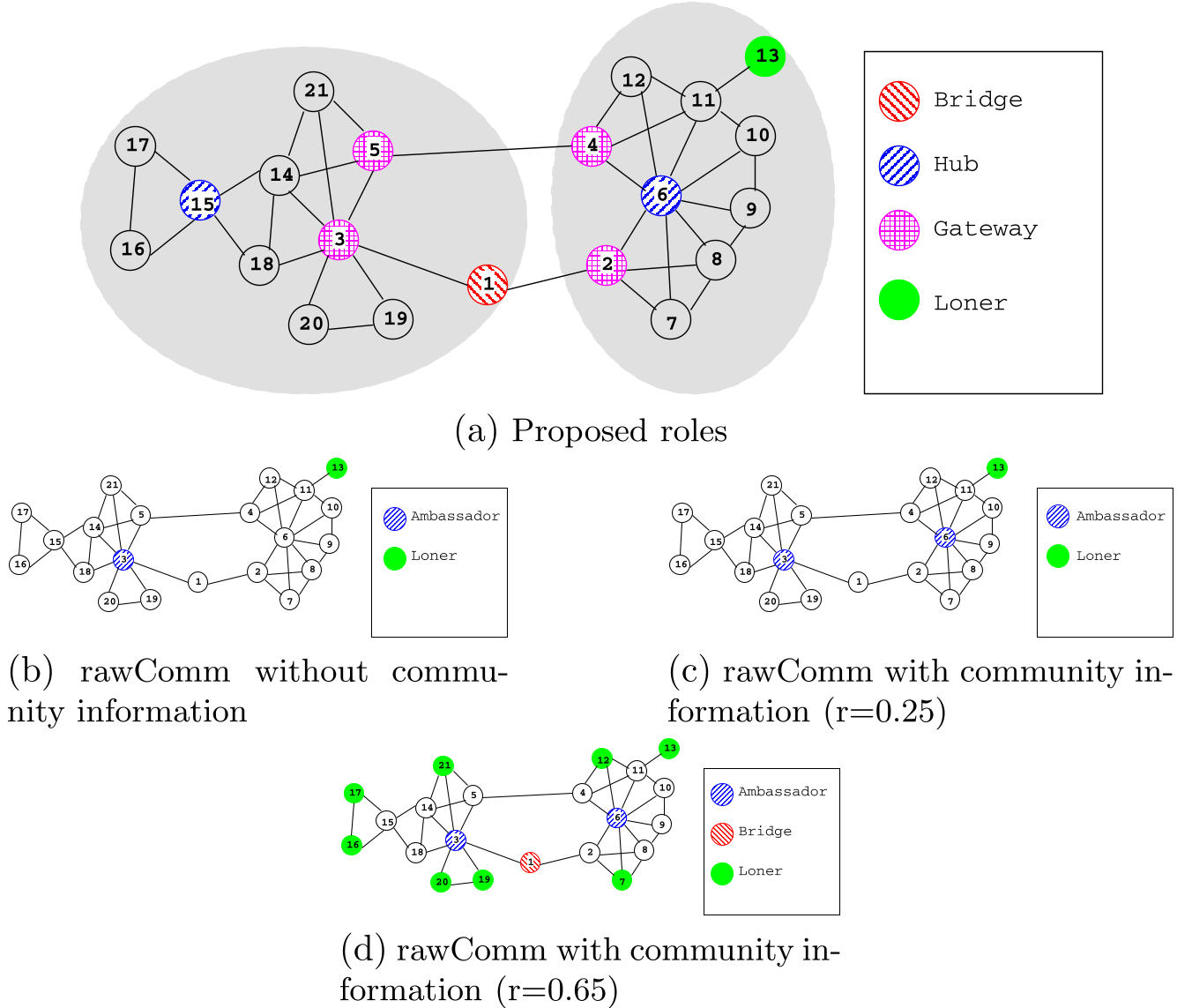 Figure: Comparison of the proposed method (a) vs rawComm (b, c, d). The proposed method more accurately captures the inter-community structure.
Critical Analysis & Conclusion
This paper provides a refreshing local-first perspective on network roles. By moving away from "Clique-only" definitions, it opens the door for detecting bridges in "sparse" social networks—like those found in law enforcement (criminal rings) or epidemiology (disease spreaders between different cities).
Limitations: The algorithm currently assumes a node can only have one role. In highly complex networks, a node might act as a Hub for one cluster while being a Gateway for another.
Future Outlook: The authors suggest that these roles should be the precursor to community detection. Instead of finding communities and then assigning roles, we can use these "Bridges" and "Gateways" to define where one community ends and another begins—potentially solving the problem of "overlapping communities."
Takeaway for Practitioners
In viral marketing or information dissemination, don't just look for the node with the highest degree. Look for the Gateways. They are the gatekeepers who control the flow of information from the mainstream into specialized sub-communities.