
Community-Preserving Generalization: Balancing Privacy and Utility in Social Networks
Community-Preserving Generalization of Social Networks
The paper introduces a community-preserving graph generalization approach for privacy-preserving social network mining. By integrating k-shell decomposition with vertex similarity measures (Manhattan and 2-path), the method creates super-vertices that reduce network scale while maintaining the essential community structure of the original graph.
TL;DR
Social network data is a goldmine for research, but releasing it raw poses massive privacy risks. This paper proposes a Community-Preserving Generalization algorithm that summarizes graphs by grouping nodes not just by "similarity," but also by their "functional depth" (k-shells). This approach allows for significant data compression and anonymization while maintaining a high Precision Index (up to 99%) for community detection tasks.
Background & Motivation
When we share social network data, we usually strip away names (naïve anonymization). However, attackers can often re-identify individuals by looking at the "neighborhood" of a node—its unique structural fingerprint.
To combat this, researchers use Graph Generalization (also called summarization). This process merges nodes into "super-nodes." The challenge? Most existing methods "smear" the community structure, making the resulting graph useless for clustering analysis. The authors hypothesize that by respecting the k-shell of a node (its core-ness), they can hide identities without destroying the network's social backbone.
Methodology: The Power of K-Shells
The core innovation is combining Graph Degeneracy with Structural Similarity.
- K-Shell Decomposition: Nodes are categorized based on their "inner circle." To be in a 3-core, a node must have at least 3 neighbors who are also in the 3-core. This separates the "hubs" and "cores" from the "periphery."
- Structural Similarity: Within each shell, the authors use Manhattan Similarity (considering both common neighbors and non-neighbors) and 2-Path Similarity to decide which nodes are "twins" that can be merged.
- Super-node Construction: Nodes are fused. The super-node tracks how many original nodes and internal edges it contains, while super-edges track the volume of traffic between these groups.
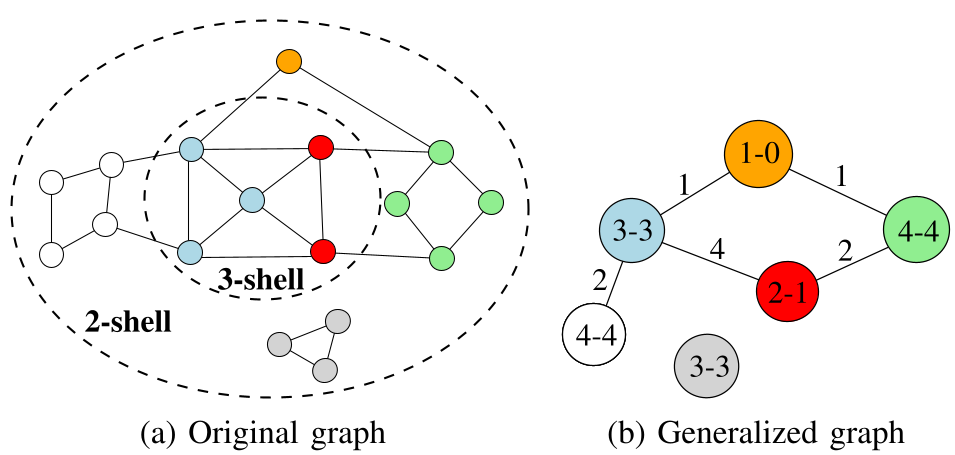 In the figure above, a 17-vertex graph is condensed into 6 super-vertices. Note how the "colors" (clusters) and layers remain distinct.
Experiments & Performance
The authors tested their approach against synthetic (Erdős-Rényi, Barabási-Albert) and real-world networks (Polblogs, Karate Club).
Key Findings:
- High Precision: On political blog data (Polblogs), the method achieved a precision index of nearly 1.0, meaning that a community detection algorithm run on the summarized graph would find the same communities as on the original graph.
- Structural Fidelity: Unlike standard clustering (like Fastgreedy), the k-shell approach preserves the Degree Distribution of the network, which is critical for understanding how information spreads.
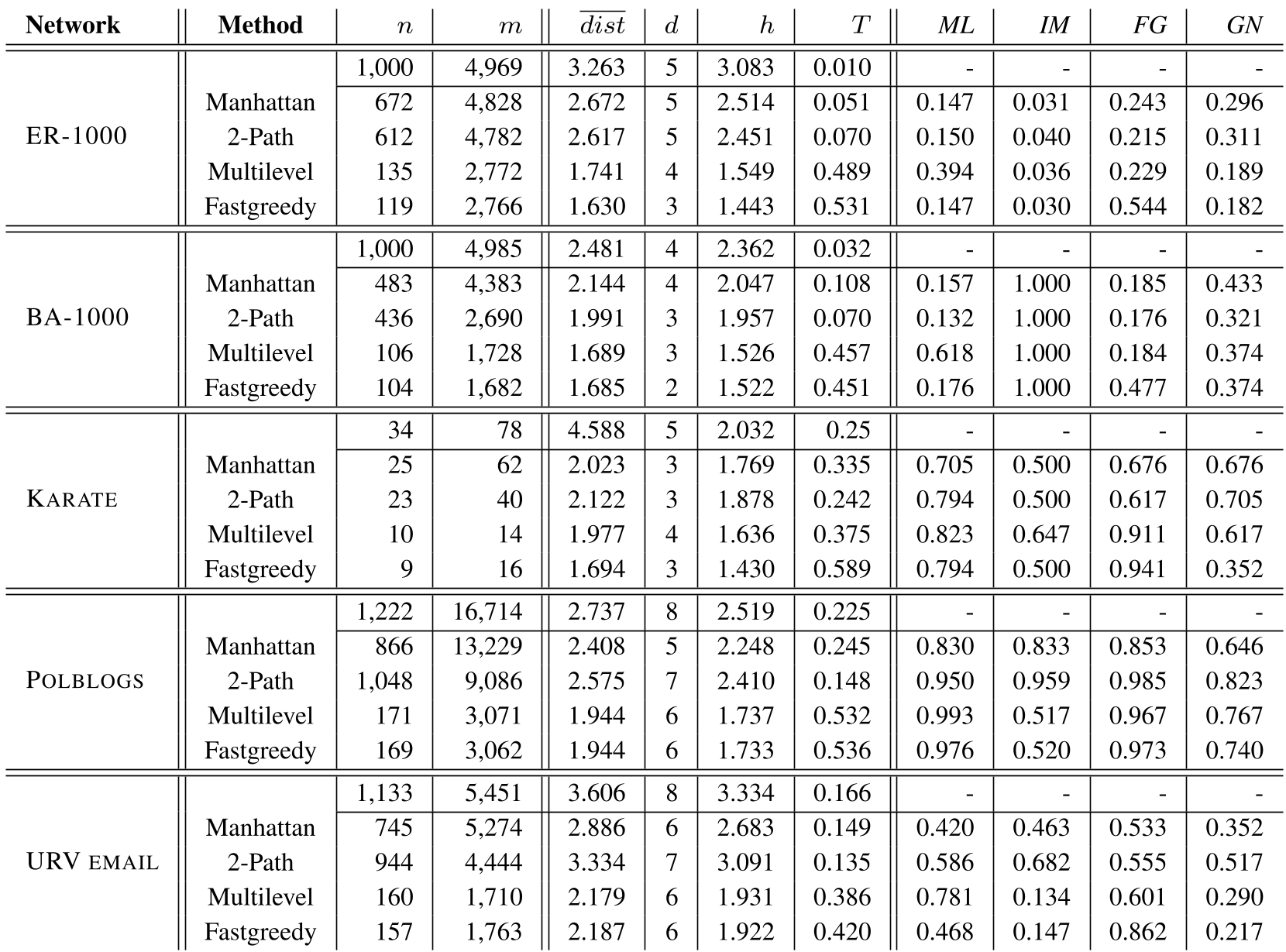 The table shows that Manhattan-based generalization maintains structural metrics like transitivity and average distance much closer to the original values than aggressive clustering.
Critical Insight & Conclusion
Why does this work so much better than just clustering? Clusters represent "hubs," but K-Shells represent "layers."
By ensuring that a "core node" only merges with another "core node," the algorithm maintains the hierarchical hierarchy of the network. The Takeaway is clear: If you want to anonymize a graph for research, don't just group nodes that are "near" each other; group nodes that play the "same role" in the network's hierarchy.
Limitations: The current method is designed for undirected/unlabeled graphs. Future work is needed to handle directed "influence" edges and rich node attributes simultaneously.