
CRDNT: Optimizing Opportunistic Social Networks through Community Recombination
Community recombination and duplication node traverse algorithm in opportunistic social networks
This paper proposes the Community Recombination and Duplication Node Traverse (CRDNT) algorithm for opportunistic social networks. It leverages node social attributes and similarity factors to restructure communities and filter redundant nodes, achieving a state-of-the-art delivery ratio of 0.91.
Executive Summary
TL;DR: The paper introduces CRDNT, a novel routing algorithm that treats mobile devices as social nodes. By recombining communities based on node similarity and filtering duplicate nodes using an AVL-tree structure, it achieves a 91% delivery ratio and slashes latency by 75% compared to traditional "blind" forwarding protocols.
Context: In the landscape of Opportunistic Social Networks (OSNs), this work sits as a significant structural optimization study. It moves the needle from simple probabilistic forwarding (like PRoPHET) toward an architecturally aware approach that reorganizes the network topology to maximize resource efficiency.
The Problem: The "Flooding" Pandemic in OSNs
Current opportunistic routing often relies on two extremes:
- Epidemic Routing: Every node copies everything to everyone. It’s effective for delivery but annihilates the cache and ruins overhead.
- Spray and Wait: Limits copies but often "sprays" to the wrong nodes, leading to long waits and incomplete paths.
The core motivation for CRDNT is that nodes are not just carrying data; they are social agents with predictable trajectories and relationships. Ignoring these social attributes leads to "duplication nodes" that occupy bandwidth without contributing to the final delivery.
Methodology: Social-Aware Community Restructuring
The CRDNT algorithm operates on a three-pillared definition of node behavior:
- Node Similarity Degree: Measures the shared neighborhood between nodes.
- Node Central Degree: Quantifies a node's hub-like status in the network graph.
- Mobile Connect Degree: Captures how frequently a node's neighbors change, indicating its potential to bridge disparate communities.
The "How": AVL-Tree and Modularization
The authors treat the network as a modular system. To solve the complexity of finding the best community structure, they use a Balanced Binary Tree (AVL tree) initialization. By calculating the Module Independence Degree (Q-value), the algorithm determines whether a node should join a community or be excluded as a "duplication" that doesn't add value.

The workflow follows four sub-algorithms:
- Initializes the relationship matrix.
- Constructs and balances the AVL tree for community hierarchy.
- Distinguishes non-overlapping communities.
- Traverses and filters duplication nodes to refine the structure.
Experiments & SOTA Results
The researchers used the Opportunistic Network Environment (ONE) simulator with a map-based movement model (SPMBM) that reflects real-world city mobility (parks, shops, streets).
Key Performance Indicators:
- Delivery Ratio: CRDNT reached 0.91, significantly outperforming PRoPHET (~0.7) and Epidemic (~0.6).
- Overhead: While Epidemic and Spray and Wait saw overhead spikes as time increased, CRDNT remained stable by accurately predicting "transmitting neighbors."
- End-to-End Delay: By using social trajectories, CRDNT reduced the "waiting time" inherent in Spray and Wait by 75%.
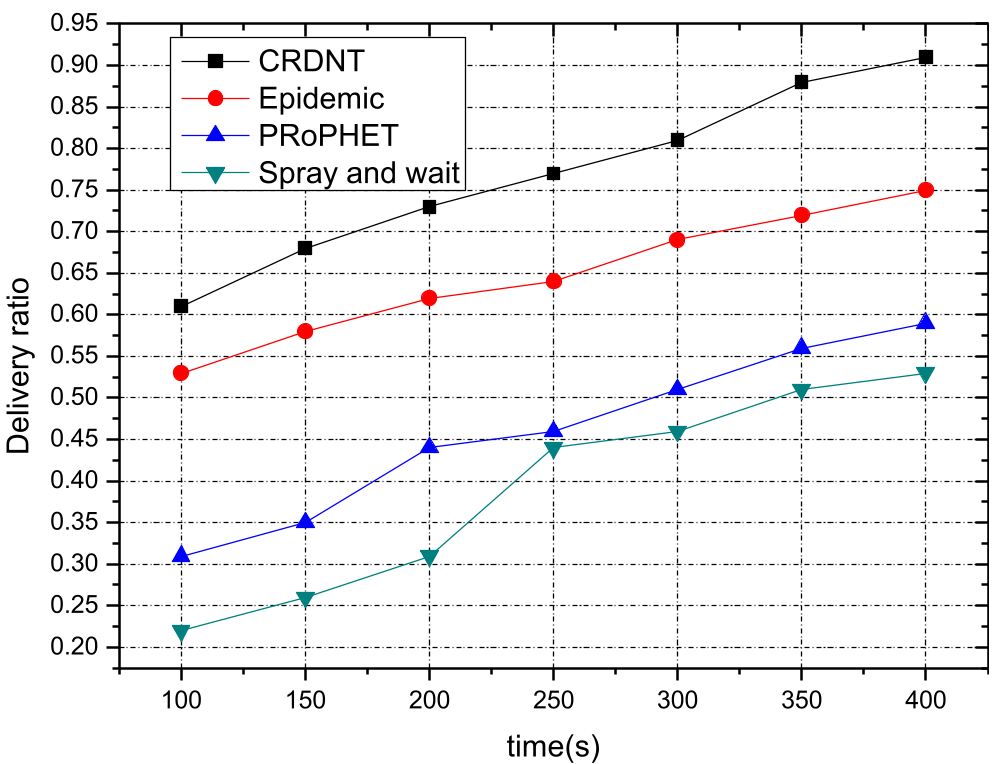 Figure: CRDNT consistently maintains the highest delivery ratio over time.
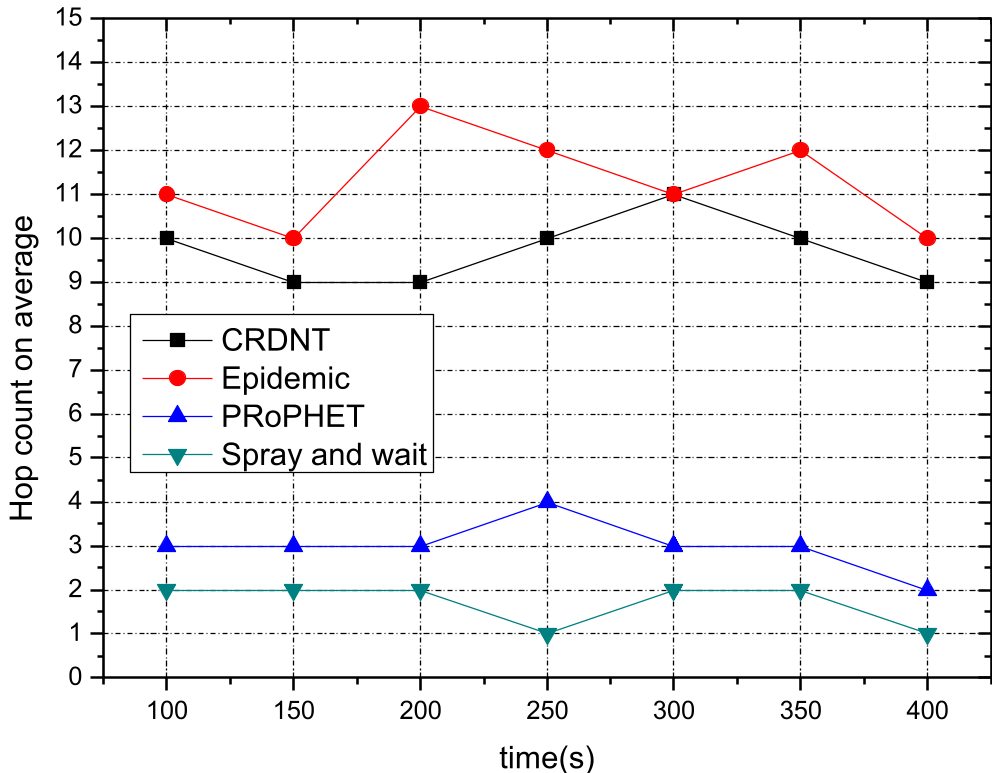 Figure: CRDNT maintains a low overhead (30-60 range), proving its resource efficiency.
Critical Insight & Conclusion
The brilliance of CRDNT lies in its Filtering Logic. Most algorithms focus on who to send to; CRDNT focuses on which nodes are redundant. By identifying duplication nodes through the AVL-tree traverse, the system ensures that the limited cache of mobile devices is used only for high-probability paths.
Limitations: The algorithm's performance relies heavily on the accuracy of the social relationship matrix. In highly volatile environments where social patterns change abruptly (e.g., emergency evacuations), the "Similarity Degree" might lag behind reality.
Future Outlook: For researchers, the next step is integrating Energy Harvesting and Data Security into this social framework. As nodes become more heterogeneous (drones, smartphones, wearable sensors), the community recombination logic will need to account for power-constrained lifetimes.
Takeaway: Effective OSN routing is not about making more copies—it's about making smarter communities.