
Deciphering the Echo Chambers: Community Sentiment on Climate Change in Social Networks
Community Sentiment on Environmental Topics in Social Networks
This paper presents a framework for monitoring environmental discourse on Twitter by combining retweet network analysis with community-specific sentiment classification. Utilizing a dataset of 15 million tweets, the authors identify influential communities (Activists, Sceptics, Celebrities, Media) and map their unique emotional leanings toward 14 distinct environmental topics.
TL;DR
Researchers have developed a hybrid methodology to map the "Who," "What," and "How" of environmental discourse on Twitter. By analyzing over 15 million tweets through the lens of retweet networks and SVM-powered sentiment analysis, the study reveals how distinct communities—ranging from radical activists to climate sceptics—perceive specific topics like fracking and renewable energy. The results show a clear segregation of sentiment that mirrors real-world policy antagonisms.
Background: Beyond the "Million Follower Fallacy"
In digital advocacy, the number of followers a user has is often a "vanity metric" that doesn't reflect actual influence. This paper builds on the intuition that retweeting is an act of agreement. By focusing on who retweets whom, the authors can move past individual noise to identify cohesive ideological communities. Their goal is to provide policy makers with a tool to monitor how different interest groups respond to environmental regulations in real-time.
Methodology: High-Resolution Social Mapping
The authors' approach is a three-tier pipeline:
- Network Construction: They built a massive graph of 2.1 million users. Using the Louvain Method, they maximized modularity to find clusters of people who "talk to each other" via retweets.
- Influencer Identification: They defined influence not by followers, but by the cumulative weight of retweets a user receives within the network.
- Community-Weighted Sentiment: Instead of a simple average of "happy" or "sad" words, they used a Support Vector Machine (SVM) trained on 1.6 million tweets. Crucially, they weighted the sentiment by the retweet count, ensuring that an influential user's opinion "weighs" more in the community's overall score.
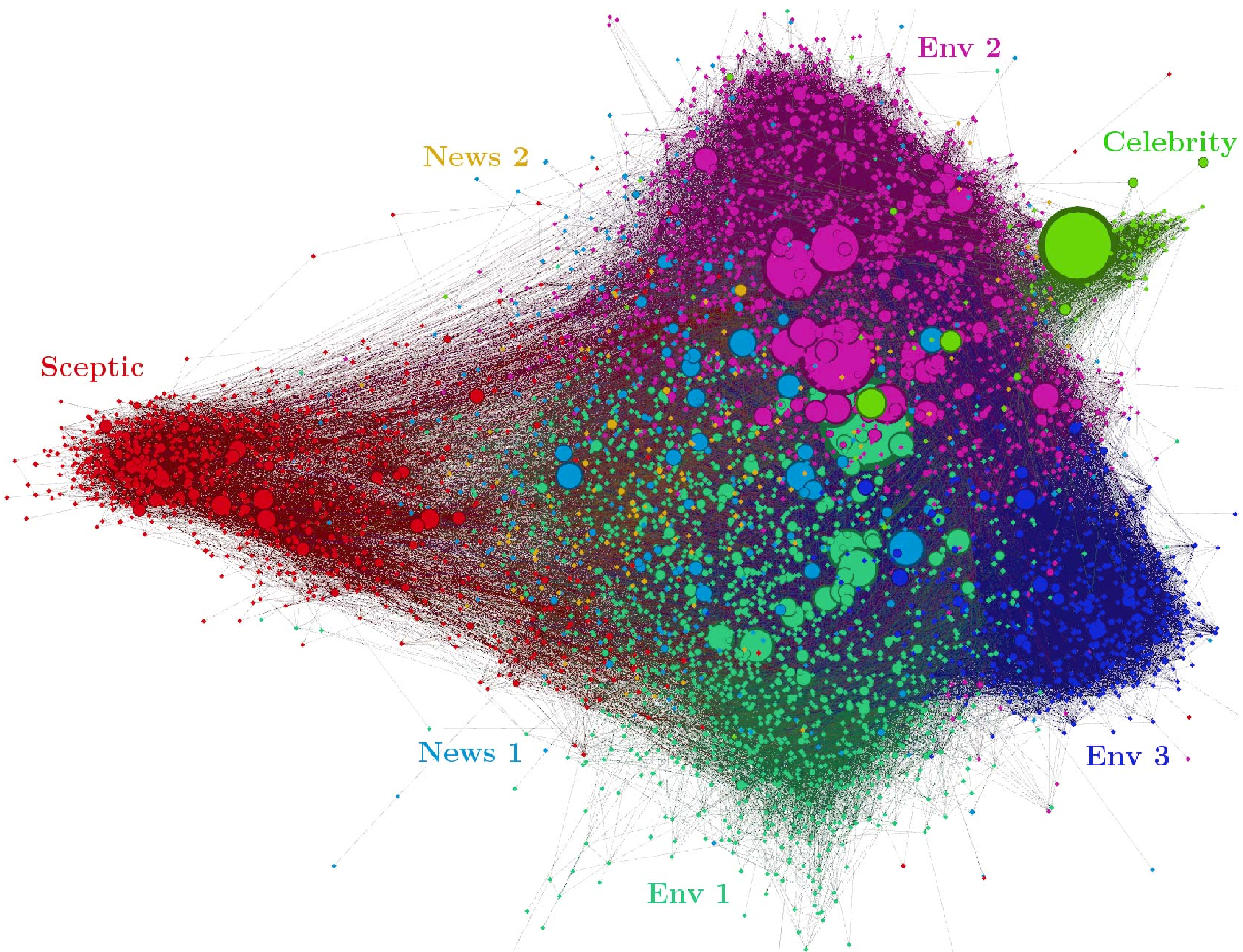 Figure: Subgraph of the retweet network showing clear segregation between communities like 'Env 1' (Activists), 'Sceptic', and 'Celebrity'.
The "Sceptic" Anomaly and "Celebrity" Influence
The study's most striking findings come from comparing the Sentiment Leanings across 14 topics.
- The Sceptic Community: While most groups (Activists, News, etc.) showed a positive leaning toward "Renewables" and a negative leaning toward "Pollution," the Sceptic community was inverted. They were the only group with a significantly positive stance on fracking, oil, and gas, and the most negative toward sustainability.
- The Celebrity Factor: Users like Ian Somerhalder represent a unique bridge. Although the "Celebrity" community produces a low volume of unique content, their reach is astronomical. However, their sentiment is often highly polarized, likely due to the use of "opinionated language" intended to provoke engagement.
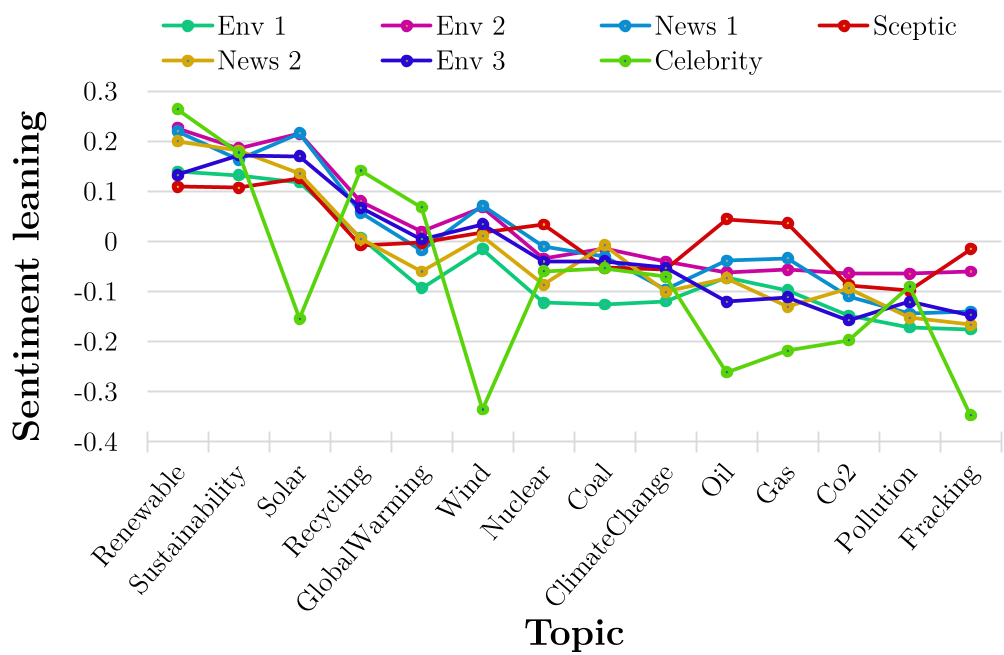 Figure: The sentiment 'tilt' of different communities. Notice how the Sceptic community (purple) consistently diverges from the pro-environmental baseline of the others.
Critical Insight: Why This Matters
The core contribution here isn't just "sentiment analysis"—which is common—but the structural contextualization of sentiment. By proving that the "Sceptic" community is structurally isolated (as seen in the network graph) and ideologically contrary (as seen in the sentiment chart), the authors demonstrate that Twitter is not a single public square, but a collection of distinct, self-reinforcing echo chambers.
Limitations & Future Outlook
The authors acknowledge a key weakness: they used a generic sentiment model (trained on emoticons) rather than a domain-specific one. In the jargon-heavy world of environmental policy, words like "nuclear" or "biomass" carry complex emotional weights that simple classifiers might miss. Future work intends to use expert-labeled "environmental" datasets to refine these insights.
For industry and policy stakeholders, this research provides a blueprint for identifying which "community" a piece of disinformation or a new green policy is likely to resonate with, allowing for more targeted communication strategies.