
The Power of the Clique: How Community Structure Stabilizes Behavior in Social Networks
Community structure promotes the emergence of persistence behavior in social networks
This paper investigates the evolution of cooperation in real-world social networks (SCN and PGP) using the Prisoner's Dilemma game model. It demonstrates that community structure significantly stabilizes individual strategies, leading to "persistence behavior" where nodes—especially small-degree followers—firmly adopt the strategies of their local hubs.
TL;DR
In the complex dance of social cooperation, why do some groups remain steadfastly helpful while others succumb to selfishness? This paper reveals that the "Community Structure"—the tendency for people to cluster into tight-knit groups—is the secret ingredient that promotes Persistence Behavior. By analyzing real collaboration and trust networks, the researchers show that these clusters protect individuals from strategic uncertainty, effectively allowing local "hubs" to dictate long-term cooperation or defection.
Background: Beyond Random Connections
In the study of Complex Networks, we often talk about "Scale-Free" properties (the rich get richer) or "Small-World" effects (six degrees of separation). However, real-world social networks like the Scientific Collaboration Network (SCN) and the PGP trust network have a more distinct feature: Modularity. People don't just connect randomly; they form communities. This paper shifts the focus from "how much" cooperation exists to "how stable" that cooperation is within these communities.
The core Dilemma: To Cooperate or Defect?
The researchers used the Weak Prisoner's Dilemma (PD). In this game, individuals choose between Cooperation (C) and Defection (D). While mutual cooperation yields a reward (), the temptation to defect () can lead to a "race to the bottom" where everyone loses.
The critical insight here is how strategies update. In a network, you don't just play against the world; you learn from your neighbors. If a neighbor has a higher payoff, you are likely to copy their strategy.
Methodology: Social Networks vs. The Chaos of Randomness
The authors compared two real networks against Null Models (versions of the same networks where connections were shuffled but the number of friends per person stayed the same).
 Table 1: Notice the massive difference in Clustering Coefficient () and Modularity () between real networks and their Null Models.
Key Findings: The "Anchor" Effect of Hubs
The research identifies three types of players in the steady state:
- Pure Cooperators (PureC): Never change their mind; always help.
- Pure Defectors (PureD): Consistently selfish.
- Fluctuating Individuals (FI): The "drifters" who flip-flop between strategies.
1. Communities Reduce Neutrality
In the Null Models, where community boundaries are erased, the system is filled with Fluctuating Individuals. Without the protective "shell" of a community, small-degree nodes are constantly buffeted by different signals from across the network.
2. The Hub-Follower Dynamic
In real social networks, hubs (nodes with many connections) usually stick to cooperation because their high volume of interactions keeps their payoffs stable. Because of the community structure, small-degree nodes primarily interact within the hub's "fiefdom." They observe the hub’s success and mimic it, leading to a "persistence" of behavior that is much rarer in randomized networks.
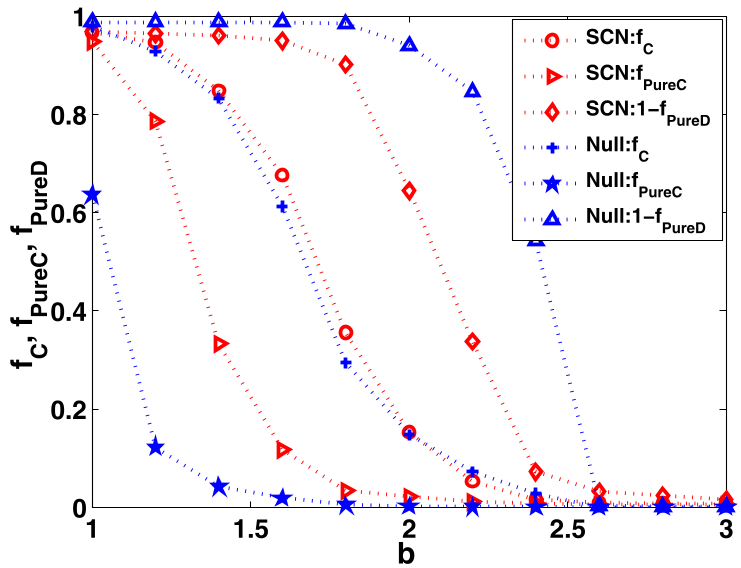 Fig 2: Evolution of cooperation (fC) and pure strategies (fPureC) as temptation (b) increases. Note how pure strategies persist longer in SCN than in the null model.
Deep Insight: Positive and Negative Feedback Loops
The paper highlights a fascinating feedback mechanism:
- Positive Feedback: When neighbors learn from a cooperative hub, the hub's payoff increases (more people to cooperate with), reinforcing its cooperation.
- Negative Feedback: If a hub defects, its neighbors eventually defect too. This causes the hub's payoff to plummet, forcing the hub to eventually switch back to cooperation to survive.
Conclusion and Future Outlook
This study proves that the topology of our society dictates the persistence of our ethics. Communities act as social "incubators" where strategies can take root without being immediately extinguished by external noise.
Limitations: The model assumes replicator dynamics (learning from others). In the real world, human psychology involves more than just copying the most successful neighbor; it involves institutional memory and direct reciprocity.
Takeaway: If you want to foster long-term cooperative behavior in an organization or online platform, building tight-knit sub-communities is more effective than creating a "global" open marketplace. Local hubs are the keys to cultural persistence.