
Social Circuits: Finding Community Structure through Electric Circuit Modeling
Finding Community Structure in Social Network by Electric Circuit Modeling
This paper proposes an improved community detection algorithm that models social networks as electric circuits. By quantifying edge currents and utilizing modularity maximization, the method identifies community boundaries with high accuracy and low computational complexity across unweighted and weighted graphs.
TL;DR
Researchers have developed a method to treat social networks (like Facebook friendships or Twitter follows) as electric circuits. By simulating current flow across the network, the algorithm identifies "high-voltage" edges that act as bridges between communities. By cutting these high-current bridges and maximizing a quality metric called "Modularity," the system can automatically group people into communities with higher accuracy and speed than legacy algorithms.
Background & Positioning
In the landscape of network science, finding Community Structure—the tendency of nodes to form dense clusters—is the key to understanding everything from functional biology to viral marketing. Historically, we had a trade-off: use accurate but heat-death-of-universe slow algorithms like Girvan-Newman (), or use fast algorithms that required you to "guess" the number of communities beforehand (like the Wu-Huberman approach).
This paper introduces a "Physics-Intuitive" middle ground that achieves SOTA accuracy without needing prior information about the network's size or structure.
The Core Insight: Networks as Circuits
Why use electricity? In a social graph, if two people (nodes) are closely related, the "resistance" between them is low. If they are strangers, the resistance is high.
By applying a random voltage to nodes and solving the system using Kirchhoff’s Laws, the authors discovered that edges connecting two different communities act like narrow bridges. These bridges are forced to carry much higher "current" compared to edges nestled safely within a dense community.
The Methodology
- Modeling: Represent nodes as terminals and edges as resistors ( = 1 for unweighted; for weighted).
- Simulation: Assign random voltages ( to ) and solve the voltage for each node:
- The Cut: Identify the edge with the largest current () and remove it.
- Optimization: Monitor Modularity (Q). As you cut edges, increases. The moment starts to drop, the algorithm stops, signaling the "perfect" division.
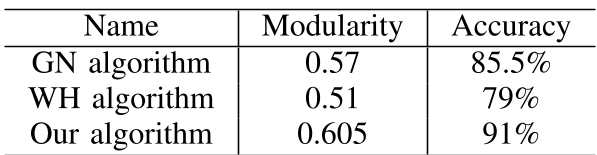 Table 1: The proposed method outperforms classic GN and WH algorithms in both Accuracy and Modularity.
Experiments and Results
The authors validated their approach on three distinct benchmarks:
- Zachary’s Karate Club: A classic 34-node social network. The algorithm correctly split the club into 3 groups with 0.374 modularity, misclassifying only a single node.
- US College Football: A complex network of 11 conferences. The algorithm achieved 91% accuracy, far exceeding the GN algorithm's 85.5%.
- Les Miserables: A weighted network based on character co-occurrences in the novel. The algorithm successfully identified 6 core character clusters.
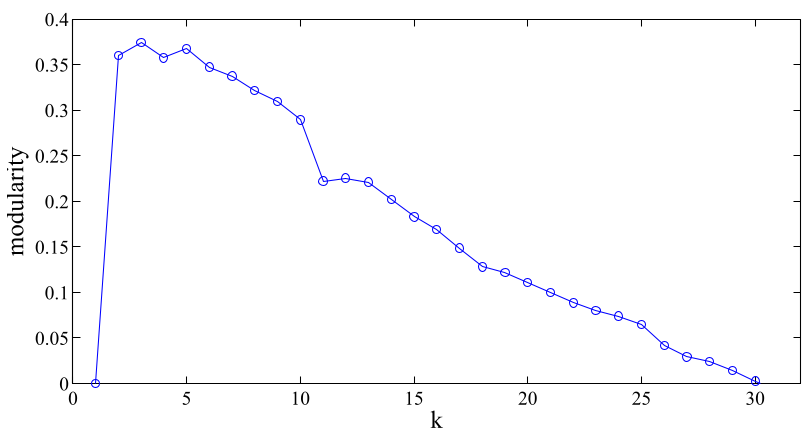 Fig 1: The peak in this curve represents the "Goldilocks" zone—the exact point where the community division is most meaningful.
Critical Analysis & Conclusion
The beauty of this research lies in its computational efficiency. While the worst-case complexity is , for sparse "real-world" networks, it approaches (linear with the number of edges).
Takeaway: This work demonstrates that transitioning from purely topological metrics (like betweenness) to physical flow metrics (like current) provides a more robust and faster way to navigate large-scale social data.
Limitations: While effective, the reliance on random voltage initializations suggests that for extremely massive graphs, multiple "runs" might be needed to ensure the current distributions stabilize, potentially adding a hidden constant factor to the runtime.
Future Outlook: Expect to see this circuit-modeling approach applied to web-graph analysis and protein-protein interaction networks where the sheer number of edges makes strategies obsolete.