
A Comparative Analysis of Industrial vs Traditional Cooking for Chinese Dishes: Why Most Nutrients Barely Differ, but Vitamin B6 Does
A comparative analysis of nutritional content changes in six Chinese cuisines prepared using industrial versus traditional hand-cooked modes
This paper is a comparative food nutrition study evaluating how six popular Chinese dishes change nutritionally when prepared by industrial cooking versus traditional hand-cooking. Its core methodological contribution is a dry-matter-normalized before/after comparison with inter-group statistical testing, designed to remove moisture-induced bias. The main finding is negative rather than headline SOTA: across most measured nutrients, industrial cooking does not significantly differ from traditional cooking, except that vitamin B6 retention is significantly better in industrial mode.
Executive Summary
TL;DR. This paper asks a very practical question: are industrially prepared Chinese dishes nutritionally worse than traditional hand-cooked versions? Using six representative dishes and a careful dry-matter normalization protocol, the authors show that for most macronutrients, fatty acids, vitamins, and minerals, the answer is no statistically significant difference. The one consistent exception is vitamin B6, whose retention is significantly lower in traditional hand-cooking than in industrial cooking.
Where this work sits in the landscape. This is not a flashy “new method” paper in the machine learning sense; it is a measurement-and-comparison study that addresses a real gap in food science. Its value lies in methodological fairness: instead of comparing cooked foods on a naive wet basis, it corrects for moisture changes and asks a cleaner question about nutrient retention. That makes the conclusions much more credible than many everyday discussions about “processed food” versus “home cooking.”
Problem & Motivation
There is a strong consumer intuition that industrially prepared dishes should be nutritionally worse than hand-cooked food. That intuition is not unreasonable:
- Industrial food often involves reheating, centralized processing, or prolonged thermal exposure.
- Prepared dishes are frequently associated with flavor deterioration, lipid oxidation, or excessive processing.
- Prior literature has shown that heat-sensitive nutrients can degrade under high temperature or long cooking times.
But there is a major scientific problem: most apparent nutrient changes after cooking are confounded by water.
If one dish loses more moisture than another, its nutrient concentration per 100 g can rise even if the absolute nutrient amount did not improve. Conversely, if water or broth is retained differently, nutrients can appear diluted. So a superficial comparison between industrial and home cooking can easily mistake moisture concentration effects for true nutrient retention.
That is the central motivation of this paper. The authors are effectively saying:
- Compare the same dish under the same recipe.
- Normalize nutrient values to dry matter basis.
- Evaluate relative change from raw ingredients to cooked product.
- Then test whether industrial cooking systematically differs from hand-cooking.
This is the right question, and more importantly, it is asked in a way that avoids one of the biggest traps in cooking-nutrition studies.
Methodology - The Core
Study design
The authors selected six common Chinese dishes based on market popularity:
- Braised Pork in Brown Sauce (BPBS)
- Braised Beef with Radish (BBR)
- Steamed Pork with Preserved Vegetables (SPPV)
- Braised Tomato Beef (BTB)
- Braised Beef with Potatoes (BBP)
- Braised Pork Ball in Brown Sauce (BPBBS)
For each dish, ingredients were prepared according to standardized recipes and split into three parts:
- one uncooked control
- one industrial-cooked version
- one traditional hand-cooked version
This is conceptually important because it reduces ingredient-level variance. The paper is not comparing different commercial products against different home recipes; it is comparing cooking modes applied to the same formulation.
Why dry matter normalization matters
The most important technical move in the paper is moisture correction.
The authors measured raw and cooked water content and then reported nutrients on a dry matter basis. They quantified nutrient change as:
- nutrient content in cooked dish / nutrient content in raw ingredients
- expressed as a relative percentage
The intuition is simple:
- If cooking evaporates water, wet-basis nutrient concentration can artificially increase.
- Dry-matter correction tries to isolate genuine chemical or physical nutrient changes.
- This makes industrial vs traditional comparisons substantially fairer.
In food analysis terms, this is a strong design choice because it separates:
- concentration artifacts
- from retention, degradation, leaching, and release effects
Measurement scope
The paper is broad in analytical coverage. It includes:
- Macronutrients: protein, fat, cholesterol, dietary fiber, sugars
- Vitamins: B1, B2, B3, B6, A, D, E
- Fatty acids: total FAs, SFA, MUFA, PUFA, TFA
- Minerals: Ca, Cu, Fe, K, Mg, Mn, Zn
Analytical methods include HPLC, GC-FID, AOAC protocols, and ICP-OES, with triplicate measurements and QC samples. This breadth matters because cooking does not affect all nutrients through the same mechanism:
- proteins mainly undergo denaturation and leaching
- lipids undergo oxidation and extraction changes
- water-soluble vitamins suffer from heat and leaching loss
- minerals can increase due to release from tissue or migration from cookware
Statistical logic
The final comparison uses an independent t-test to assess whether the nutrient-change distributions differ between industrial and hand-cooked modes.
This means the paper is not asking whether cooking changes nutrients at all — clearly it does. It asks something more targeted:
Given that both modes alter nutrients, do they alter them differently enough to be statistically distinguishable?
That framing is much more useful for the prepared-food industry.

Experiments & Results
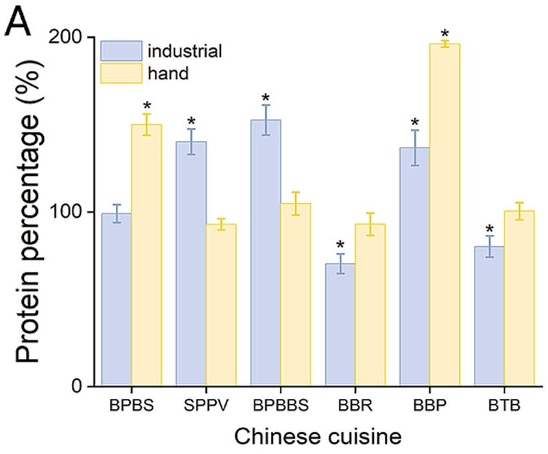
1. Macronutrients: mostly stable, with dish-specific variation
The broad result is that macronutrients remain relatively stable across both cooking modes. Most changes are within 20%, though some dishes show larger deviations.
Key observations:
- Protein sometimes increased and sometimes decreased, depending on dish.
- Fat was largely stable except for a more obvious change in Braised Tomato Beef under industrial cooking.
- Cholesterol tended to increase in animal-based dishes, likely because thermal processing released cholesterol from bound forms.
- Sugar changed little in most dishes, except BPBS where it increased sharply due to added sugar for browning.
- Dietary fiber declined across all dishes, roughly 6.5% to 47.8%.
The mechanistic interpretation is reasonable:
- Protein: cooking denatures proteins and can improve digestibility, but measured content can fall if soluble nitrogenous compounds leach out.
- Dietary fiber: heat and water exposure degrade fiber structure and can dissolve soluble fiber fractions.
- Sugar: can decrease via thermal chemistry, but recipe additions can dominate the signal.
Crucially, despite these within-dish changes, the industrial-vs-traditional difference was not statistically significant for these categories.
2. Vitamins: the paper’s most important finding
This is where the study becomes most interesting.
Fat-soluble vitamins
Vitamins A and D changed relatively little, in the range of 2.6% to 39.4% across most dishes. Vitamin E generally increased.
Why might vitamin E rise?
- cooking oils may contribute tocopherols
- heating can disrupt tissue structure and release lipophilic compounds more efficiently
So the increase does not necessarily imply “synthesis”; it likely reflects enhanced extractability or added oil contribution.
Water-soluble vitamins
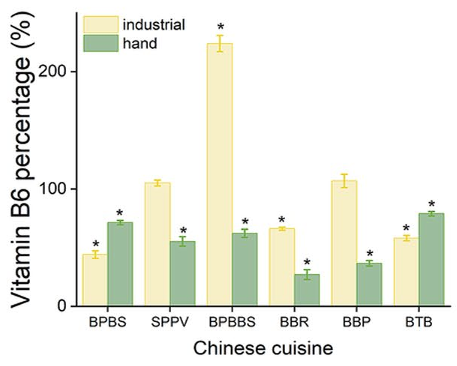
Vitamins B1, B2, B3, and B6 all declined after cooking in both modes.
This is expected:
- they are heat-sensitive
- they are oxidation-sensitive
- they can leach into cooking liquid during steaming or stewing
But the critical result is that only vitamin B6 showed a significant between-mode difference:
- traditional hand-cooking retained less vitamin B6
- industrial cooking retained more vitamin B6
- the difference reached p < 0.05
The authors attribute this to industrial equipment using more efficient heating, possibly electromagnetic heating, which reduces total heating time and limits degradation of heat-sensitive nutrients.
This is a plausible explanation. In nutrient retention problems, time-at-temperature often matters as much as absolute peak temperature. Industrial systems can sometimes outperform domestic cooking not because they are gentler in principle, but because they are:
- more controlled
- more uniform
- more repeatable
- less prone to prolonged overcooking
3. Fatty acids: composition tracks total fat, no mode-level difference
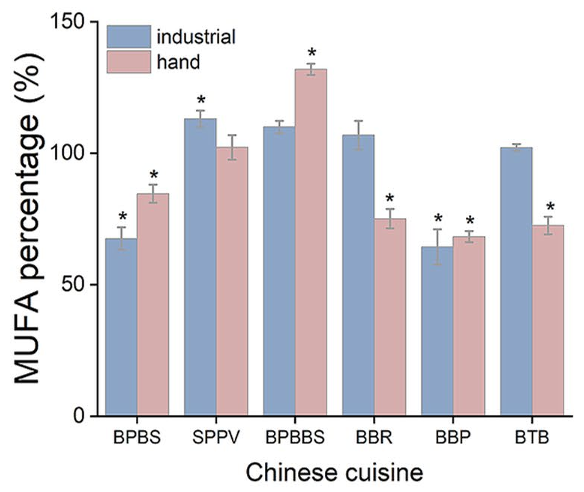
Fatty acids showed moderate dish-dependent increases or decreases:
- some dishes lost 12.7% to 40.2% of FAs under industrial cooking
- others increased by 18.9% to 45.9%
- home cooking showed a similar mixed pattern
The composition of:
- SFA
- MUFA
- PUFA
- TFA
generally followed the trend in total fat content.
The chemistry is standard:
- PUFAs are more oxidation-prone at high temperature
- oxidation and decomposition can reduce measured unsaturated fatty acids
- extraction and release from tissues can also increase apparent content in the final dish
The important take-home is that fatty acid ratios and distribution were broadly consistent across the two modes, and no significant industrial-versus-traditional difference was detected.
4. Minerals: often increased after cooking
Minerals behaved differently from vitamins.
The general trend was moderate increase in Mg, K, Ca, Fe, Cu, Mn, and Zn for most dishes, especially under stewing-based preparation. Possible explanations include:
- release of intracellular minerals due to tissue breakdown
- concentration changes after cooking
- migration of metal ions from cookware into food
- incomplete recovery of cooking liquid in steaming scenarios, which can instead reduce measured content
One interesting observation is that divalent metals tended to show larger increases, which the authors link to stronger protein-complex formation behavior.
Again, the key inferential point is not whether minerals changed — they did — but whether the pattern of change differs by cooking mode. The answer remains: not significantly.
Why the conclusion is stronger than it first appears
At first glance, “no significant difference” might sound uninteresting. In fact, it is the paper’s main contribution.
In public discourse, industrial food is often treated as automatically nutritionally inferior. This study suggests that, at least for these six Chinese dishes under controlled recipe conditions, that claim is too simplistic.
The deeper message is:
- Cooking mode alone is not the dominant determinant for most nutrients.
- Nutrient outcomes are driven by a combination of:
- heating time
- temperature profile
- water contact
- ingredient matrix
- oil addition
- broth retention
- extraction effects
- cookware interaction
Once moisture is properly corrected, the global nutritional gap between industrial and hand-cooking becomes much smaller than people expect.
That is a valuable result for both science and industry.
Ablation-style interpretation: which nutrient classes are actually sensitive?
Although this is not an ML paper with a formal Ablation Study, we can still read the results in an “ablation-like” way by asking which nutrient classes are truly discriminative.
Low sensitivity to cooking mode
These categories changed with cooking but did not distinguish industrial from traditional mode:
- protein
- fat
- cholesterol
- sugar
- dietary fiber
- fat-soluble vitamins A and D
- vitamin E
- fatty acid classes
- minerals
This suggests that for these variables, the dominant effect is cooking itself, not whether the cooking is industrial or manual.
High sensitivity to cooking mode
Only one category showed a statistically significant between-mode difference:
- vitamin B6 retention
This makes B6 the paper’s most informative “indicator variable” for process optimization.
If I were designing a follow-up study or a product QC program, I would prioritize:
- vitamin B6 as a sentinel marker
- time-temperature profiles
- broth-loss accounting
- heating uniformity
- packaging and reheating interactions
Critical Analysis & Conclusion
What this paper really contributes
The paper’s real contribution is not a new biochemical mechanism. It is a better framing of a practical comparison.
Specifically, it shows that:
- dry-matter normalization is essential for fair cooking comparisons
- many widely assumed nutritional differences between industrial and home cooking may be overstated
- micronutrient preservation, not macronutrient preservation, is the more meaningful optimization frontier
- among micronutrients, vitamin B6 appears especially sensitive to process design
Strengths
- Controlled comparison using the same recipes across raw, industrial, and hand-cooked conditions
- Broad nutrient panel, which prevents over-generalization from a single analyte
- Dry matter correction, arguably the most important methodological choice
- Statistical testing, so conclusions are not based on visual pattern-matching alone
- Practical relevance, especially for prepared-dish manufacturing and consumer perception
Limitations
The paper is careful, but several limitations matter.
- Only six dishes were studied, so the generality is limited.
- Chinese cuisine is far broader than this sample, especially in frying intensity, fermentation, soup retention, and ingredient diversity.
- The paper focuses on content change, not bioavailability or bioaccessibility after digestion.
- It measures major nutrient categories, but not deeper structural changes such as:
- protein oxidation states
- lipid oxidation products
- vitamin isomerization
- matrix-driven digestibility changes
- The industrial cooking description is somewhat coarse; more explicit temperature-time trajectories would improve mechanistic interpretation.
In particular, the vitamin B6 result is interesting but still somewhat under-explained. Without direct thermal profiling, it remains a plausible but not fully proven claim that electromagnetic or more efficient industrial heating is the main causal driver.
Future Work
The most promising next steps are clear.
-
Expand dish diversity
- include deep-fried dishes
- include soups with retained broth
- include vegetable-dominant dishes
- include cold-chain reheating products
-
Measure process kinetics
- exact time-temperature curves
- heating uniformity
- oxygen exposure
- reheating cycles
-
Go beyond content to nutritional function
- bioaccessibility after in vitro digestion
- digestibility
- oxidation markers
- structural nutrient transformations
-
Build predictive processing models
- identify which nutrients are most sensitive to industrial parameter changes
- optimize industrial cooking specifically for labile vitamins rather than bulk composition
Final Takeaway
This paper delivers a useful correction to a common assumption: industrialized Chinese dishes are not automatically nutritionally worse than traditional hand-cooked versions. Once moisture effects are removed, most nutrient changes look surprisingly similar across the two modes. The real process-sensitive signal is not bulk nutrition but specific labile micronutrients, with vitamin B6 emerging as the clearest example.
For researchers, the lesson is methodological: always normalize carefully before drawing conclusions about cooking retention. For industry, the lesson is strategic: broad nutritional equivalence may already be achievable, but the next competitive advantage will come from targeted micronutrient preservation.