
The Convergence of Battlefield and Boardroom: Decoding Hybrid Communities of Practice
A Comparative Analysis of Professional Forums in the United States Army and Hybrid Communities of Practice in the Civilian Sector
This paper presents a comparative analysis between U.S. Army Professional Forums (PFs) and civilian Hybrid Communities of Practice (HCoPs). By applying qualitative typologies and expert interviews, it demonstrates that despite divergent organizational cultures, the structural characteristics and Knowledge Management (KM) practices of military and civilian communities are fundamentally converging.
TL;DR
Contrary to the belief that military organizational structures are uniquely insular, this paper reveals that U.S. Army Professional Forums (PFs) and civilian Hybrid Communities of Practice (HCoPs) have effectively converged. By analyzing 21 structural characteristics across giants like Siemens, Caterpillar, and the U.S. Army, the research proves that the "logic of sharing" transcends organizational boundaries—whether the goal is combat effectiveness or corporate profit.
Problem & Motivation: The Myth of Military Uniqueness
For years, both military and civilian leaders operated under the assumption that the Army's "Command and Control" culture required a fundamentally different approach to Knowledge Management (KM). Civilian HCoPs were seen as organic and flexible, while military forums were viewed as structured and rigid.
The authors set out to investigate: Are Army Professional Forums truly "slightly different," as doctrine claims, or are we looking at the same engine under a different hood? The stakes are high; understanding this convergence allows for the cross-pollination of "best practices"—a survival necessity in what the authors describe as an asymmetric and highly adaptive global environment.
Methodology: The Four-Phase Stress Test
The researchers didn't just look at surface-level features; they deep-dived into the structural DNA of these communities using a four-phased approach:
- Typology Mapping: They applied the Dubé et al. framework (covering demographics, organizational context, membership, and IT environments) to Army forums like CompanyCommand and S1 Net.
- Corporate Benchmarking: They compared these results against established case studies from Caterpillar, Siemens, HP, and Rolls Royce.
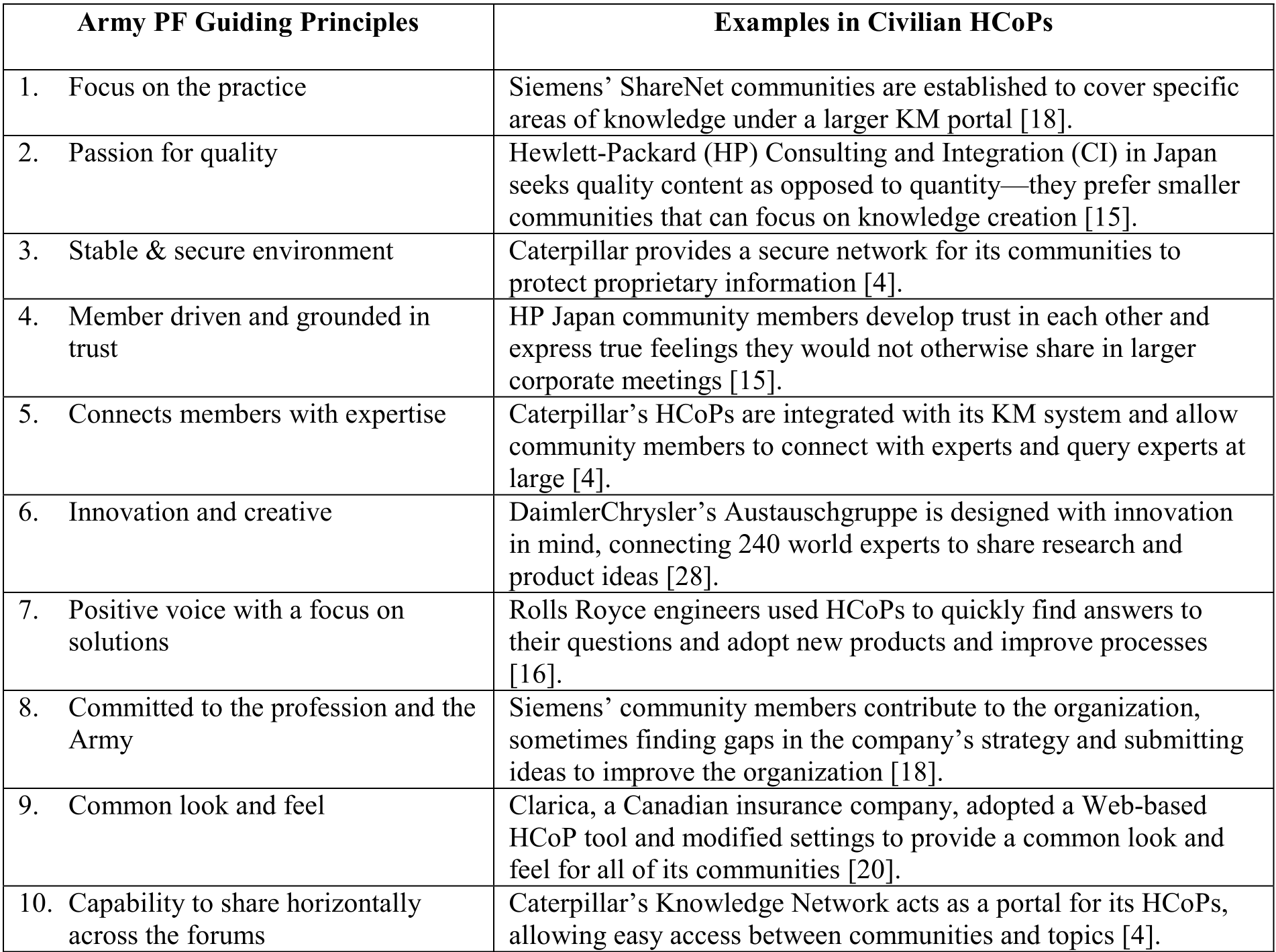
- Principle Alignment: They audited the 10 guiding principles of Army PFs against civilian equivalents.
- Expert Validation: They interviewed the "Founding Fathers" of CoP theory—Etienne Wenger, Kent Greenes, and Hubert Saint-Onge.
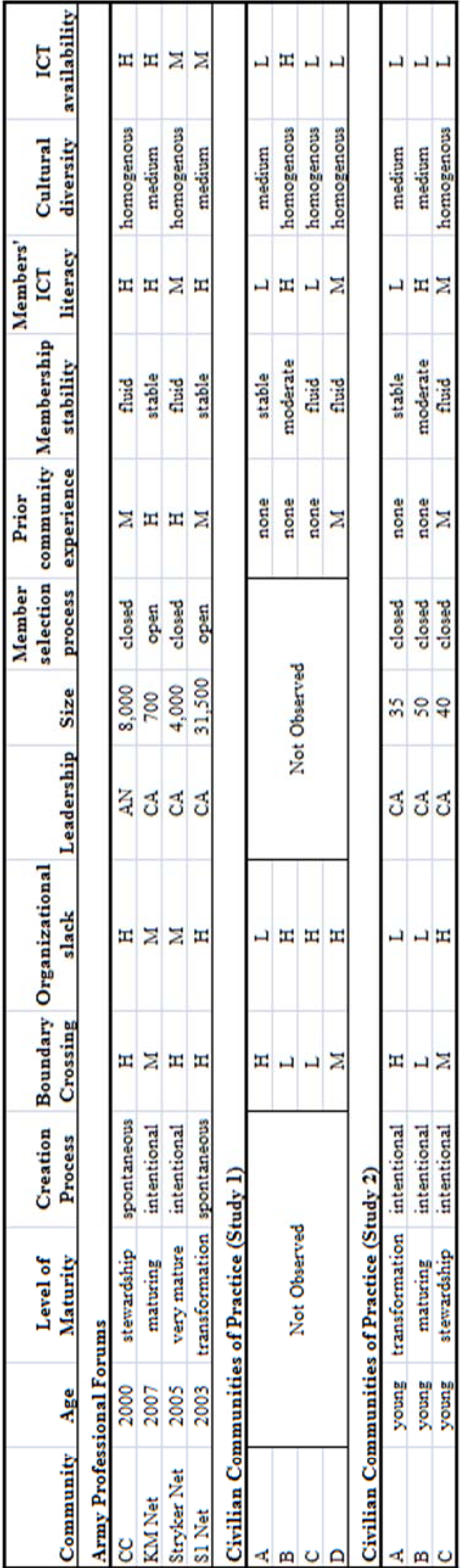
Structural Comparison of Communities
The following table (adapted from the paper) illustrates how varied these communities can be, even within the same organization.
Core Analysis: Why the Gap Vanished
The analysis yielded a striking realization: the differences are cultural, not structural.
- Motivation: Both sectors found that intrinsic motivation (passion for the profession) far outweighs extrinsic rewards (like Siemens' early experiment with "share points" or frequent flyer miles).
- Trust and Security: Just as Caterpillar uses a secure network for proprietary info, the Army uses AKO (Army Knowledge Online) to protect mission-sensitive data.
- Leadership: While the Army assigns "facilitators," the internal dynamics of successful forums like CompanyCommand mirrored the "emergent leadership" seen in high-performing civilian units.
Comparison of Guiding Principles
The convergence is most evident when looking at the operational rules of these forums:
The "Ownership" Insight
A standout finding was Hubert Saint-Onge’s observation: the Army’s CompanyCommand forum is perhaps the global "best-in-class" for domain ownership. In the Army, soldiers felt an intense responsibility for the community’s content because their lives—and the lives of their peers—depended on the quality of the shared knowledge.
However, the civilian sector held a slight edge in content harvesting—the ability to turn messy forum discussions into structured, searchable organizational assets.
Critical Analysis & Conclusion
The paper concludes that we are in a "cycle of imitation." The Army borrows L6S (Lean Six Sigma) from industry; industry borrows logistics and leadership models from the military.
The Key Takeaway: In the age of AI and Web 2.0 (and now 3.0), the "Hybrid" model—merging virtual ease with face-to-face trust—is the definitive architecture for any learning organization.
Limitations: The study acknowledges that "Culture" is a multi-dimensional beast. While the structures match, the "judicial" and "professional norms" (the fear of airing dirty laundry in front of superiors) remain a hurdle that military facilitators must manage more delicately than their civilian counterparts.
Future Outlook: As we move into an era of AI-mediated KM, the challenge will be maintaining the "human passion" that the Army has successfully leveraged, while adopting the technical "content capture" efficiencies of the corporate world.