
Beyond the Small World: Decoding Expert Search Strategies in Social Networks
A Comparative Study of Expert Search Strategies in Online Social Networks
This paper presents a comprehensive comparative study of expert search strategies within online social networks (OSNs), focusing on the effectiveness of Profile-Based (PB), Structure-Based (SB), and Hybrid approaches. Using data from Tribe.net, the study identifies SB(BC) (Best-Connection) as the superior strategy for maximizing success rates in local-information-only routing.
TL;DR
How do you find an expert in a sea of millions when you only know your immediate friends? This paper evaluates how "local information"—who your friends are and what their profiles say—can be used to route queries effectively. The verdict: Trust the "Social Butterflies" (structure) to find the answer, but use their profiles (metadata) to save on the phone bill.
The "Local Knowledge" Dilemma
The "Six Degrees of Separation" theory suggests everyone is connected, but in a massive network like Tribe.net, there is no "Google Maps" for people. Actors must act as routers, deciding which friend to forward a query to based only on what they know locally.
The authors identify a gap in research: most studies look at either who a person is (Profiles) or how many people they know (Structure), but rarely evaluate them side-by-side or in combination to find the optimal hybrid strategy.
Methodology: The Three Pillars of Search
The researchers extracted 135,598 profiles and 3 million relationships from Tribe.net to test three main strategy types:
- Profile-Based (PB): Selecting friends based on similarity in
Occupation,Interest, orLocation. - Structure-Based (SB): Selecting the most "connected" friends (
Best-Connection) or those with the most "unique" social circles (Hamming Distance). - Hybrid: A two-stage process. First, narrow down the friends to a few "hubs," then pick the one with the most relevant profile.
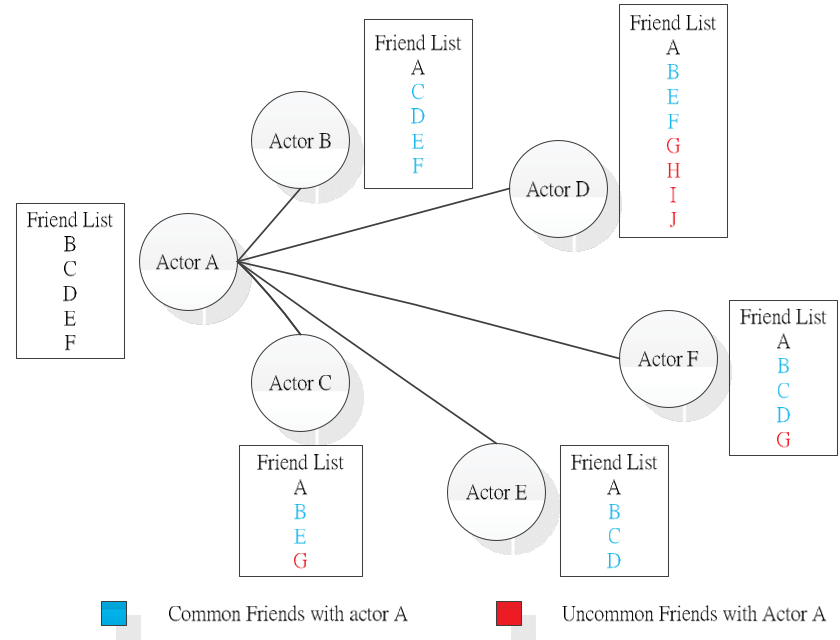 Figure 1: Visualizing structural selection—Actor A must choose between B, C, D, E, or F based on their connectivity and overlap.
Key Results: Structure Trumps Profile
The experimental results were striking. The Best-Connection (SB-BC) strategy, which always forwards to the person with the most friends, reached a success rate of 79.5%. In contrast, the best profile-based strategy (searching by Occupation) barely hit 25.4%.
Why? In online social networks, profiles are often sparse or incomplete (e.g., a few keywords for interests). However, the "Power Law" distribution of social networks means that "hubs" (highly connected people) act as massive directories, making them much more likely to be one step away from the expert than a person who simply shares a job title with the target.
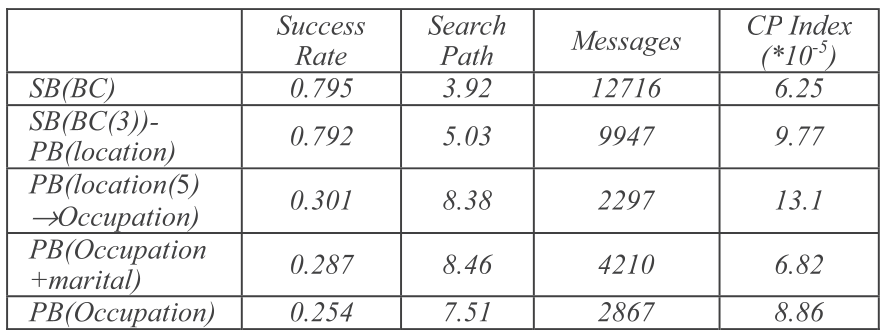 Table 1: The "CP Index" shows that Hybrid strategies (SB(BC(3))-PB) offer the best balance of success vs. message cost.
The Synergy: Efficiency through Hybridization
While skipping structural search is a mistake, using only structure is expensive in terms of "Message Cost" (the number of pings sent across the network). The study found that:
- Hybrid strategies (Structural screening followed by Profile matching) reached nearly the same success rate as pure structural search but with a higher CP Index (Cost-Performance).
- Specifically,
SB(BC(3))-PB(Location)achieved a similar success rate to pure high-degree search but used significantly fewer messages.
Critical Insight & Conclusion
This paper confirms a fundamental truth of social navigation: Topological position is more valuable than topical similarity for routing. In a sparse information environment, a "know-it-all" (high degree) is a better bet than a "look-alike" (high similarity).
Future Outlook: While this study utilized VSM (Vector Space Models) for similarity, today’s LLM-based embeddings could potentially revive Profile-Based strategies by extracting deeper semantic meaning from even sparse profiles, potentially closing the gap between structural and profile-based search.