
AI Robots and the Privacy Frontier: Why Traditional Law is Failing and How "Privacy by Design" Can Save It
Comparative legal study on privacy and personal data protection for robots equipped with artificial intelligence: looking at functional and technological aspects
This paper presents a comparative legal study on privacy and data protection for AI-equipped robots across the EU, USA, Canada, and Japan. It identifies core challenges such as profiling, algorithmic bias, and transparency, advocating for the international adoption of Privacy by Design (PbD) as the primary regulatory framework.
Executive Summary
As Artificial Intelligence (AI) transitions from digital algorithms to physical robotic agents—from autonomous drones to nursing assistants—our traditional legal definitions of privacy are reaching a breaking point. This study by Kaori Ishii provides a high-level comparative analysis of how the EU, USA, Canada, and Japan are grappling with the "unpredictability" of AI. The core thesis is clear: because AI learns and evolves autonomously, we cannot wait for harm to occur before applying the law. Instead, we must embed privacy into the very code and sensors of the robot—a concept known as Privacy by Design (PbD).
The Core Dilemma: The Unpredictability Peak
The author identifies a fundamental conflict between law and technology. Most legal systems are reactive; they define rules based on foreseeable outcomes. However, machine learning—and specifically Deep Learning—is defined by its ability to create decision-making rules that even its creators might not fully understand.
This leads to several critical "Pain Points":
- The Algorithmic Black Box: If a robot makes a discriminatory decision (e.g., a photo app misidentifying a race), the rationale is often buried in a neural network's weights, making it "inscrutable."
- The Psychological Barrier: Robots that look human elicit higher trust, leading users to disclose sensitive data they would never type into a computer.
- The Failure of Consent: How can a user "consent" to data processing when the AI's future learning path is inherently unpredictable?
Methodology: A Comparative Legal Architecture
The paper maps out the global response to these issues, highlighting the diverse "inductive biases" of different legal regions:
1. The EU & GDPR: The Gold Standard?
While the GDPR includes provisions for "Profiling" (Art. 21) and "Automated Individual Decision-Making" (Art. 22), the author argues it remains limited. The "statistical purposes" exemption often fails to cover AI that makes real-world decisions about people.
2. The Japanese Perspective: Toward a "Convivial Society"
Japan focuses on the "Wisdom Network Society" (WINS). The proposed Robot Law Principles are among the most comprehensive, including a hierarchy of rules starting with "Humanity First" and specifically mandating PbD for AI-to-AI networking.
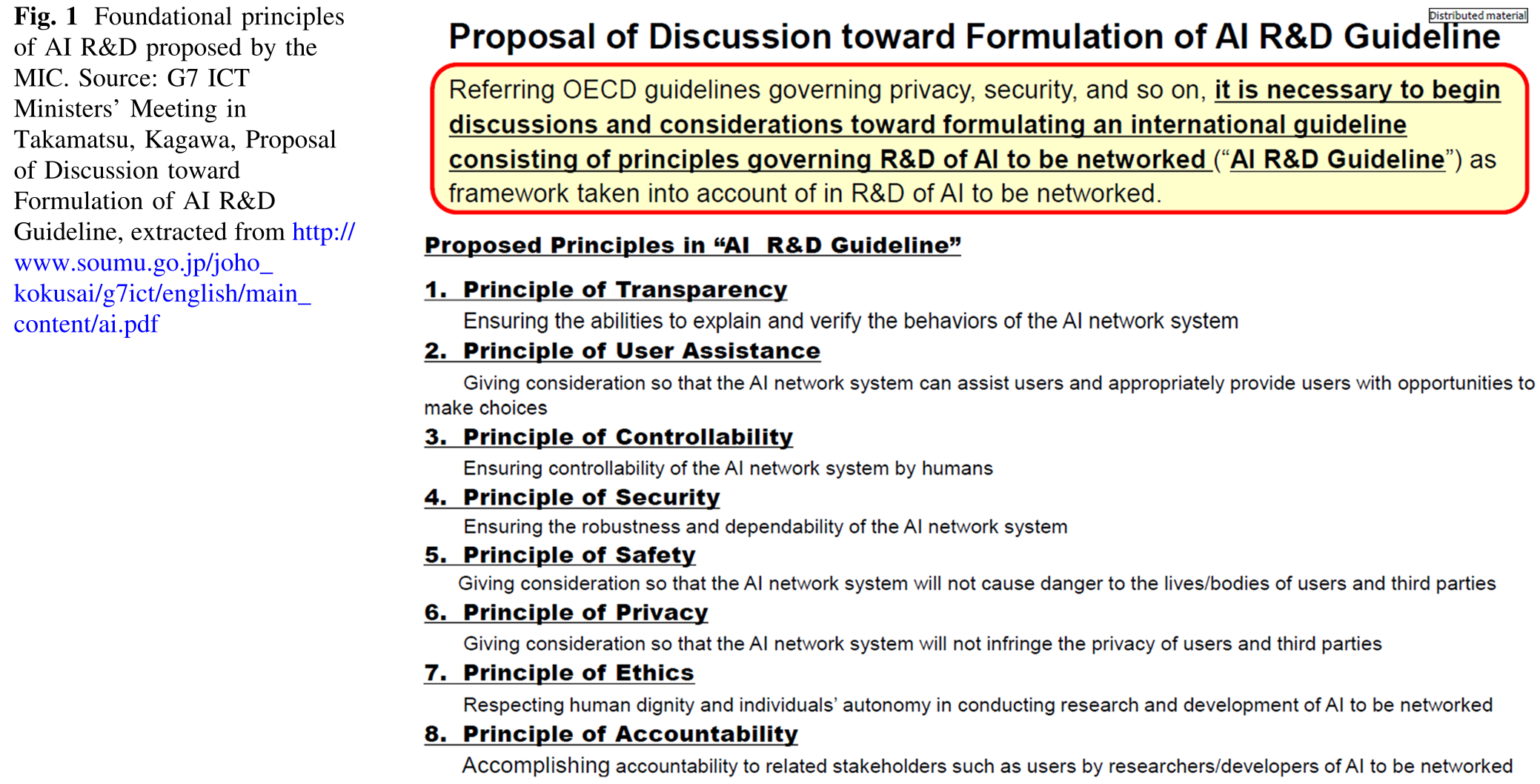 Figure 1: The MIC’s proposed principles for an AI-networked society, balancing transparency with human controllability.
The Solution: Privacy by Design (PbD) and Contextual Integrity
The author argues that PbD is the only "flexible" approach that can keep pace with AI. PbD rests on seven principles, most notably:
- Privacy as the Default: No user action is required; protection is built-in.
- Privacy Embedded into Design: It is not an "add-on" but a core functional requirement.
The Role of "Context"
A key takeaway is the refinement of Helen Nissenbaum’s "Contextual Integrity." In the world of AI, privacy isn't just about "hiding" data—it's about ensuring data flows are "appropriate" for the environment. A nursing robot needs different data than a delivery drone. The author suggests that AI should be equipped with Virtual Cognitive Agents (SmartData) that act as "clones" of the user’s preferences, automatically negotiating data release as the context changes.
Technical Safeguards: Beyond Simple Encryption
The paper delves into several advanced technical strategies to implement these legal ideals:
- Differential Privacy: Adding "noise" to datasets so AI can learn group patterns without ever identifying a specific individual.
- Procedural Regularity: Using cryptographic proofs to ensure that even if the algorithm is a "black box," the process it followed was fair and consistent for all users.
- The "Kill Switch": As a last resort, if an AI exceeds certain intelligence or ethical thresholds, a physical or software termination function must preserve human decisional autonomy.
Critical Insight & Future Outlook
The author concludes that the transition from a "collection-based" privacy regime to a "use-based" regime is inevitable. We can no longer prevent AI from "seeing" data in a hyper-connected IoT world; we can only control how that AI uses what it sees.
Takeaway for Tech Leaders: Future-proofing AI products requires moving beyond compliance. Adopting a PbD framework now isn't just about avoiding fines—it's about building the "Trust Equity" required for robots to be welcomed into our homes and hospitals.
Conclusion
We are entering an era of "Robot Law" where the code is the counselor. This paper serves as a vital reminder that while AI may surpass human intelligence (the Singularity), it must never be allowed to bypass human dignity.