
Beyond the Black Box: Securing Privacy in the Age of AI Robotics
8929_Comparative legal study on privacy and personal data protection for robots equipped with artificial intelligence looking at functional and technologic
This paper presents a comparative legal study of privacy and data protection for AI-equipped robots across the EU, USA, Canada, and Japan. It identifies "Privacy by Design" (PbD) as the primary flexible framework to manage the unpredictability of Machine Learning and proposes foundational policy suggestions to balance innovation with individual "informational self-determination."
TL;DR
As AI-equipped robots transition from science fiction to nursing homes and battlefields, our current legal guardrails are beginning to crack. This study argues that the unpredictability of machine learning makes traditional laws ineffective. The solution? A global shift toward Privacy by Design (PbD), treating privacy not as a legal afterthought, but as a core engineering requirement.
Contextualizing the AI Boom
We are at a junction where "Narrow AI" (specific tasks like image recognition) is ubiquitous, and "General AI" looms on the horizon. The paper identifies a critical shift: robots are no longer just tools; they are physical agents that sense, think, and act. This evolution creates a "decisional privacy" crisis where human choice is increasingly mediated by algorithms we don't fully understand.
The "Unpredictability" Trap: Why Laws are Failing
The author points out that traditional data protection relies on the Consent Principle. However, in a world of deep learning and neural networks:
- The Black Box Problem: If even the developers cannot explain why an AI made a specific decision (the "AlphaGo" effect), how can a user give "informed" consent?
- Psychological Manipulation: Humanoid robots break down our social defenses, tricking users into disclosing sensitive details as if talking to a friend rather than a data-gathering machine.
- Bias Reinforcement: Automated profiling can lead to systemic discrimination (e.g., Google's early photo tagging errors) that is hard to "debug" or hold legally accountable.
Comparative Legal Landscape
The study analyzes four major jurisdictions to find common ground:
- EU (GDPR): Leads with the "Right to Object" to profiling but struggles with ensuring human intervention in ongoing AI processing.
- USA: Focuses on sector-specific laws (FCRA) and surveillance concerns but lacks a comprehensive federal AI privacy mandate.
- Canada: The birthplace of Privacy by Design, advocating for "No-Go Zones" for sensitive data processing.
- Japan: A leader in service robotics, proposing "Robot Law Principles" that prioritize human dignity and "Robot-Convivial Society."
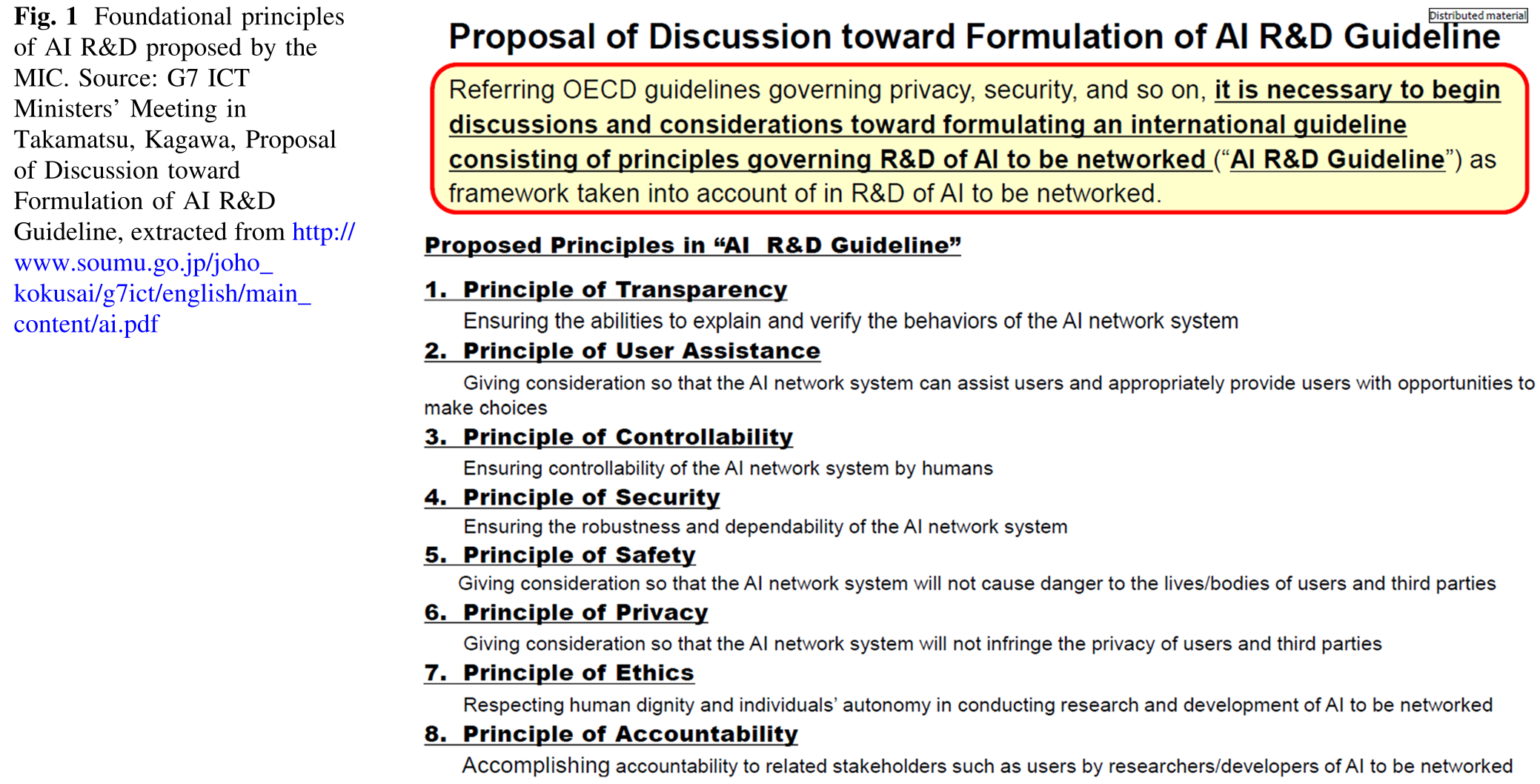 Figure 1: The G7-accepted foundational principles proposed by Japan’s Ministry of Internal Affairs and Communications (MIC) emphasize Accountability and Controllability.
Methodology: The Privacy by Design (PbD) Solution
The author suggests that since we cannot predict AI's path, we must make privacy the default setting.
1. The Positive-Sum Approach
Instead of viewing Privacy vs. Utility as a zero-sum game, PbD seeks a "win-win." For instance, a nursing robot can monitor vital signs (Security/Utility) while using Differential Privacy to ensure that data uploaded to the cloud cannot be traced back to the individual (Privacy).
2. SmartData and Contextual Integrity
Drawing on Helen Nissenbaum's theory, the paper argues for "Contextual Integrity." This means privacy isn't just about hiding data—it's about the appropriate flow of information. A robot in a hospital has different "appropriateness" norms than a robot in a private bedroom.
3. The Ultimate Recourse: The "Kill Switch"
As a last resort for preserving human agency, the author suggests a "terminating function" or kill switch. If AI autonomy exceeds ethical thresholds or threatens individual choice, the system must allow for an immediate override.
Critical Insight & Future Outlook
The most profound takeaway is the transition from Administrative Law to Algorithmic Accountability. We are moving toward a "Soft Law" era where certification systems and engineering standards will likely be more effective than courtroom litigation.
Limitations: The paper acknowledges that "SmartData" (virtual agents protecting your data) is conceptually brilliant but historically difficult to implement at scale.
Conclusion: We must prepare for an AI-prevalent society with a "flexible approach." By embedding logic and ethics into the silicon itself through Privacy by Design, we can welcome robots into our homes without surrendering our fundamental "right to be let alone."