
Deconstructing Geoprivacy: A Comparative Structural Analysis of Geosocial Application Faultlines
A comparative privacy analysis of geosocial networks
This paper presents a foundational comparative privacy analysis of early geosocial networks, specifically examining Foursquare, Qype, La Ruche, and Twitter. By introducing an eight-tiered evaluative framework based on data minimization and data sovereignty, the authors dissect the structural privacy loopholes inherently present in location-aware application ecosystems.
Executive Summary
TL;DR
This foundational research presents a multi-dimensional privacy audit of early geosocial platforms (Foursquare, Qype, La Ruche, and Twitter), introducing an eight-tiered analytical framework based on the axioms of data minimization and data sovereignty. The authors establish that the unmitigated leakage of spatio-temporal logs serves as a highly unique quasi-identifier, vulnerable to automated profiling, social graph de-anonymization, and physical tracking. The text exposes a stark divergence in engineering defaults between heavily regulated European platforms and market-driven American applications.
Background Orientation
Positioned at the intersection of emerging Spatial Databases and Operating System Security, this work serves as an analytical blueprint that mapped corporate data ingestion methodologies before the universal adoption of modern compliance frameworks (like GDPR). It expands traditional non-geolocated social graph threat dimensions into the actual physical realm, asserting that spatial trajectory is the ultimate vector for deanonymization.
The Core Conflict: Spatio-Temporal Dimensions as Identity Proxies
Traditional privacy metrics for online social networking platforms focus on user graph edge concealment (e.g., masking friend lists and group affiliations). However, geosocial networks introduces continuous coordinate capture (), transforming location logging into a passive tracking mechanism.
Prior systems operated under the naïve assumption that location data is merely an ephemeral context wrapper rather than a permanent fingerprint. The authors emphasize that location history contains an exceptionally high degree of information entropy. For instance, knowing an individual’s precise home and work nodes—a pair commonly derived from standard check-in frequencies—is statistically sufficient to isolate and identify that individual out of millions.
The core motivation of this study is to challenge the lack of baseline regulatory alignment in web-and-mobile-based platforms, advocating for Privacy by Design rather than retrospective security patches implemented following public data exposures.
Evaluation Framework & Methodology
The study evaluates platforms across eight core privacy dimensions configured to test the user's ultimate sovereignty over their data:
- Registration Information Minimization: Evaluating the platform's initial identity assertion surface against Article 7 of the European Data Protection Directive.
- Real Identity Enforcement vs. Pseudonymity: Testing if systemic architectural choices mandate verified real names or enable decoupling from real-world personas.
- Information Proximity Boundaries: Evaluating access stratification (Public vs. Registered Members vs. Trusted Friends).
- Privacy Settings Elasticity: Checking if platforms feature multi-layered options or force binary "all-or-nothing" concessions.
- Data Ownership Rights: Reviewing the legal terms of use to trace if data becomes absolute corporate inventory upon ingestion.
- The Right to Oblivion: Examining absolute account and backup log deletion policies.
- Spatial Data Acquisition Management: Checking for explicit active user check-ins versus passive, real-time backend background telemetry components.
- Communication Stack Hardening: Looking for baseline cryptographic implementation (e.g., default HTTPS) and automated sybil-defense mechanisms (e.g., CAPTCHAs).
Architectural Deconstruction & Structural Disparities
The authors systematically review four systems chosen for their distinct geographical distributions, structural variations, and ideological approaches to privacy protection:
- Foursquare: Market leader utilizing psychological gamification mechanics (points, badges, and "mayorships") to maximize check-in volume.
- Qype: European forum network pairing reputation-based scoring matrix elements with restaurant/locale crowd-sourced reviews.
- La Ruche: A highly localized hyper-niche European system engineered specifically to counter corporate data collection monopolies.
- Twitter: Asymmetric messaging platform introducing explicit spatial coordinates inside micro-blog annotations.
Platform Structural Comparison Overview
The structural layout differences between localized European community-oriented platforms and corporate American models are visible in their core front-end designs:
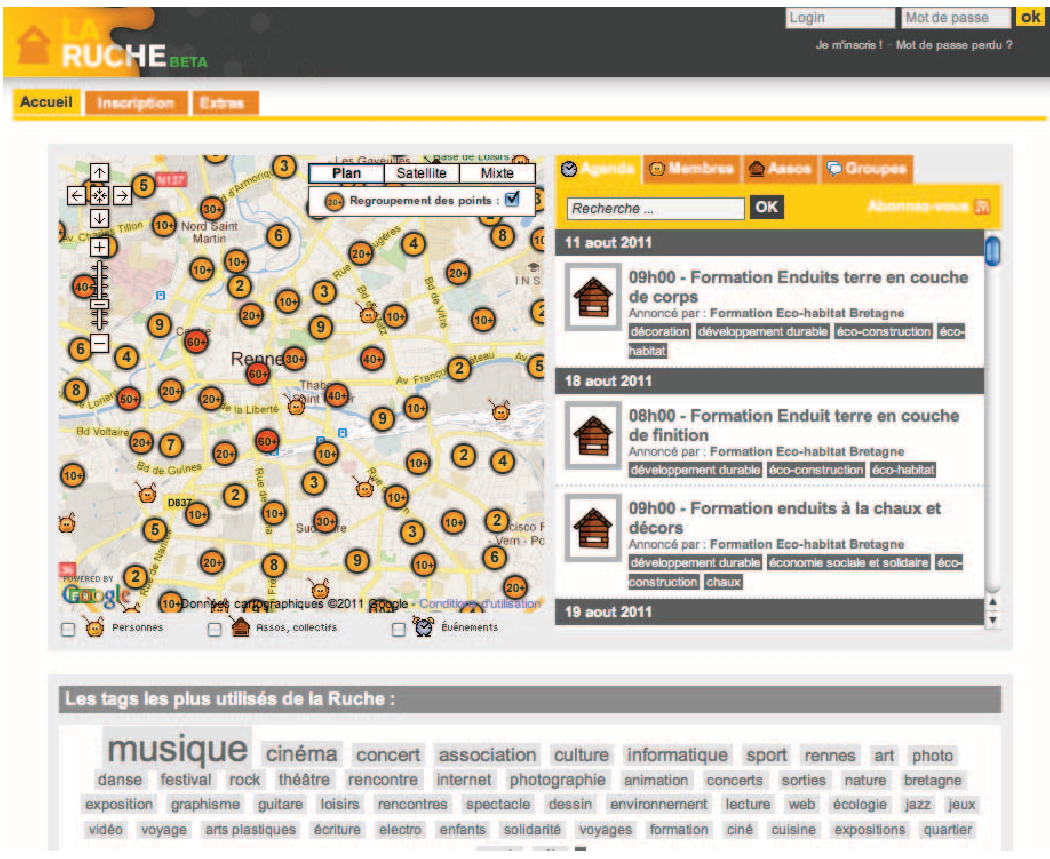
                       [Geosocial Platform Models Compared]
                                      │
              ┌───────────────────────┴───────────────────────┐
              ▼                                               ▼
     [American Corporate]                             [European Local]
 (Foursquare, Twitter, Facebook)                       (Qype, La Ruche)
              │                                               │
  • Intrusive Default Settings                     • Data Minimization Driven
  • Absolute Content Rights Licenses               • Native Pseudonym Support
  • Graph-Linking Interoperability                 • Minimal Initial Reg Metrics
Empirical Insights & Comparative Results
The comparative evaluation yielded critical architectural insights regarding how platforms manage default exposures.
- Foursquare's Structural Flaunts: By default, Foursquare exposed public logs detailing a user's chronological check-in trails, won badges, and current mayorship statuses. The authors highlight that "mayorships" reliably pinpoints an individual's explicit workspace node.
- The Facebook-Twitter Data Conduit: Testing a random batch of 5,000 Foursquare instances revealed that 32% of active users manually interconnected their profiles directly onto Facebook’s graph, while 16% cross-posted coordinates onto Twitter. This overlapping mapping vector enables attackers to accurately link seemingly pseudonymous profiles across networks.
The baseline privacy control vulnerabilities are highlighted by analyzing Foursquare's primary default dashboard layout:
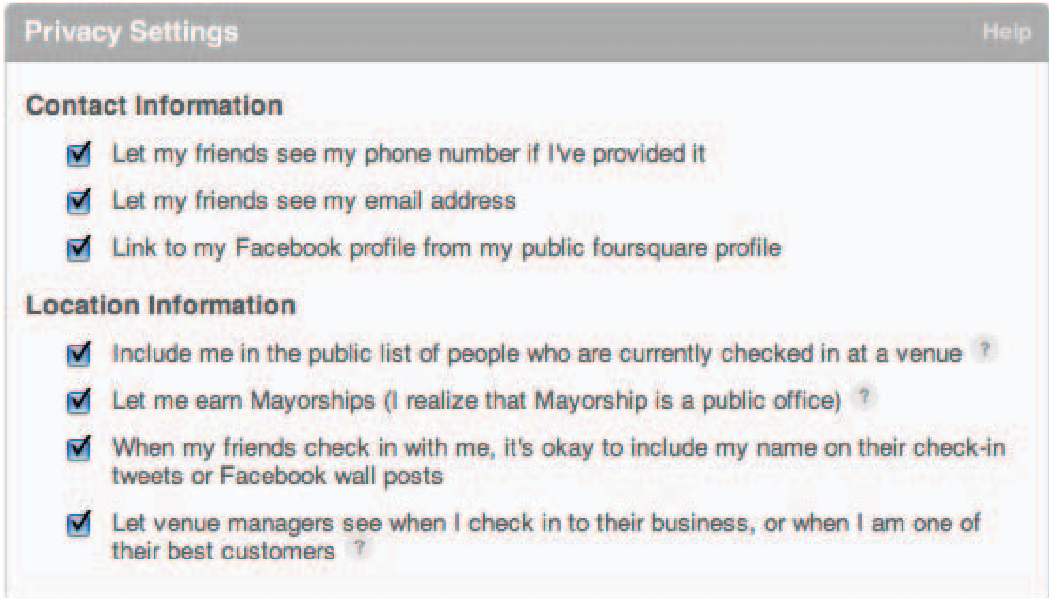
The Threat of Exploitative Scrapers
The paper notes empirical real-world validation scenarios of these explicit threats:
- The "Please Rob Me" Aggregate: Demonstrated how public geospatial tweets indicate precise vacancy timelines for private residences.
- The Andersen Scraping Exploit: An attacker continuously scraped Foursquare's unchecked endpoint, which served 50 recent profile pictures per location page. This allowed the attacker to reconstruct the daily mobility routines of 875,000 unsuspecting users in San Francisco without breaking password parameters.
Architectural Recommendations & Conclusion
To counter systematic geographical data logging vulnerabilities, the authors outline a series of core design recommendations for future engineers:
- Context-Dependent Granularity Filters: Systems must implement dynamic precision scalers, identical to early Twitter options allowing users to broadcast at arbitrary neighborhood or city levels rather than exact coordinate telemetry.
- Explicit Trust-Circle Partitioning: Move away from binary global friend designations to permit localized graph segregation rules (e.g., concealing spatial coordinates from co-workers on weekends).
- Implementation of the Privacy Lens: Integrating native rendering UI modules that allows users to audit exactly what spatial footprints their profile exposes to unauthorized eyes.
Critical Discussion & Future Roadmap
While the paper serves as an exceptional structural foundation for spatial risk taxonomy, it assumes that users maintain conscious control over actively initiated check-ins. Modern trends have shifted toward continuous, background coordinate streams integrated directly into mobile operating systems, changing the primary security threat from public user-to-user snooping to deep, centralized platform-level corporate monetization. Regardless, the paper's core assertion remains unchallenged: any platform tracking spatial indices must implement data sovereignty at the architectural level rather than as a secondary compliance patch.