
Twitter vs. The Polls: The Hidden Divergence in the 2011 Egyptian Uprising
A Comparative Study of Social Media and Traditional Polling in the Egyptian Uprising of 2011
This study presents a comparative analysis of sentiment trends during the 2011 Egyptian uprising by contrasting traditional Gallup polling data with large-scale Twitter sentiment analysis. Utilizing data from 48,077 Egyptian Twitter users and representative face-to-face surveys, the research investigates the alignment between social media "pulses" and established longitudinal polling methodologies.
TL;DR
Is social media a mirror of the public soul or just a localized megaphone for the frustrated? This study analyzes over 820,000 tweets and two years of Gallup polling data from the 2011 Arab Spring to find out. Unexpectedly, the results show a complete "Sentiment Gap": while official polls reported a surge in post-revolution optimism, Twitter users grew significantly more negative.
Background: The Digital Pulse of a Revolution
The January 25, 2011 uprising in Egypt is often called a "Twitter Revolution." With internet usage spiking by nearly 40% and millions of tweets flooding the platform, Twitter became a primary resource for journalists and researchers. This paper asks a critical question: Can we trust this digital "pulse" as a scientific measurement of public opinion, or is it fundamentally disconnected from the average citizen on the ground?
The Sentiment Gap: Motivation & Problem
Traditional polling (like Gallup's) is the "gold standard" but is slow, expensive, and subject to Interviewer Bias or Impression Management (people saying what they think the interviewer wants to hear). Conversely, Social Media is instant and raw, but it suffers from Socio-economic Bias—in 2010, only 5.5% of Egyptians were on Facebook, and Twitter users were even more skewed toward the young, tech-savvy, and urban elite.
The authors hypothesized that if the two methods aligned, social media could effectively replace or augment traditional surveys.
Methodology: Manifolds and Stratification
The researchers utilized a sophisticated two-pronged approach:
- Traditional Gallup Surveys: Nationally representative, face-to-face interviews in Arabic.
- Twitter Keyword Manifold: After filtering for English tweets from users verified to be in Egypt, they used a Latent Emotion Manifold regressor. Unlike simple keyword matching (which fails at context), this method maps text into a multi-dimensional emotion space to capture the nuance between "excited," "depressed," and "angry."
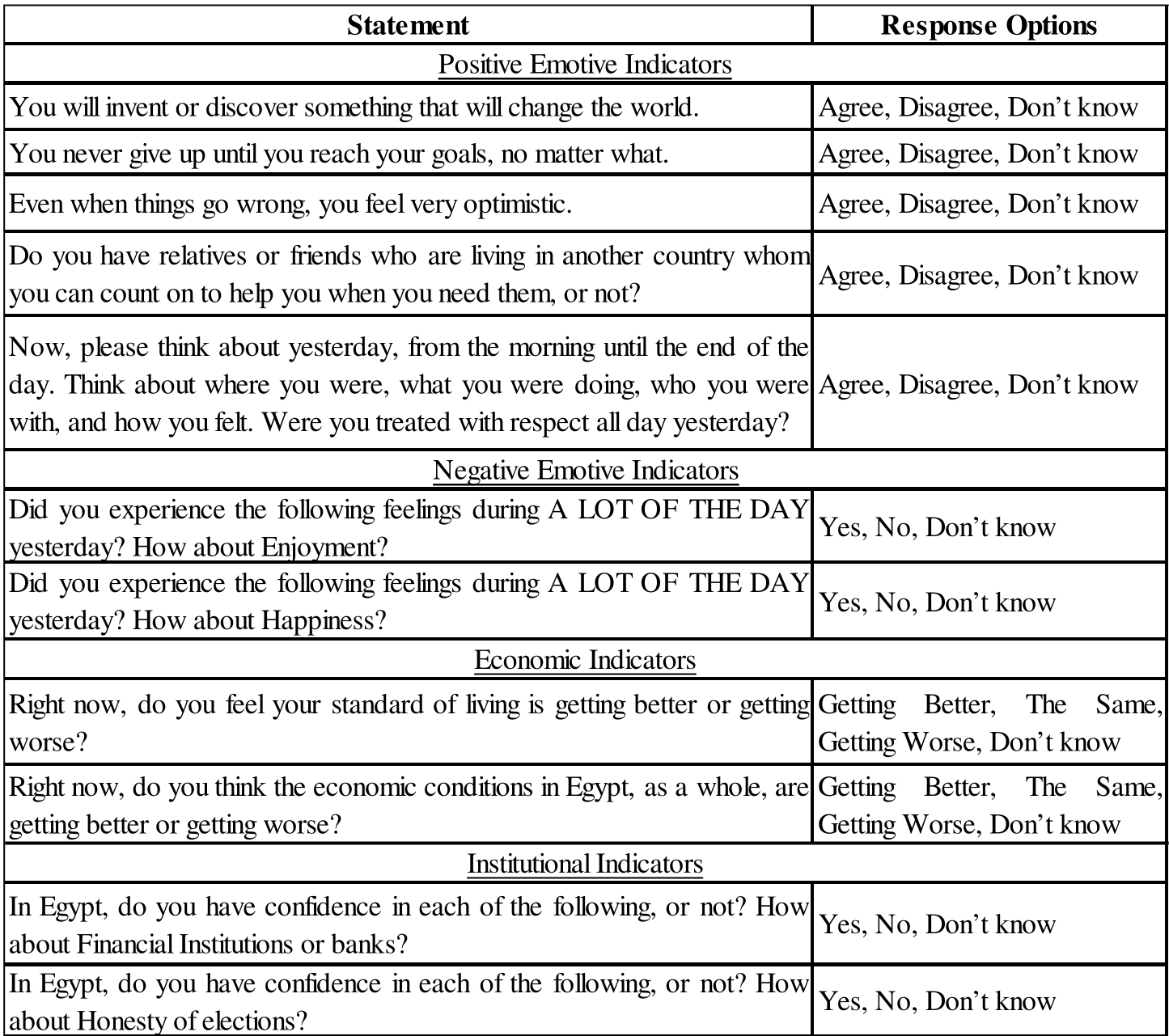 Above: The specific indicators used by Gallup to measure institutional and emotive sentiment.
The Great Divergence: Experimental Results
The findings were a wake-up call for computational social scientists.
1. The Gallup Result: Revolutionary Optimism
Polling data showed a statistically significant increase in positivity. Following the fall of the regime, Egyptians reported feeling more respected and more optimistic about their economic future. Every metric—Economic Optimism, Institutional Confidence, and Overall Positivity—showed a clear upward trend.
2. The Twitter Result: Growing Negativity
In stark contrast, the Twitter analysis showed that overall sentimentality decreased. Users became more negative regarding the judicial system, the government, and the honesty of elections post-uprising.
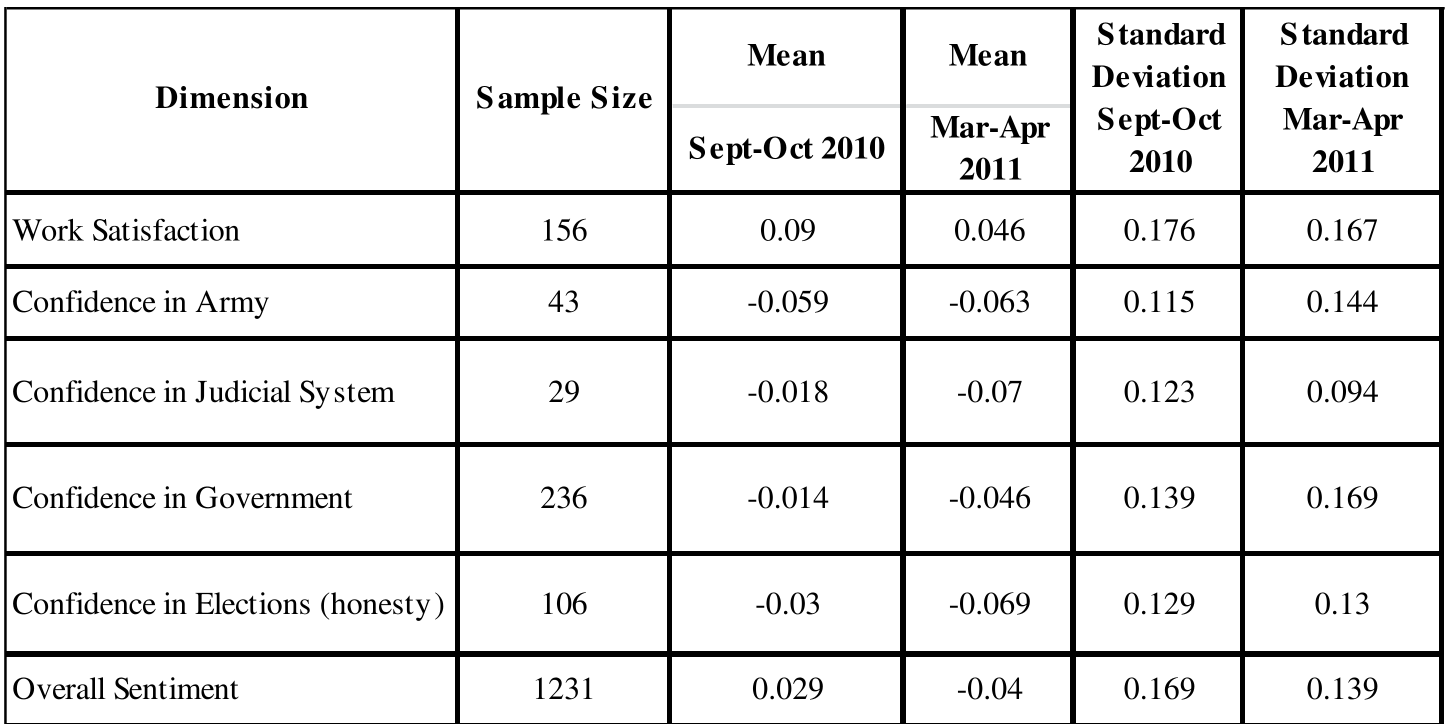 Table 4: Twitter data showing a consistent downward (negative) trend in sentiment across almost all dimensions.
Critical Insight: Why the Discrepancy?
Why would Twitter users feel worse while the general public (via polls) felt better? The authors suggest three main drivers:
- The "Chaos Bias": Twitter is unstructured and often used to vent immediate frustrations, chaos, and confusion. It captures the heat of the moment, while surveys capture a more reflective state.
- Demographic Skew: Twitter users in 2011 Egypt were an elite sub-population. Their expectations for the revolution may have been higher, leading to faster disillusionment compared to the general public.
- Linguistic Limitations: The study focused on English tweets (due to the unreliability of automated Arabic translation at the time). English-speaking Egyptians likely represent a specific ideological and economic class.
Conclusion and Takeaway
This paper serves as a vital Skeptic’s Guide to social media analytics. While Twitter is a fantastic tool for tracking events in real-time, it is a biased tool for tracking attitudes.
For future tech products or policy research, the lesson is clear: Data volume does not equal data representation. Relying solely on the "Twitter pulse" during a crisis may lead to a fundamental misreading of the public's true sentiment.
Future Work
The authors suggest that future research must bridge the gap by improving Natural Language Processing (NLP) for Arabic dialects and developing multi-modal tools that can account for the unique socio-economic filters of digital platforms.