
Symptom Synergies: Validating Big Social Data Against Clinical Rigor
A Comparative Study of Symptom Clustering On Clinical and Social Media Data
This paper presents a comparative study of breast cancer symptom clustering using two distinct datasets: structured clinical trial data (N=653) and unstructured social media data from MedHelp (50,426 messages). By applying K-medoid clustering and Average Silhouette Width (ASW), the authors identify significant overlap in symptom patterns between the two sources, validating social media as a viable supplementary health data stream.
TL;DR
Can the "noise" of social media forums match the "signal" of expensive clinical trials? This study compares symptom clusters in breast cancer patients derived from a medical forum (MedHelp) and a formal clinical study. The verdict: There is substantial overlap in how symptoms group together, though social media requires careful "contextual filtering" to avoid confusing related but opposite conditions.
Problem & Motivation: The Credibility Gap of Big Social Data
For years, "Big Social Data" has been a double-edged sword. While it offers a massive, non-intrusive window into patient behavior (Ecological Validity), it has faced harsh criticism for accuracy—most notably when Google Flu Trends overpredicted influenza rates by 100%.
The authors argue that the missing step in medical informatics is validation. By comparing unstructured forum posts with the highly structured "Symptom Checklist" (a 1-4 scale survey) used in clinical trials, we can determine if social media is a reliable mirror of clinical reality or just a hall of mirrors.
Methodology: Bridging Unstructured Text and Structured Metrics
The researchers utilized two datasets:
- Clinical Data: 653 breast cancer survivors who completed a 39-item checklist.
- Social Media Data: 50,426 messages from MedHelp.com.
To bridge these, they used the Consumer Health Vocabulary (CHV). Instead of just looking for medical terms, they mapped "patient-speak" (e.g., "loose stools") to clinical terms (e.g., "diarrhea").
The Clustering Engine: K-medoids
Unlike K-means, which creates "virtual" centers (centroids), K-medoid clustering selects actual data points (symptoms) as the "anchor" for each cluster. This is crucial for medical interpretability—it allows doctors to say, "Hot flashes is the representative symptom of this menopausal cluster."
 The similarity formula used to quantify the relationship between symptoms based on their co-occurrence.
Experiments & Results: Where They Meet and Where They Part
The optimal number of clusters was found using Average Silhouette Width (ASW). Social media settled on K=8, while clinical data settled on K=7.
1. The Successes (Shared Clusters)
The overlap was striking. Both datasets identified:
- Menopausal Cluster: Hot flashes, night sweats, and mood changes.
- Pain Cluster: General aches, headache, and back pain.
- Gastrointestinal Cluster: Nausea and diarrhea.
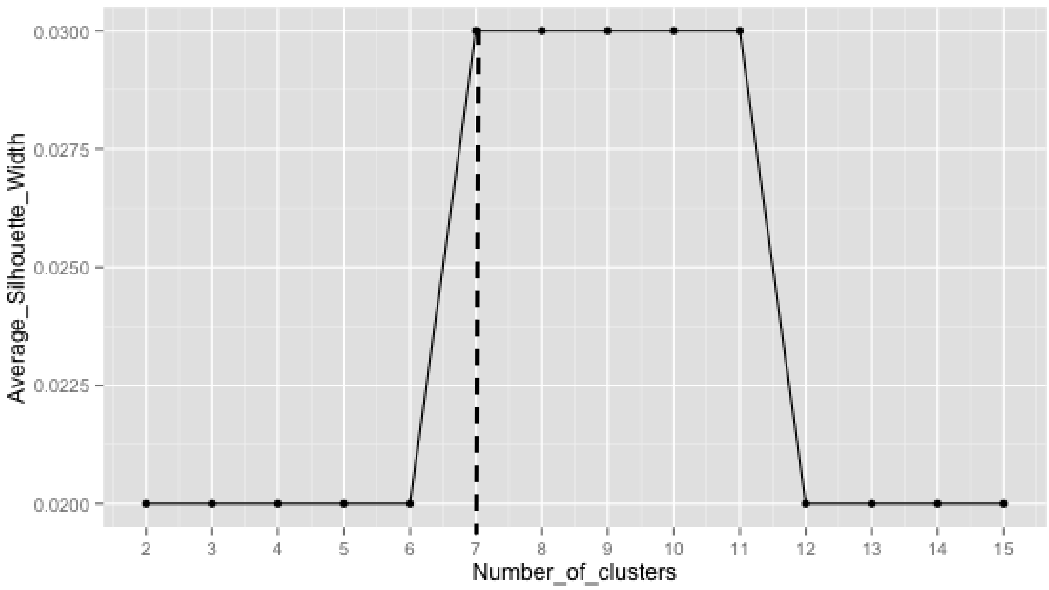 The ASW plot used to determine the optimal number of clusters for clinical data.
2. The Discrepancies (The Context Trap)
The primary failure of the social media model was Context Sensitivity.
- The Weight Paradox: In social media, "Weight Gain" and "Weight Loss" were clustered together. Why? Because users often discuss them in the same post (e.g., "I'm worried about weight gain, but some experience weight loss").
- Clinical Reality: In the trial data, these are distinct; one is linked to fatigue, the other to appetite loss.
Critical Analysis & Conclusion
This paper proves that social media data isn't just "noise"—it possesses a coherent structure that aligns with medical science.
Key Insights:
- Sparsity is a feature, not a bug: Clinical participants go through a "laundry list" of symptoms because they are asked to. Social media users only mention what is bothersome. This makes social media a better tool for identifying "high-impact" symptoms.
- Validation is non-negotiable: Social media can supplement clinical data, but it cannot replace it yet due to its inability to distinguish the context of co-occurrence (e.g., mentioning a symptom vs. experiencing it).
Future Outlook: The next frontier for this research lies in using Deep Learning and LLMs to parse the sentiment and negation in forum posts, ensuring that when a user says "I don't have nausea," it isn't clustered as a positive symptom.