
Decoding Social Dynamics: A Comparative Study on Tracking Evolving Communities
A Comparative Study of Different Approaches for Tracking Communities in Evolving Social Networks
This paper presents a comprehensive comparative study of mainstream algorithms for tracking community evolution in dynamic social networks. It evaluates four prominent frameworks—Greene et al., Takaffoli et al., Brodka et al., and Tajeuna et al.—across DBLP, AS, and Yelp datasets, covering both overlapping and non-overlapping (disjoint) community structures.
TL;DR
In the rapidly shifting landscape of social networks, users don't stay in static groups—they merge, split, and vanish. This paper provides an academic "stress test" for the most popular community tracking algorithms. By comparing frameworks like GED and Jaccard-based alignment against real-world datasets (DBLP, Yelp, AS), the authors reveal a fundamental trade-off: some algorithms are better at finding many evolving groups, while others (specifically Brodka et al.'s GED) are significantly better at ensuring the groups they find actually stay similar over time.
Problem & Motivation: The Moving Target
Traditional social network analysis often treats graphs as static snapshots. However, real-world networks—from academic collaborations to router communications—are dynamic.
The core difficulty lies in lineage tracking. If a community exists at time , and a similar community appears at , are they the same group? What if half the members left? What if two groups merged? Existing methods use different "similarity yardsticks" (thresholds) and detection algorithms, leading to inconsistent results. The authors set out to answer: Which metric actually captures the "soul" of a community as it evolves?
Methodology: The Standardization Engine
The researchers implemented a rigorous two-step pipeline to compare these moving parts fairly:
- Community Detection: They used Infomap for disjoint communities and CPM (Clique Percolation Method) for overlapping ones.
- Tracking & Similarity: They tested four distinct similarity philosophies:
- Jaccard Coefficient (Greene et al.): Simple node overlap.
- Dynamic Thresholds (Takaffoli et al.): Content-aware automated thresholds.
- Inclusion Metric (Brodka et al.): A sophisticated mix of node overlap and topological importance (how central a node is within the group).
- Transition Probability Vectors (Tajeuna et al.): Comparing communities based on their shared "footprint" across the entire timeline.
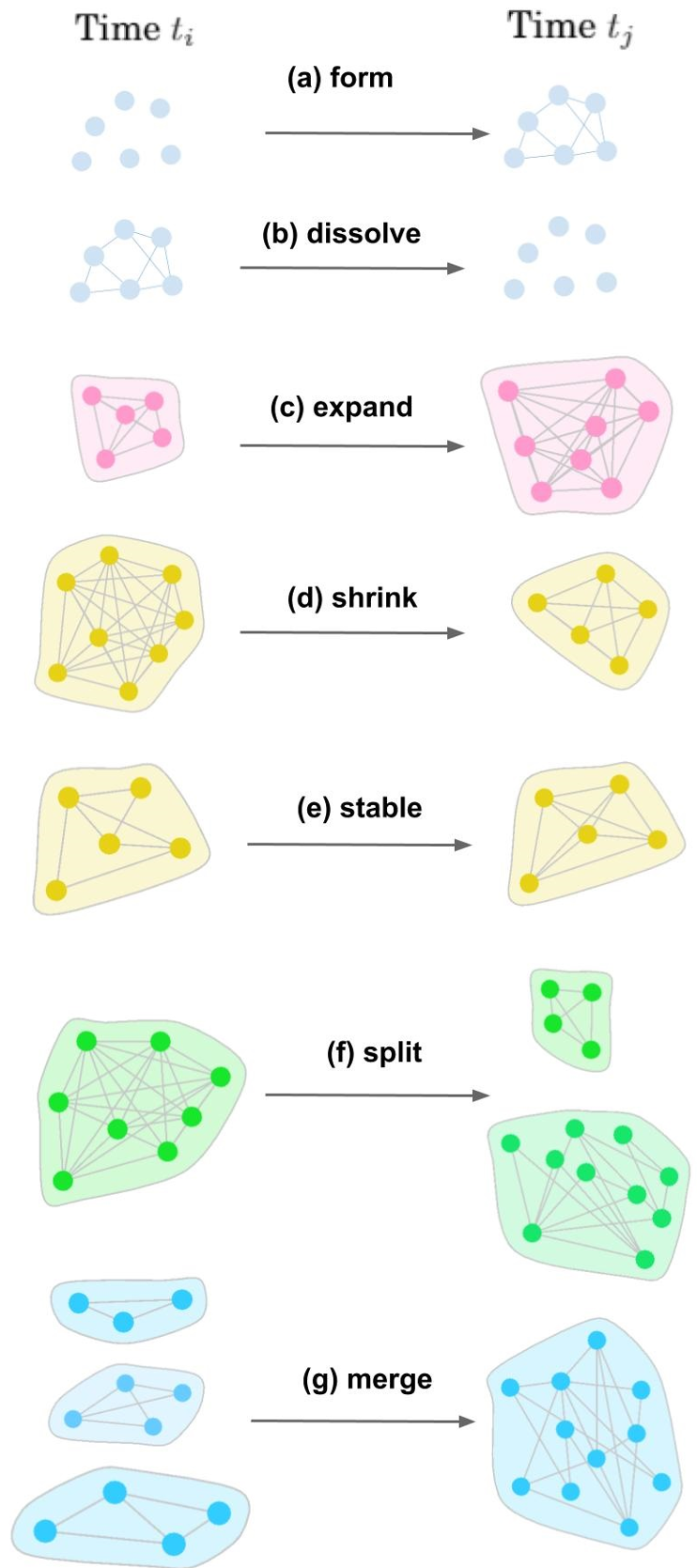 Fig 1: The taxonomy of change—communities can merge, split, expand, shrink, or dissolve.
Experiments & Results: Quality vs. Quantity
The study utilized three diverse datasets: DBLP (Co-authorship), AS (Internet topology), and Yelp (Friendship).
High-Quality Tracking (The Brodka Advantage)
Using APCC (Average Pearson Correlation Coefficient) and APNP (Average Proportion of Nodes Persisting), the authors measured how "pure" an evolving sequence remained. The results were clear: Brodka et al.'s method dominated the quality charts. By accounting for the importance of specific nodes rather than just counting heads, it maintains a much tighter resemblance within the tracked sequences.
High-Quantity Tracking (The Discovery Leaders)
However, Brodka's method was often "too picky." For small-sized communities in DBLP, it tracked only about half as many sequences as Greene et al. or Takaffoli et al.
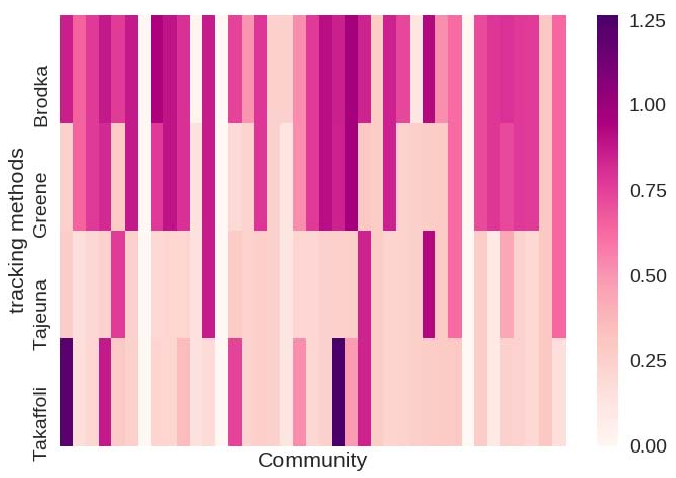 Fig 2: Heatmap analysis showing the performance (APCC/APNP) across different algorithms. Darker cells indicate higher tracking quality.
Critical Analysis & Conclusion
Takeaway
There is no "one size fits all" algorithm.
- If you are building a system to detect stable historical trends (e.g., the long-term evolution of a scientific field), use Brodka et al.'s GED with its topological focus.
- If you need to discover as many potential changes as possible in a highly volatile environment (e.g., detecting emerging delinquent groups in criminology), Greene et al.'s Jaccard approach is the more efficient choice.
Limitations & Future Work
The study notes that the performance of these algorithms is heavily tethered to the initial community detection step. If the first snapshot is noisy, the entire tracking sequence fails. The authors' future work aims to move beyond mere tracking to predicting critical events before they happen—allowing us to forecast when a community might split or dissolve.