
ELM: Revolutionizing Face Gender Recognition with Ultra-Fast Learning
Comparing Studies of Learning Methods for Human Face Gender Recognition
This paper evaluations three machine learning paradigms—Back Propagation (BP), Support Vector Machine (SVM), and Extreme Learning Machine (ELM)—for the task of human face gender recognition. The authors demonstrate that ELM achieves a superior balance of recognition accuracy and computational efficiency, significantly outperforming traditional methods in training speed.
TL;DR
Determining gender from facial images is a cornerstone of personalized human-computer interaction. While Support Vector Machines (SVM) and Back Propagation (BP) networks represent the traditional "gold standard," they are often bogged down by heavy training requirements. This paper introduces Extreme Learning Machine (ELM) to the field, proving it can match the accuracy of SVM while being 40 times faster to train, effectively solving the bottleneck for real-time applications.
Problem & Motivation: The Parameter Tuning Trap
In the landscape of supervised learning, BP and SVM have long dominated. However, they come with significant "baggage":
- BP Neural Networks: Suffer from slow convergence and the risk of getting stuck in local optima.
- SVM: Requires tedious tuning of kernel functions and penalty factors ().
The authors identified that for real-time systems—like intelligent robots that need to adapt to a user's gender instantly—these legacy methods are too computationally expensive. They looked toward Extreme Learning Machine (ELM) as a high-speed alternative that treats training as a simple linear algebra problem rather than a long, iterative optimization process.
Methodology: The Core of ELM
The brilliance of ELM lies in its simplicity. For a Single-hidden Layer Feed-forward Network (SLFN), ELM posits that:
- Random Initialization: Input weights and hidden layer biases are assigned randomly and never changed.
- Analytical Solution: Instead of gradient descent, the output weights are calculated in one shot using the Moore-Penrose generalized inverse.
System Architecture
The proposed pipeline follows a standard recognition flow but replaces the "brain" with ELM:
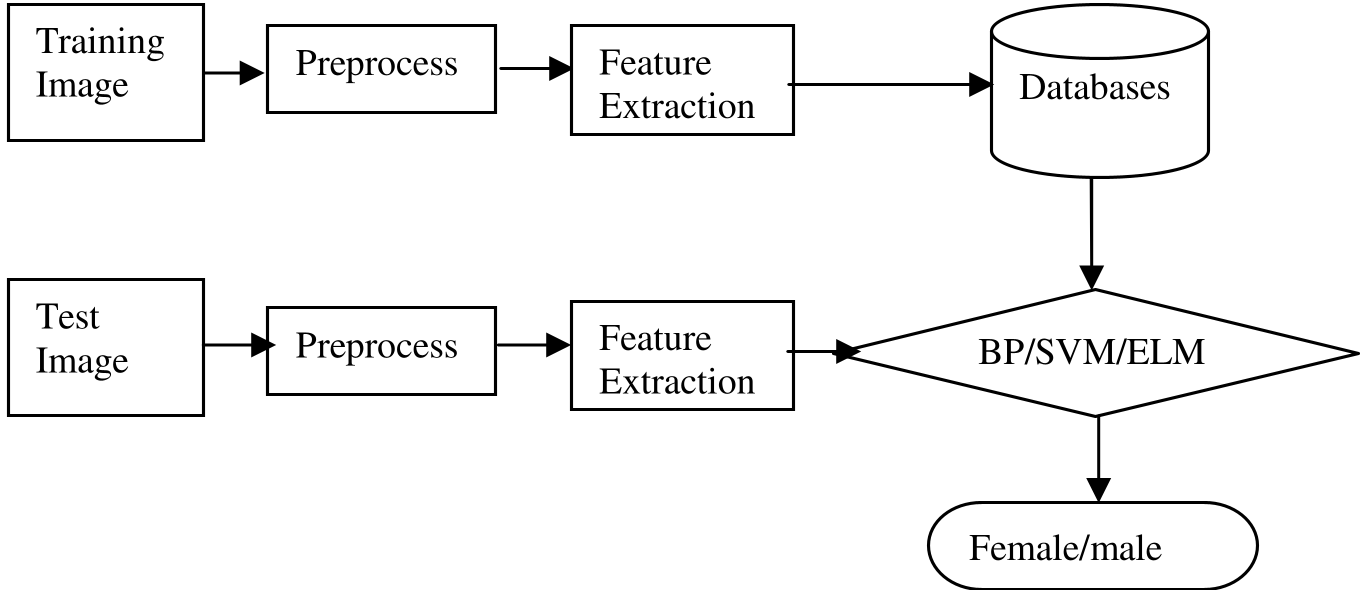
- Pre-processing: Normalization and lighting compensation.
- Feature Extraction: Utilizing Eigenfaces (PCA) to reduce image dimensionality (e.g., from 200x200 down to ~150 principal components).
- Classification: ELM determines the gender based on the extracted features.
Experiments & Results: Efficiency without Compromise
The study conducted rigorous testing across three major databases: Stanford, ORL, and FERET.
1. Speed Comparison
The most striking result is the training time. While BP and SVM took roughly 36 to 42 seconds to train on the Stanford dataset, ELM completed the task in just 0.94 seconds.

2. Accuracy Comparison
Speed didn't come at the cost of precision. On the Stanford database, ELM achieved 93.75% total accuracy, slightly edging out SVM (93.13%) and significantly beating BP (87.5%).
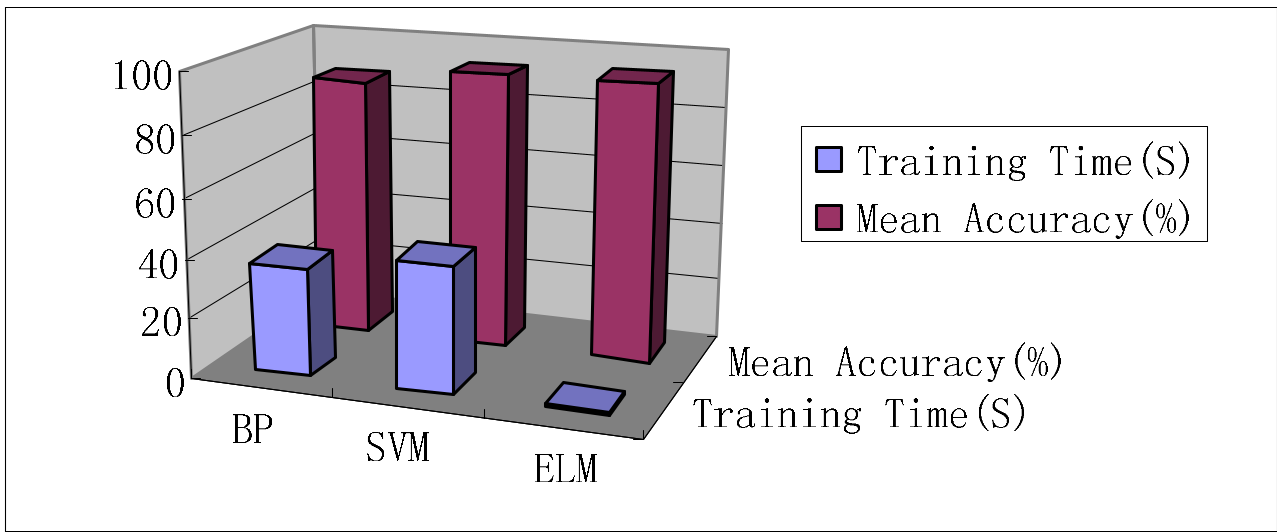
Across other datasets like FERET, ELM maintained its lead, proving its generalization ability—the capacity to perform well on new, unseen data—is superior to traditional neural networks.
Critical Analysis & Conclusion
Takeaways
The paper successfully demonstrates that ELM is a "Real-Time Ready" algorithm. By bypassing the iterative weight-update phase typical of gradient descent, it eliminates both the computational time and the expertise required to "fine-tune" a model.
Limitations & Future Work
While ELM is exceptionally fast, the paper relies on PCA (Eigenfaces) for feature extraction. In modern contexts, handcrafted features or PCA are often replaced by Convolutional layers. A potential future direction would be integrating ELM as the final classification layer of a deep feature extractor, combining the "structural understanding" of CNNs with the "learning speed" of ELM.
Final Thought: For researchers and engineers working on edge devices or low-power hardware, this work serves as a reminder that more complex optimization isn't always better; sometimes, a clever linear algebra shortcut is all you need.