
Twitter vs. Weibo: Comparing the Digital Pulse of Global Events
Comparing the pulses of categorical hot events in Twitter and Weibo
This paper presents a cross-cultural comparative study of Twitter and Weibo users' responses to "hot events" identified through Wikipedia click logs. By utilizing IR methods and temporal analysis, the authors quantitatively contrast popularity, temporal dynamics, and information diffusion patterns across different categories like Politics, Science, and Arts.
How does the world "make sense" of a major event? If Barack Obama wins an election or Apple drops a new iMac, does a user in Beijing react the same way as a user in New York? This paper, a classic in social media mining, moves beyond simple statistics to perform a deep "pulse check" on the two largest microblogging communities: Twitter (representing the Western/US world) and Weibo (representing China).
TL;DR
By using Wikipedia as a neutral "third-party" proxy for real-world interests, the researchers found that while we all care about similar things (Popularity correlation), how we talk about them and who influences us (Internal Diffusion vs. External Exposure) differs wildly based on cultural and political backgrounds.
The Problem: The High Cost of Cultural Insight
Understanding ideological differences usually requires expensive surveys and human studies. Social media provides a "live" laboratory, but previous research was shallow—counting hashtags or URLs without looking at the temporal pulse of events. The authors argue that a "Political" event might propagate through a network very differently than a "Scientific" one, requiring a categorical approach.
Methodology: Wikipedia as the "Event Sensor"
The authors used a clever 4-step framework:
- Peak Detection: They monitored Wikipedia page-view spikes to identify "hot events."
- Categorization: Using Wikipedia's hierarchy, they mapped events into 25 categories (e.g., AGR, ART, POL, SCI).
- Cross-Language Retrieval: Since Wikipedia provides linked English/Chinese titles, they used these as queries to find relevant posts on both Twitter and Weibo.
- Pulse Comparison: They measured Popularity, Peak Delay (how fast the spike occurs), and Information Diffusion (how the news spreads).
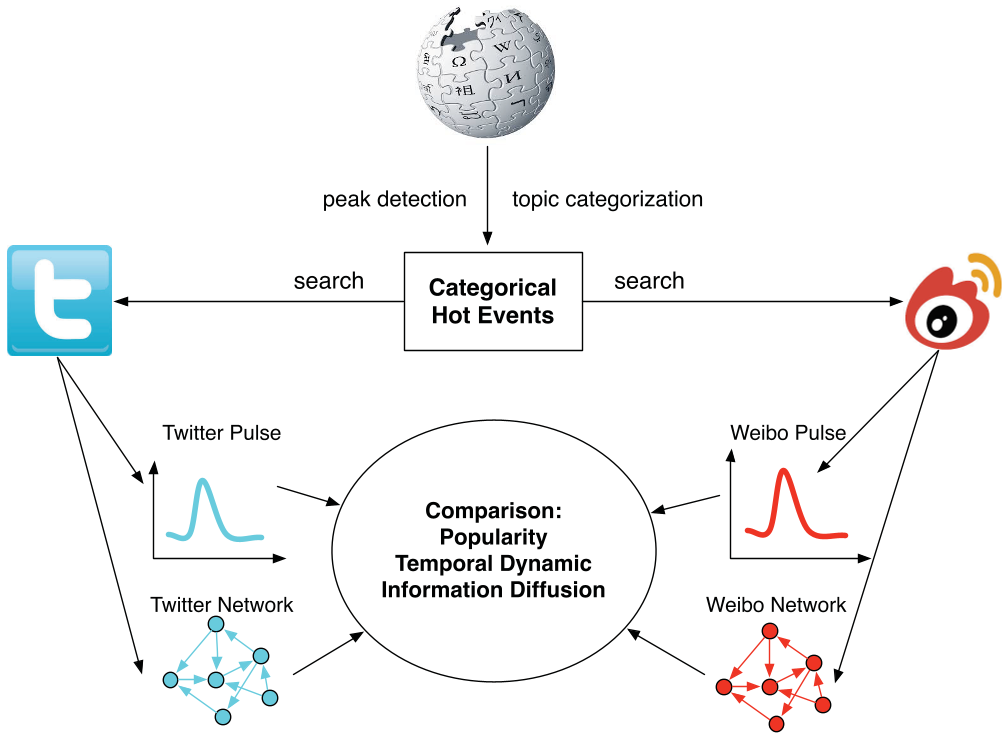 Figure 1: The research framework utilizing Wikipedia as the bridge between Twitter and Weibo.
Key Insights: Where We Diverge
1. The "Global Bridge" of Science
The study found that for Science and Technology, the responses were almost synchronized. When a new iMac was released, the peak delay and KL-divergence (a measure of distribution difference) were minimal. Science appears to be a "universal language" where information flows freely without cultural friction.
2. The "Cultural Gap" in Arts and Politics
Conversely, events in Politics and Arts showed massive gaps. Twitter users were far more responsive and "bursty" regarding US elections (Obama), while Weibo users showed a "lag" or different intensity. For instance, the Nobel Prize in Literature for Mo Yan (a Chinese author) created a massive spike on Weibo that was nearly invisible on Twitter's temporal pulse.
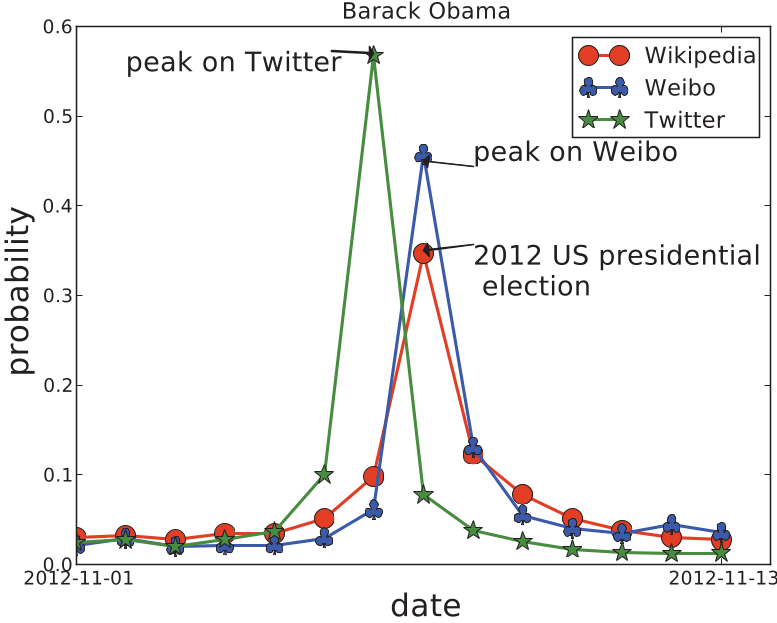 Figure 2: Comparing the pulse of "Barack Obama" across Wikipedia, Twitter, and Weibo. Note the tight alignment but distinct peak differences.
3. Who Influences You?
One of the most profound findings relates to Information Diffusion.
- Twitter displays "Complex Contagion": The more of your friends talk about a topic, the more likely you are to join in. It’s an internal, social-driven mechanism.
- Weibo (for these global events) relies more on "External Exposure": Users likely heard the news from traditional news sites or portals first, rather than their immediate social circle on Weibo.
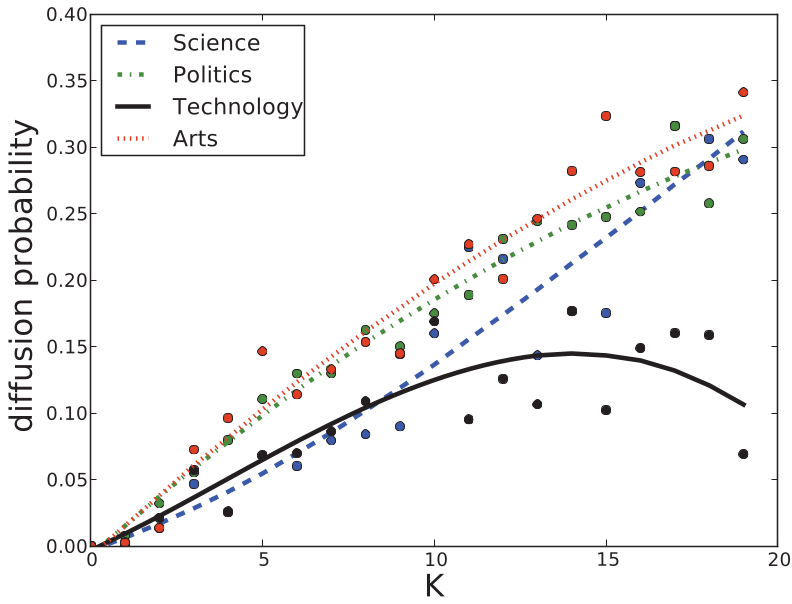 Figure 3: Diffusion probability on Twitter across different categories. Politics and Arts show higher 'social' contagion compared to Science.
Critical Analysis & Takeaways
The paper highlights a critical "Inductive Bias" in global social media research: because Twitter is often used as the default dataset, we assume its social-driven diffusion is universal. This study proves that the platform and the culture change the mechanism of news spread.
Limitations:
- The search relied on keyword matching. In Weibo, users often use homophones or metaphors (especially for sensitive political events) to bypass filters, which may have led to an undercount of the "true" Chinese pulse.
- Since the events were sourced from Wikipedia, there is a natural bias toward "Western-centric" global events.
Conclusion
This study serves as a reminder that the "Global Village" is not a monolith. While we share interests in global "hot events," our digital rhythms are dictated by our local cultures, political environments, and the specific architectures of the social networks we inhabit.