
Decoding the Twitter Mind: A Comparative Study of Tag Clustering for Interest Mining
Comparing Tag Clustering Algorithms for Mining Twitter Users' Interests
This paper investigates the extraction of Twitter users' interests by comparing three tag clustering algorithms: PAM, Affinity Propagation (AP), and UPGMA. Leveraging the Wikipedia Link-based Measure (WLM) for semantic relatedness and unsupervised Silhouette width for parameter estimation, the study identifies UPGMA as the superior method for modeling user topics without prior category knowledge.
TL;DR
Twitter is a goldmine of real-time human intent, but its "noise" makes interest mining difficult. This paper benchmarks three clustering algorithms—PAM, Affinity Propagation, and UPGMA—to see which can best categorize a user's interests. By using Wikipedia as a semantic anchor and the Silhouette width for parameter tuning, the researchers found that UPGMA consistently outperforms its peers in identifying distinct, meaningful topics without any human intervention.
The Challenge: Making Sense of Micro-Chaos
Mining interests from Twitter is like trying to map a conversation in a crowded stadium. Tweets are short, riddled with slang, and highly dynamic. Traditional methods like Latent Dirichlet Allocation (LDA) often fail because:
- Context Scarcity: 140 characters rarely provide enough statistical depth.
- Fixed Taxonomies: You can't pre-define categories for everything people talk about.
- Human Subjectivity: Users are surprisingly bad at self-reporting their own interests when surveyed.
The authors argue that an unsupervised, external-knowledge-driven approach is the only way to scale interest modeling.
Methodology: Wikipedia as the "Brain"
The core of the system is a pipeline that moves from raw text to structured interest clusters:
- NLP Preprocessing: Using Stanford CoreNLP to filter nouns and lemmatize words.
- Semantic Relatdness (WLM): Since Twitter users discuss trending topics (new movies, politics, tech), the system needs a database that updates constantly. They use Wikipedia's hyperlink structure to determine if two words (e.g., "Apple" and "iPad") are related based on link overlaps.
- The Algorithms:
- PAM (Partitioning Around Medoids): Finds central "anchor" points in data.
- AP (Affinity Propagation): A message-passing algorithm where data points "vote" for their leaders.
- UPGMA (Hierarchical Clustering): Builds a tree (dendrogram) of relationships.
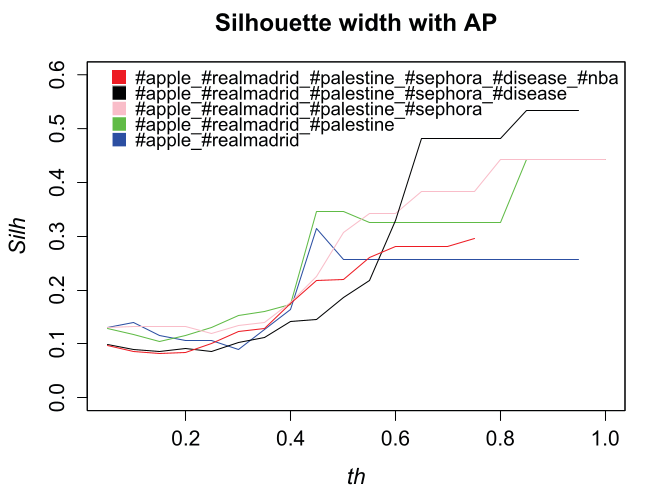 Note: The study uses Silhouette width to find the "sweet spot" for cluster counts, ensuring groups are cohesive yet distinct.
Evaluation: The Hashtag Truth
To solve the "unreliable user" problem, the authors created fictitious profiles using hashtags (#apple, #nba, #palestine). Since hashtags are implicit organizational tools, they serve as a reliable "ground truth."
The researchers optimized the Silhouette width (an unsupervised metric) and compared it against the F-score (a supervised metric). They discovered a powerful correlation: when the Silhouette width is maximized, the resulting clusters align almost perfectly with the underlying hashtags.
Key Findings
- UPGMA Wins: It produced the highest quality clusters across almost every test case.
- Parameter Correlation: There is a high correlation (0.987) between unsupervised quality and actual topic accuracy.
- Relevance Thresholding: To remove "noise" (random words that don't belong), a frequency-based threshold (around 0.55 to 0.7) is essential.
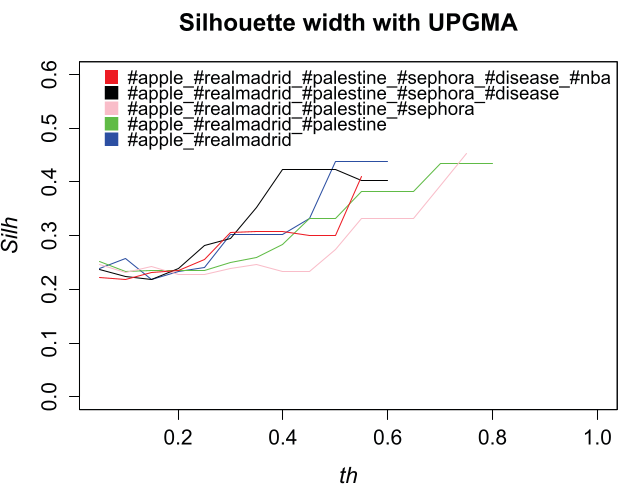 Fig 1: The peak in Silhouette width helps identify the optimal threshold for different algorithms.
Critical Insight & Future Outlook
The beauty of this research lies in its scalability. By relying on Wikipedia rather than a hand-crafted dictionary, the system adapts to new slang and trending entities automatically.
However, the study notes that not all Twitter users are the same. "Broadcasters" (who post news) behave differently than "Acquaintances" (who chat). Future iterations of this work could incorporate user behavior classes or hidden social networks to refine the weight of certain tweets.
Final Takeaway
If you want to understand what a user cares about, don't ask them—cluster their tags using UPGMA and validate the result with Silhouette width.