
Scholars on ScienceNet: Are Academic Blogs Just Digital Diaries or Research Incubators?
Comparing Topics of Scholars' Blog Posts in an Academic Social Networking Site and Publication Keywords
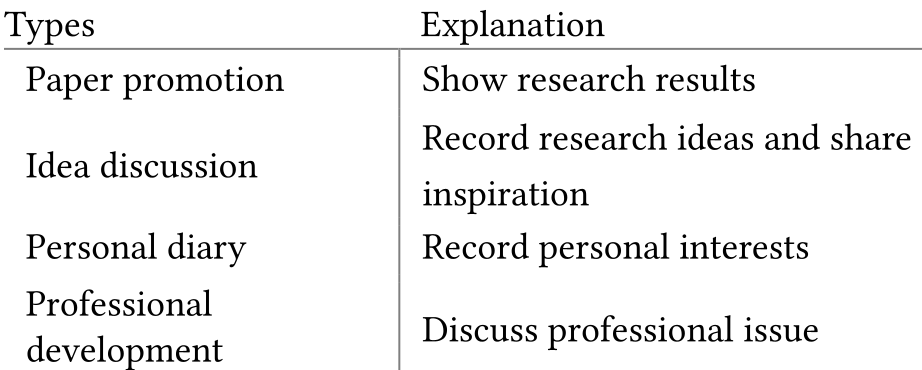
This study analyzes the relationship between scholars' blog topics on ScienceNet and their formal publication keywords using TF-IDF and Cosine Similarity. The researchers categorize academic SNS usage into four distinct patterns: Paper Promotion, Idea Discussion, Personal Diary, and Professional Development.
TL;DR
Is an academic blog a place to brainstorm new theories or just a megaphone for finished papers? This study examines a decade of data from ScienceNet to map the "semantic distance" between informal blog posts and formal journal keywords. It reveals a complex ecosystem where most scholars lean toward personal sharing, but a significant portion uses the platform as a strategic tool for Paper Promotion or Idea Discussion.
Problem & Motivation: The "Informal" Black Box
For years, we’ve known that scholars communicate outside of journals. However, analyzing these "informal channels" is notoriously difficult. Previous research struggled to distinguish between a scholar tweeting about their lunch and a scholar tweeting about a breakthrough.
The authors argue that by comparing the timing and vocabulary of blogs against official publication keywords, we can finally see the "invisible college" at work. Do ideas appear in blogs before they appear in papers (Idea Discussion), or do they appear after the paper is published (Promotion)?
Methodology: Bridging Blogs and Papers
The researchers tracked 80 high-activity scholars over 10 years, analyzing two primary data sources:
- ScienceNet: The largest Chinese real-name academic SNS.
- CNKI: The primary database for Chinese academic publications.
Using TF-IDF segmentation, they built a vocabulary of 673 topic terms and calculated the Cosine Similarity between blog content and paper keywords.
The Four-Way Classification
By comparing the similarity scores across different time frames, they categorized scholars into a 2x2 matrix:
- Promotion vs. Discussion: Based on whether blog topics aligned more with contemporary or future publications.
- Personal vs. Professional: Based on the average similarity to their academic corpus.
Insights & Results: Professionalism vs. Personality
The data suggests that the "Social" in Social Networking Sites remains dominant. 62.5% of scholars lean toward personal expression. However, those who do use the platform for work are slightly more likely to use it for Promotion (57.5%) than Discussion (42.5%).
Disciplinary Divergence
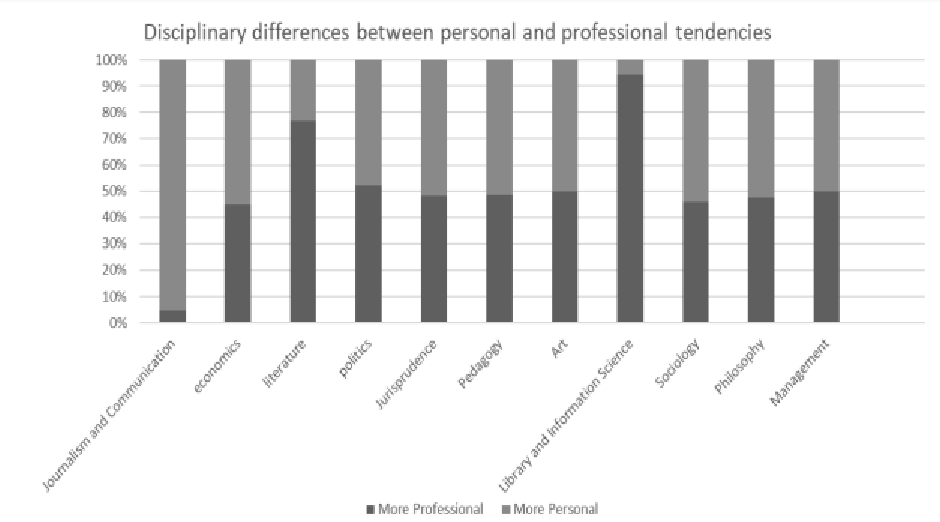
One of the most striking findings is how different fields "behave" online.
- Art and Management scholars maintain a strictly professional persona.
- Journalism scholars are the most "personal" in their blogging habits.
- Other subjects maintain a balance, treating the platform as a "hybrid" space.
Temporal Evolution
Over 10 years, scholars don't stay static. The study found two trends: some scholars become increasingly personal (rising similarity to personal interests), while others refine their focus, becoming more professional and "declining" in varied personal topics over time.
Critical Analysis & Conclusion
Takeaway
The value of an academic social network depends entirely on the scholar’s objective. For "Promotion-type" scholars, SNS is a marketing tool that increases the reach of formal work. For "Discussion-type" scholars, it is a low-stakes sandbox for testing ideas before they undergo the rigors of peer review.
Limitations
The study relies on a relatively small sample of "valid users" (80) from a specific culture (Chinese academia). Furthermore, the use of TF-IDF and Cosine Similarity might miss deeper semantic connections that modern Large Language Models (LLMs) or Embeddings could catch.
Future Outlook
As platforms move toward automated content recommendation, understanding these "User Personas" (The Promoter vs. The Thinker) will be crucial for delivering the right content to the right peers. Future research should look into whether "Idea Discussion" blogs actually lead to higher citation counts for the resulting papers.