
Legal Tech Benchmarking: Finding the Sweet Spot Between Accuracy and Interpretability
A Comparison of Classification Methods Applied to Legal Text Data
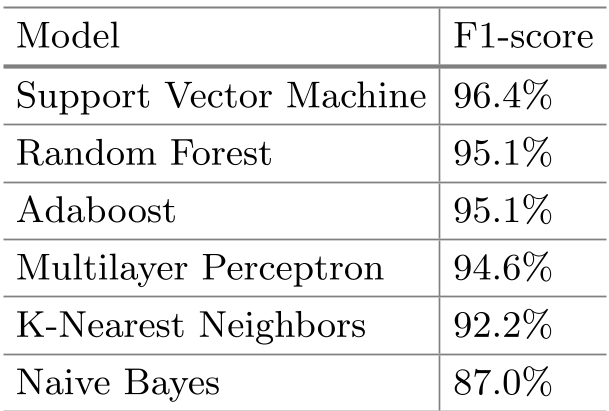
This paper presents a comparative study of supervised machine learning methods for legal text classification within the Brazilian judicial system. Utilizing TF-IDF representation on a dataset of 30,000 court documents across ten classes, the authors evaluate Support Vector Machine (SVM), Random Forest (RF), Adaboost, KNN, Naive Bayes, and MLP, with SVM achieving a top F1-score of 96.4%.
TL;DR
With millions of cases pending in Brazil, AI is no longer a luxury but a necessity for judicial celerity. This study benchmarks six classic machine learning models on 30,000 legal documents. While SVM takes the crown for raw accuracy (96.4%), Random Forest wins the "Judicial MVP" title by providing near-SOTA performance (95.1%) with the transparency required for legal auditing.
The Brazilian Judicial Bottleneck
The Brazilian court system is currently one of the largest in the world, staggering under the weight of 77 million unconcluded cases. While digitalization platforms like PJe have moved records to the cloud, the sheer volume of unstructured text—sentences, injunctions, and motions—requires automated classification to route cases efficiently. However, the legal field introduces a unique constraint: Interpretability. According to Brazilian National Council of Justice (CNJ) regulations, AI decisions in law must be auditable, a requirement that often conflicts with the "black-box" nature of modern Deep Learning.
Methodology: The Classic Pipeline
The researchers utilized a robust dataset from the Court of Justice of Rio Grande do Norte (TJRN), comprising 10 distinct procedural classes (e.g., "Dismissal of Judgment," "Preliminary Injunction," "Withdrawal").
The Feature Engineering
Interestingly, despite the rise of BERT and Embeddings, the authors opted for TF-IDF (Term Frequency-Inverse Document Frequency). Their reasoning? Computational cost and the observation that specialized legal vocabulary is distinct enough that sparse vectors perform remarkably well.
Model Architecture (MLP Focus)
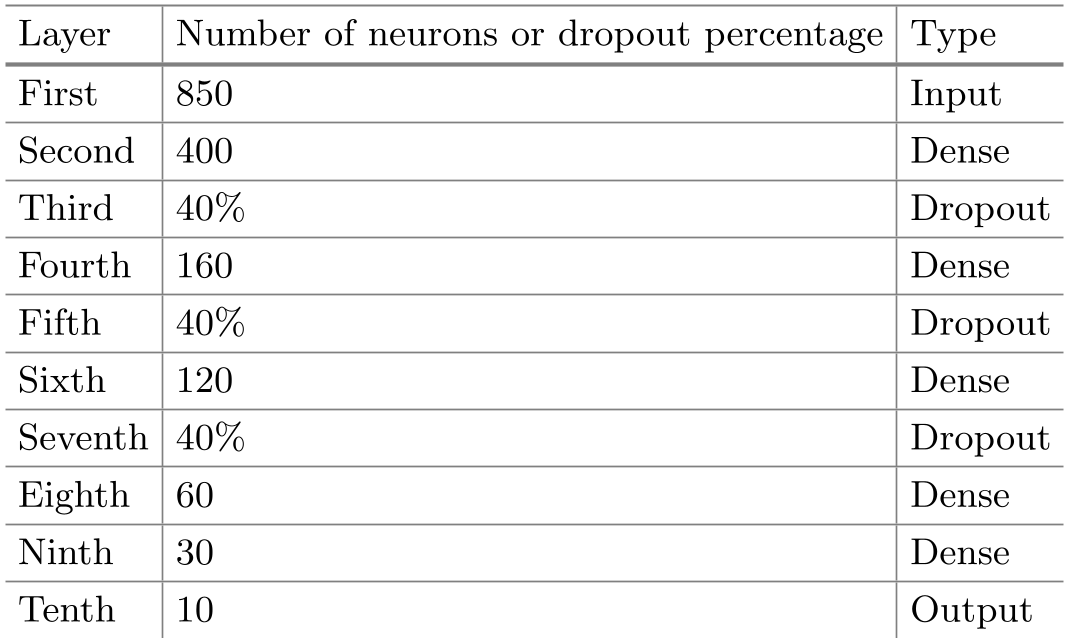
While most models were standard implementations, the Multilayer Perceptron (MLP) utilized a sophisticated 10-layer structure including multiple Dropout layers to prevent overfitting on the specific legal jargon.
Results: Performance vs. Reality
The experiments revealed a clear hierarchy in classification capability:
- SVM (96.4%): The most precise, but a "black box" that is computationally expensive for large-scale predictions.
- Random Forest/Adaboost (95.1%): High performers with excellent interpretability (decision paths can be mapped).
- MLP (94.6%): Reliable but lacks the transparency of tree-based models and the speed of Naive Bayes.
The "Confusion" of Legal Language
The study noted that classes 198 (Acceptance of motion) and 200 (Non-acceptance of motion) were the most difficult to distinguish. This is a classic Semantic Similarity problem: the two documents likely share 95% of the same vocabulary, differing only by a few "not" or "refused" keywords, which challenges TF-IDF's frequency-based logic.
Computational Efficiency
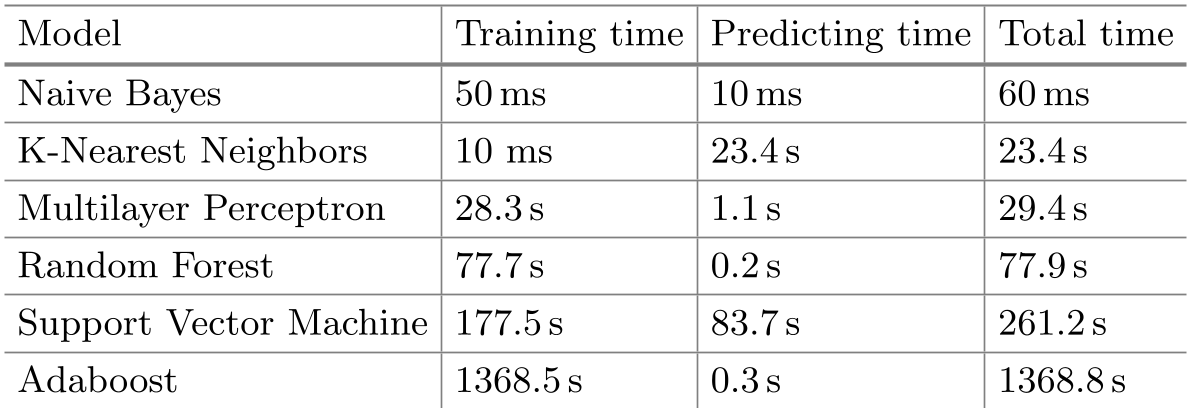
Speed is a critical factor for real-time judicial assistance. While Naive Bayes was the speed king (60ms total), SVM and Adaboost lagged significantly during inference or training, making them less suitable for high-throughput environments unless paired with significant hardware.
Critical Insight: Why Random Forest Wins
In the final ranking, which weighted F1-score, speed, and interpretability, Random Forest claimed the top spot.
- Logic: In a courtroom, a judge needs to know why a document was flagged. A decision tree provides a readable path of "if-then" conditions based on specific legal terms.
- Robustness: By reducing variance through bagging, RF handles the nuances of legal text better than a single decision tree while maintaining a much lower computational footprint than Adaboost.
Conclusion and Future Outlook
This paper serves as a vital reminder for AI practitioners: Context is King. In the legal domain, a 1% gain in accuracy (SVM over RF) is not worth the loss of explainability.
Future Work: To solve the confusion between "Acceptance" and "Non-acceptance" classes, future researchers should look toward Attention mechanisms or N-gram analysis that captures the negation context, which simple TF-IDF misses.
Takeaway for Architects
When building for regulated industries (Law, Healthcare, Finance), prioritize Ensemble Tree models first. They offer the best "Audit-to-Accuracy" ratio, ensuring both performance and compliance.