
Beyond the Silver Bullet: Deciphering Data Mining Methods for Educational Insights
A Comparison of Data Mining Methods in Analyzing Educational Data
This paper evaluates three foundational data mining techniques—Neural Networks (MLP), Logistic Regression, and Decision Trees (CHAID)—in the context of educational data from the Korea Youth Panel Survey (KYPS). The study demonstrates that Neural Networks achieve the highest prediction accuracy (CCR 83.6%) for forecasting student computer entertainment behavior, while highlighting the inherent trade-offs between predictive power and model interpretability.
TL;DR
Data mining is often marketed as a panacea for unused data, but in education, the choice of algorithm can drastically change the outcome. This study compares Neural Networks, Logistic Regression, and Decision Trees using the Korea Youth Panel Survey. While Neural Networks win on raw accuracy (83.6%), the paper argues that the "best" method depends entirely on whether you value precise prediction or the ability to explain why a student behaves a certain way.
The "Black Box" vs. "Open Book" Dilemma
In the burgeoning field of Educational Data Mining (EDM), researchers face a paradox. We have vast amounts of student data (grades, parent-child relationships, psychological stressors), but the methods used to analyze them are often chosen arbitrarily.
The motivation for this study is rooted in a critical observation: high predictive accuracy often comes at the cost of interpretability. For a teacher or policy maker, knowing a student is "at risk" is only half the battle; they need to know if the root cause is school adaptation, parental abuse, or self-esteem to provide a targeted solution.
Methodology: A Three-Way Battle
The researcher utilized the Korea Youth Panel Survey (KYPS), focusing on 2nd-grade middle school students. The task was to predict "computer entertainment behavior" based on 35 variables across three domains: Personal, Family, and School.
1. Neural Networks (The Powerhouse)
The study employed a Multi-Layer Perceptron (MLP) with two hidden layers (9 and 8 nodes respectively).
- Insight: This model captures complex, non-linear relationships that traditional statistics might miss.
2. Logistic Regression (The Balanced Veteran)
A staple of traditional statistics, used here to find the probability of a binary response.
- Insight: It offers a mathematical middle ground—faster than Neural Networks and more structured than Decision Trees.
3. Decision Trees (The Map Maker)
Using the CHAID (Chi-square Automatic Interaction Detector) algorithm, the model creates a visual flow-chart of student behavior.
- Insight: It uses statistical significance () to split the data into understandable "branches."
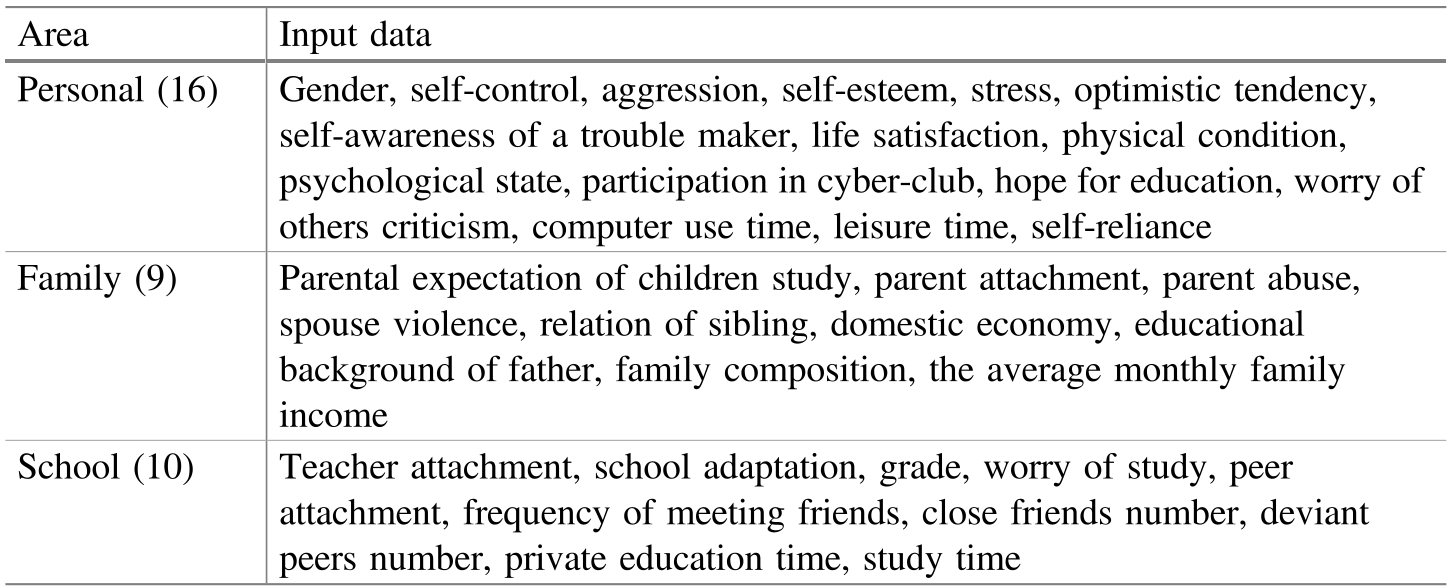 Table 1: Input variables categorized by Personal, Family, and School areas.
Experimental Results: Accuracy is Not Everything
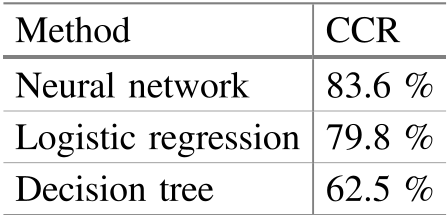
The results confirm a significant variance in Correct Classification Rates (CCR):
| Method | Accuracy (CCR) | Best For... |
|---|---|---|
| Neural Network | 83.6% | High-precision forecasting |
| Logistic Regression | 79.8% | Statistical validation & probability |
| Decision Tree | 62.5% | Identifying key influential factors |
The Decision Tree, despite having the lowest accuracy, provided a visual diagram (as seen below) that allowed researchers to trace the "pathway" to student behavior—a feat the Neural Network's hidden layers cannot replicate.
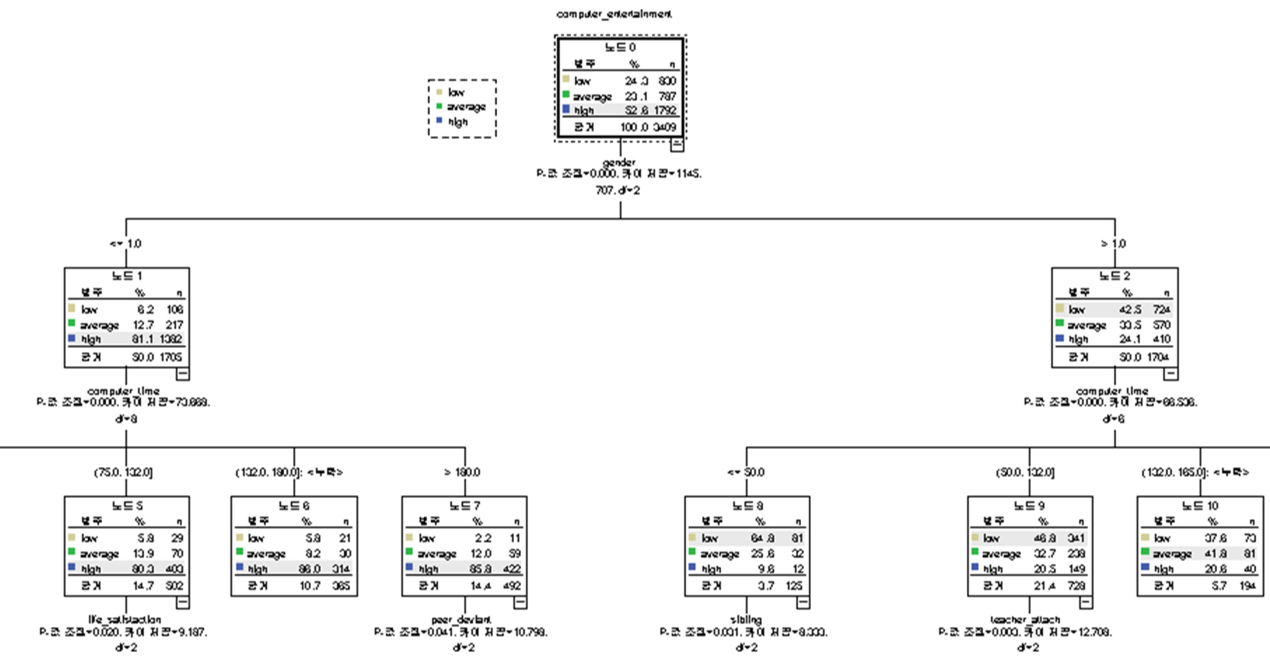 Figure 1: Transparent branching logic of the CHAID Decision Tree.
Critical Analysis: Choosing Your Weapon
The author concludes with a pragmatic framework for educational researchers:
- Neural Networks are the go-to when prediction is the end goal, but they require significant data preprocessing (normalization) and offer no "why."
- Decision Trees are essential for exploratory research and policy-making where identifying specific "trouble markers" is more important than raw CCR.
- Logistic Regression remains the most efficient for rapid analysis when computational resources or time are limited.
Limitations & Future Work
The study acknowledges that the current comparison is limited to supervised learning. As educational data becomes more unstructured (text from essays, clickstream data from LMS), the inclusion of unsupervised learning and ensemble methods (like Random Forests) will be necessary to further refine this guide.
Conclusion
This paper serves as a vital reminder that in the social sciences, SOTA performance is a multi-dimensional concept. Accuracy is a metric of the model, but utility is a metric of the research's impact on student's lives.