
RS–Boosting: Elevating Credit Risk Prediction in China's Supply Chain Finance
Comparison of individual, ensemble and integrated ensemble machine learning methods to predict China’s SME credit risk in supply chain finance
This paper investigates the prediction of credit risk for Small- and Medium-sized Enterprises (SMEs) in Supply Chain Finance (SCF) by comparing Individual (IML), Ensemble (EML), and Integrated Ensemble Machine Learning (IEML) methods. The study identifies RS–boosting as the superior predictive model, achieving state-of-the-art results on real-world datasets from Chinese listed companies.
TL;DR
Predicting the creditworthiness of SMEs is a billion-dollar challenge in Supply Chain Finance (SCF). This research demonstrates that traditional machine learning isn't enough; instead, by "integrating the ensembles"—specifically using RS–boosting—we can achieve an outstanding AUC of 0.91, significantly outperforming standard Bagging and Boosting techniques.
Context & Positioning
Small- and Medium-sized Enterprises (SMEs) are the backbone of the economy but often face a "credit crunch." Supply Chain Finance (SCF) attempts to solve this by using the credit strength of a Core Enterprise (CE) to back SME loans. However, the risk doesn't vanish—it just shifts. This paper positions itself as a critical comparative study, moving beyond simple classifiers to Integrated Ensemble Machine Learning (IEML) to solve the volatility and noise inherent in SME financial data.
The "Integration" Insight: Why Standard Ensembles Fail
The authors observe a "Boosting Paradox": in some cases, standard Boosting actually performs worse than a simple Decision Tree (74.80% vs 79.58%). This is typically due to overfitting—Boosting can over-emphasize noisy data points in the training set.
To fix this, the paper advocates for Integrated Ensembles:
- RS–boosting: Combines Random Subspace (which selects subsets of features/attributes) with Boosting (which reweights data instances). By restricting the "view" of the data through subspaces, it prevents Boosting from overfitting on noise.
- Multi-boosting: Combines Boosting (bias reduction) with Wagging (variance reduction), aiming for a more stable and robust prediction committee.
Methodology: The Architecture of RS-Boosting
The core logic involves a two-layer approach to diversification. While standard Boosting focuses on hard-to-classify samples, adding a Random Subspace layer ensures the model doesn't become "obsessed" with outliers by forcing it to look at different subsets of financial indicators (like liquidity ratios vs. turnover ratios).
 Note: The study utilized 18 financial and non-financial variables as input features for the C4.5 base classifier.
Experiments and Results
The study analyzed 377 quarterly data points from Chinese SMEs. The evaluation focused not just on accuracy, but on the Type II Error—the risk of misclassifying a "bad" loan as "good"—which is the most expensive mistake for a bank.
Performance Comparison:
| Method | Accuracy | Type II Error | AUC |
|---|---|---|---|
| Decision Tree (IML) | 79.58% | 20.40% | 0.860 |
| Boosting (EML) | 74.80% | 25.20% | 0.813 |
| RS–boosting (IEML) | 85.41% | 14.10% | 0.910 |
| Multi-boosting (IEML) | 84.08% | 15.90% | 0.907 |
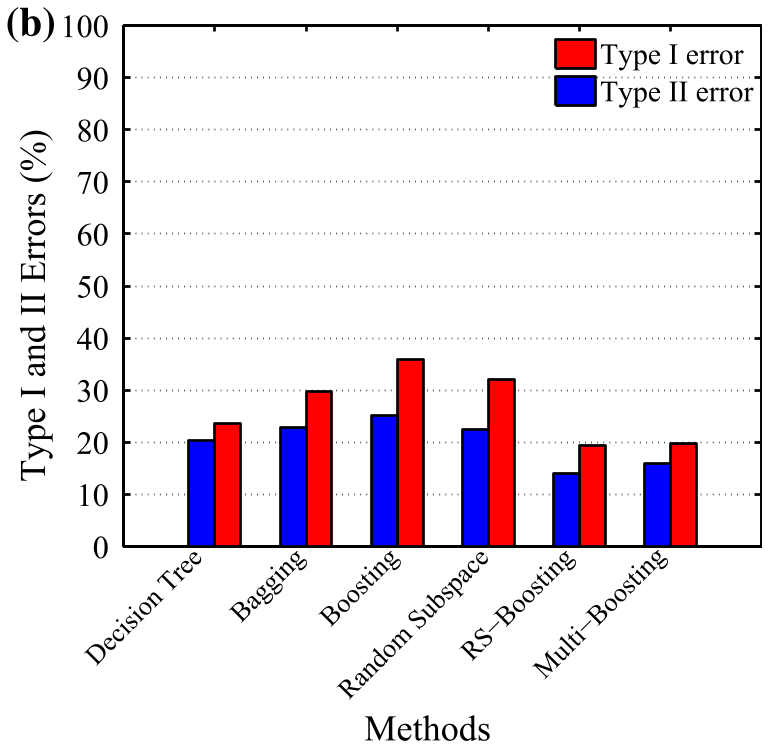
The results are striking: Integrating Random Subspace with Boosting reduced the error rate by nearly 10% compared to standard Boosting. This proves that the combination of attribute partitioning and instance partitioning creates a much more robust "Inductive Bias."
Critical Analysis & Takeaways
- Ensemble Integration is Key: The "Integrated" approach (IEML) is clearly superior to standard "Ensemble" (EML) for financial risk. It suggests that researchers should stop trying to find the "perfect" classifier and start finding the "perfect" way to combine them.
- Base Classifiers Matter: The finding that Decision Trees outperformed Neural Networks (85% vs 82% in average accuracy) confirms that for tabular, heterogeneous financial data, tree-based logic remains the gold standard over deep learning.
- Limitations: The sample size (48 SMEs) is relatively small. While 10-fold cross-validation was used, future work should test these IEML methods on "Big Data" scales or across different international markets to verify the generalizability of the RS–boosting advantage.
Conclusion
This paper serves as a blueprint for modern financial risk modeling. By leveraging Integrated Ensemble methods, financial institutions can significantly sharpen their credit decisions, potentially saving millions in avoided defaults while facilitating much-needed capital flow to SMEs.