
Decoding Healthcare Fraud: A Comparative Blueprint for Machine Learning in Medicare Claims
A Comparison of Machine Learning Methods Applicable to Healthcare Claims Fraud Detection
This paper presents a comparative study of five machine learning algorithms—Naive Bayes, Logistic Regression, Random Forest, Gradient Boosted Trees (GBT), and Artificial Neural Networks—for detecting healthcare claims fraud using Medicare participation and payment data. The study identifies Gradient Boosted Trees as the superior method, achieving a State-of-the-Art (SOTA) AUC of 0.97.
TL;DR
Healthcare fraud is a multi-billion dollar drain on global economies. This research rigorously compares traditional and modern ML architectures on the Medicare dataset. The verdict? While simple statistical models like Naive Bayes fail in the face of complex fraud patterns, Gradient Boosted Trees (GBT) and Neural Networks provide highly robust detection capabilities, with GBT reaching a peak AUC of 0.97.
Problem & Motivation: The Failure of Rule-Based Systems
The healthcare industry is plagued by "the triad of loss": Waste, Abuse, and Fraud. Unlike waste (unintentional) or abuse (non-standard practices), fraud is the intentional deception for financial gain, such as billing for services never rendered.
Prior work often relied on manually crafted rules or univariate outlier detection (looking for "big spenders"). However, modern fraud is stealthy and multi-dimensional. The author’s research intuition suggests that the relationship between provider types, submission amounts, and utilization counts is non-linear, requiring models that can capture high-order interactions.
Methodology: Bridging the Label Gap
One of the greatest hurdles in fraud research is the scarcity of labeled data. To solve this, the authors implemented a sophisticated pre-processing pipeline:
- Entity Resolution: Using Fuzzy Matching (Names + Zip Codes) to link the Medicare Payment dataset with the List of Excluded Individual/Entities (LEIE).
- Feature Selection: Focus on NPI (National Provider Identifier), provider types, and charge-to-payment ratios.
- Algorithmic Benchmarking: Comparing five distinct "archetypes" of ML:
- Probabilistic: Naive Bayes
- Linear: Logistic Regression
- Ensemble (Bagging): Random Forest
- Ensemble (Boosting): Gradient Boosted Trees (GBT)
- Connectionist: Artificial Neural Networks (ANN)
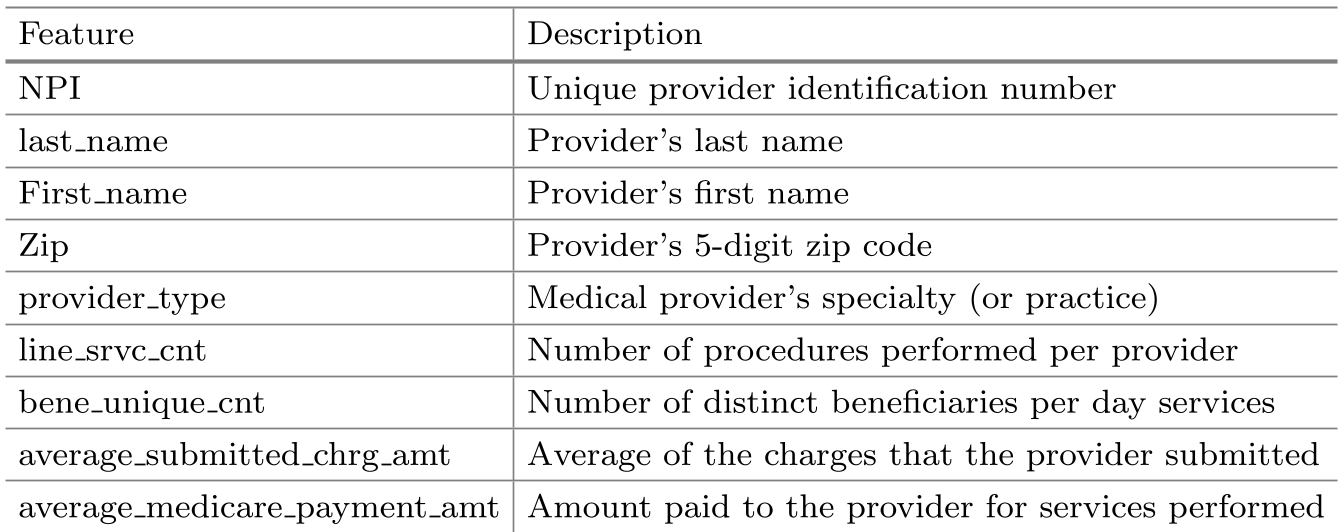 Table 1: The core features extracted from the Medicare and LEIE datasets.
Experiments & Results: The Rise of Ensemble Methods
The experiments yielded a clear hierarchy of performance. Simple classifiers suffered from "Information Underload"—Naive Bayes achieved an AUC of only 0.47, essentially behaving like a coin flip.
The real breakthrough occurred with Gradient Boosted Trees. By iteratively correcting the errors of weak learners, the GBT model achieved:
- AUC: 0.97
- Precision/Recall: 93.3%
- Specificity: 98% (Critical for minimizing false accusations against honest doctors).
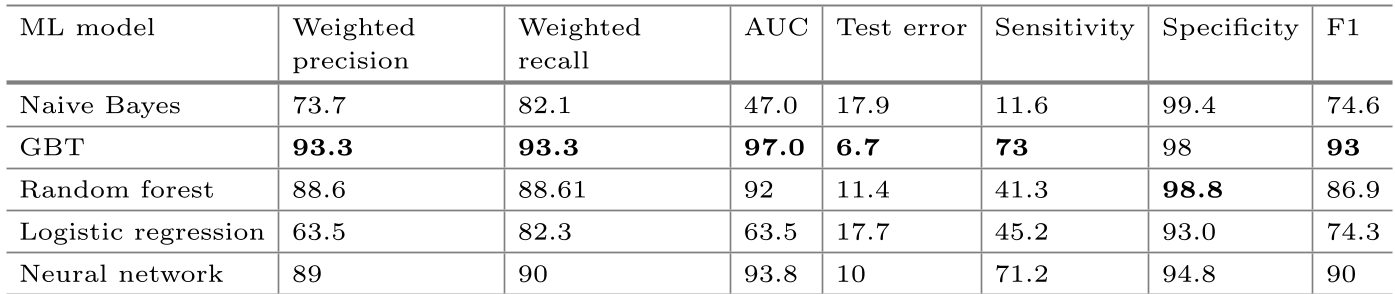 Table 2: Comprehensive comparison of ML model performance.
The Neural Network followed closely (AUC 0.938), but GBT's superior performance suggests that for structured tabular data in healthcare, tree-based boosting often maintains an edge over deep learning in terms of both accuracy and training efficiency.
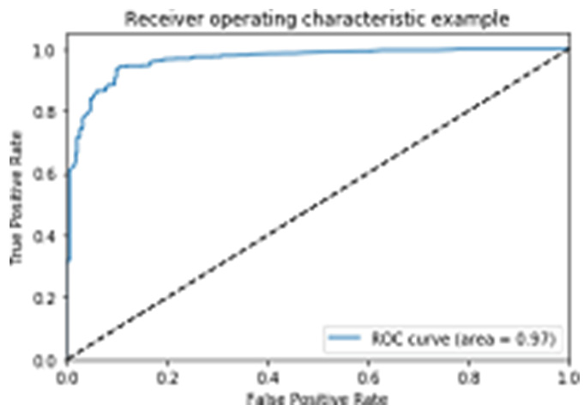 Fig 1: The ROC curve of the GBT model showing near-perfect separation power.
Critical Insight & Conclusion
Takeaway
This study proves that healthcare fraud detection is not just a "needle in a haystack" problem—it's a "changing needle" problem. The success of Gradient Boosted Trees highlights that fraud patterns are best captured through hierarchical decision boundaries rather than linear separations or simple probability distributions.
Limitations & Future Work
- Provider Bias: The current model focuses almost exclusively on the provider's behavior. Future iterations must incorporate patient-side data to detect collusion.
- Label Noise: Fuzzy matching, while clever, can introduce false positives in the ground truth.
- Interpretability: While GBT is powerful, it is a "black box." In a legal / healthcare context, "Explainable AI" (XAI) will be the next frontier to ensure providers are not unfairly blacklisted.
Final Thought: Moving from rule-based systems to GBT-driven models could save the healthcare system billions, shifting the industry from reactive auditing to proactive prevention.