
Harmonizing Hybrid Learning: Is Age Still a Barrier to Mobile Social Networking in Education?
A Comparison Study of Student Acceptance of Social Network Services and Mobile Technologies in Hybrid Learning
This study evaluates student acceptance of integrating Social Network Services (SNS), specifically Facebook private groups, and mobile technologies within a hybrid learning framework. Utilizing the Technology Acceptance Model (TAM), it compares perceived usefulness, ease of use, and behavioral intentions across different student age groups in higher education.
TL;DR
This research investigates whether age influences how higher education students accept Facebook and mobile devices as formal learning tools. By applying the Technology Acceptance Model (TAM), the study concludes that there is no significant difference in acceptance between students aged 18-24 and those aged 25-40, suggesting a convergence in digital fluency that simplifies hybrid learning design.
The Hybrid Learning Dilemma: Beyond the "Digital Native" Myth
For years, the education sector has operated under the assumption of a sharp generational divide—the "Digital Natives" versus "Digital Immigrants." As hybrid learning (the mix of face-to-face and online instruction) becomes the standard, educators often worry if older students will struggle with newer ICT tools like mobile social networks.
The authors argue that simply adding technology is not a guaranteed win. The success of a hybrid approach depends on Technology Affordance—how the properties of the tech match the needs and abilities of the users. If a 30-year-old student finds Facebook-based learning cumbersome compared to a 19-year-old, a unified teaching strategy might fail.
Methodology: The TAM Lens
The study utilizes the Technology Acceptance Model (TAM), focusing on three core pillars:
- Perceived Usefulness (PU): Does the student think this will help them learn better?
- Perceived Ease of Use (PEOU): Is the tool effort-free to navigate?
- Behavioral Intention (BI): Does the student actually plan to use it?
The researchers integrated Facebook private groups and Moodle (LMS) into a hybrid course, then surveyed 68 students divided into two age groups: G1 (18-24) and G2 (25-40).
 Figure 1: Measurement development based on established TAM literature.
Key Findings: Closing the Gap
Contrary to the hypothesis that younger students would be more receptive, the statistical analysis (Paired Sample T-Test) showed that both groups were surprisingly aligned.
- Perceived Usefulness: G1 (3.44) vs G2 (3.32) — Result: Not Sig.
- Perceived Ease of Use: G1 (3.81) vs G2 (3.68) — Result: Not Sig.
- Behavioral Intention: G1 (3.23) vs G2 (3.14) — Result: Not Sig.
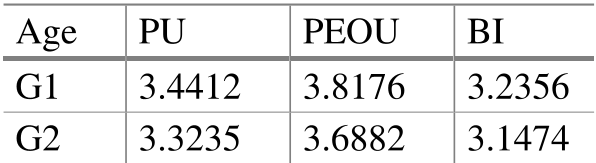 Figure 2: Mean acceptance scores highlighting the minimal variance between age groups.
The data suggests that the "Advanced Information and Communication Technology (ICT)" of the mid-2020s has transformed daily life so thoroughly that Facebook use is a normalized skill for all working-age adults.
Critical Analysis & Insights
Why did age not matter?
The authors suggest that while a "big age gap" (e.g., teenagers vs. elderly) might still show differences, the gap between 20-year-olds and 35-year-olds in a professional education setting is negligible. Social media is no longer a "youth toy"; it is a primary communication infrastructure.
Limitations
- Sample Size: With only 68 respondents, the study lacks the power for complex regression analysis.
- Platform Specificity: Facebook's dominance is shifting. Future studies should look at Discord, Slack, or TikTok to see if the age parity holds for newer, "trendier" platforms.
Conclusion: A Green Light for Educators
The takeaway for instructional designers is clear: Don't over-segregate your tech strategy by age. Instead, focus on the "Khan’s Octagonal Framework"—balancing pedagogy, interface design, and resource support. Mobile-based social learning is a "low-risk pedagogical strategy" that enjoys broad acceptance across the adult learner spectrum.
The future of hybrid learning lies not in choosing the "youngest" tech, but in selecting ubiquitous tools that reduce friction for every student, regardless of their birth year.