
Measuring the Human Firewall: A Multidimensional Approach to User Competence in Social Networks
8391_Competence measure in social networks.
This paper introduces a multidimensional measurement framework to assess "User Competence" in detecting security threats within Online Social Networks (OSNs). By integrating four dimensions—Self-Efficacy, Privacy Awareness, Security Awareness, and Cybercrime Experience—the authors validate a new scale using the Schriesheim and Hinkin item-categorization approach to establish a robust metric for human-centric cybersecurity.
TL;DR
In the escalating arms race of cybersecurity, the "Human Factor" remains the most volatile variable. This paper moves beyond the cliché of users being the "weakest link" by proposing and validating a rigorous User Competence Measure. By synthesizing Self-Efficacy, Privacy/Security Awareness, and Past Experience, the researchers provide a validated 16-item scale designed to quantify a user's ability to detect and deflect OSN-based threats.
The "Weak Link" Fallacy: Why Current Metrics Fail
For years, organizations have treated security training as a monolithic "checkbox" exercise. The underlying problem is a lack of differentiation. If we cannot accurately measure why a user fails—is it a lack of knowledge, a lack of confidence (self-efficacy), or a lack of relevant experience?—we cannot fix the behavior.
The authors argue that "User Competence" isn't just about knowing what a phishing link looks like; it's a complex intersection of:
- Affective-oriented (Self-efficacy: "Do I believe I can protect myself?")
- Cognitive-oriented (Past experience: "What have I learned from being burned?")
- Skills-oriented (Awareness: "Do I know the practical steps for safe browsing?")
Methodology: Beyond Simple Surveys
Constructing a new scale requires more than just writing questions; it requires Content Validity. The authors employed the Schriesheim and Hinkin approach, a sophisticated item-categorization method rare in the InfoSec field.
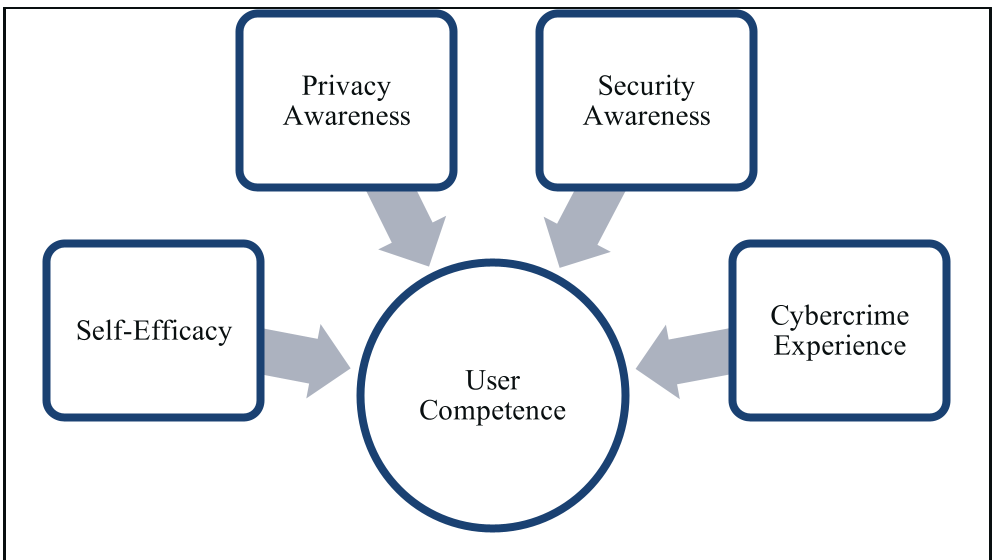
Rather than just asking if a question is "good," they tasked experts with mapping each question to the four dimensions. This revealed where our definitions of "Security" and "Privacy" actually overlap in the user's mind.
Critical Results: Trimming the Fat
The study initially proposed 20 measurement items. Through expert analysis, four items were discarded for failing to meet the 60% relevance threshold.
| Key Finding | Insight |
|---|---|
| Ambiguity in Reporting | Item 11 (reporting malicious accounts) was confused between "Security Awareness" and "Self-Efficacy," suggesting that the act of reporting is as much about user confidence as it is about knowledge. |
| The Experience Factor | Cybercrime experience items (e.g., identity theft, fraud) were highly distinct and validated, proving that past victimization is a unique and powerful component of competence. |
| Terminology Matters | The shift from technical terms like "configure" to "manage" significantly improved expert consensus, highlighting the need for accessible language in security UI. |
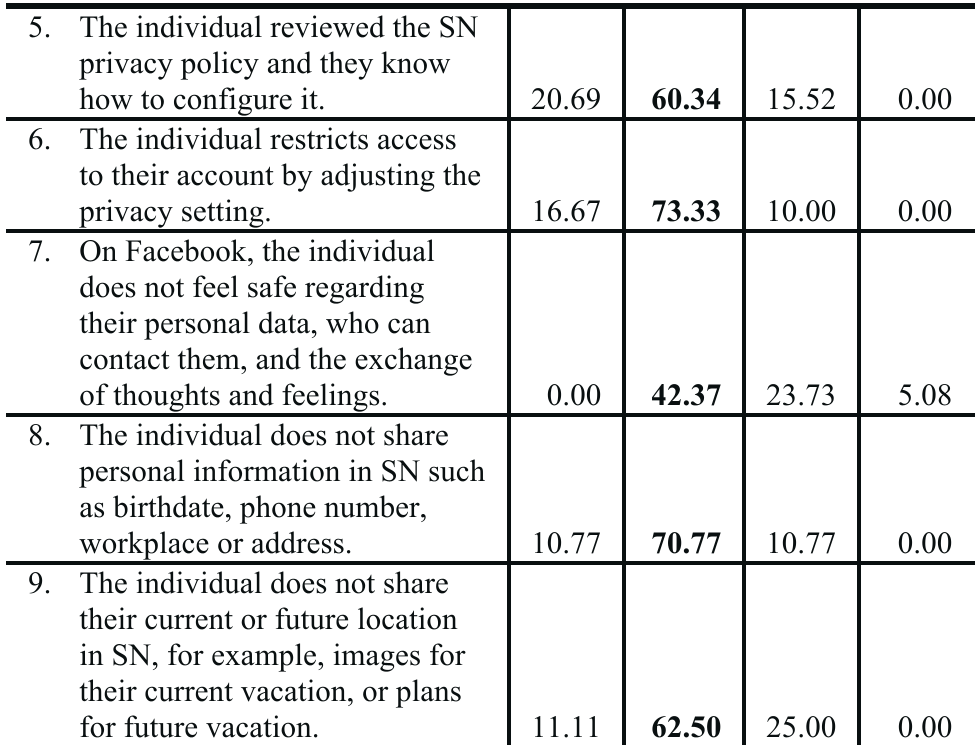 Example of Likert-based relevance mapping for Privacy Awareness items.
Deep Insight: From Generic to Tailored Security
The real-world value of this paper lies in Adaptive Training. If an organization uses this scale, they might find that "Group A" has high security awareness but zero self-efficacy (they know the rules but don't think they can apply them), while "Group B" has high self-efficacy but low privacy awareness.
The resulting training programs would be fundamentally different:
- Group A needs "hands-on" simulations to build confidence.
- Group B needs "knowledge-based" briefings on data footprints.
Conclusion & Future Outlook
This work provides a scientifically grounded starting point for quantifying human security potential. While the sample size was small (17 experts), the methodology provides a blueprint for future large-scale empirical tests. As we move toward 2026, where AI-driven social engineering will be the norm, having a "Human Competence Score" might become as standard as a network vulnerability scan.
Takeaway: Stop blaming the user and start measuring the dimension of their struggle. Only then can we build a truly resilient defense.