
Detecting Competency in Human Interactivity: A Pragma-Linguistic Approach
Competencies detection approach from professional interactions
The paper proposes a pragma-linguistic approach for "Competencies Detection" from professional mediated communications (e.g., chats/emails). By combining Searle’s Speech Act Theory with the E-DISCO taxonomy, the authors developed two algorithms to automatically identify competence manifestations and distinguish between "competence requesters" and "competence deliverers."
TL;DR
Most organizations rely on static CVs to track talent, but real skills are visible in how employees solve problems together. This paper introduces a novel framework for detecting implicit competencies within professional chat logs (like the Ubuntu community forum) by analyzing the "acts" behind the words. By isolating "help-loops" and counting specific linguistic cues like "Directives" and "Evaluations," the researchers can objectively distinguish the expert from the learner.
Problem & Motivation: The "Self-Declaration" Paradox
The core problem identified by Merzouki et al. is that traditional competence management is static and subjective.
- The CV Bias: A CV represents what an individual thinks or wants others to think about their skills.
- The Evolution Gap: Skills evolve daily through problem-solving, yet this evolution is rarely captured by HR systems.
- The Context Blindness: Standard text mining (keyword counting) cannot tell the difference between someone asking "How do I fix the SIS video card?" and someone answering it.
The authors propose that interaction is the crucible of competence. When two people interact to solve a technical problem, the latent knowledge "in their heads" becomes visible through the language they use to direct and evaluate others.
Methodology: From Speech Acts to Skill Taxonomies
The researchers moved beyond simple keyword matching to Pragma-Linguistic Analysis. The framework operates on two distinct logical layers:
1. The Competency Assumption (Finding the Loop)
Competence manifestation isn't just a single word; it's a process. The first algorithm identifies Help-loops. These are segments of dialogue that start with a "Directive Request" (e.g., "Can you help me?") and end with a "Closure" (e.g., "Thanks").
2. The Manifestation Analysis (Identifying the Expert)
Once a loop is found, the second algorithm analyzes the "Weight of Authority" using two main tools:
- Searle’s Speech Acts: Experts use Directives (telling what to do) and Evaluations (judging if it works). Requesters use Requests.
- E-DISCO Taxonomy: A multilingual dictionary used to map specific "Action Verbs" (Configure, Diagnose, Build) to specialized technical domains.
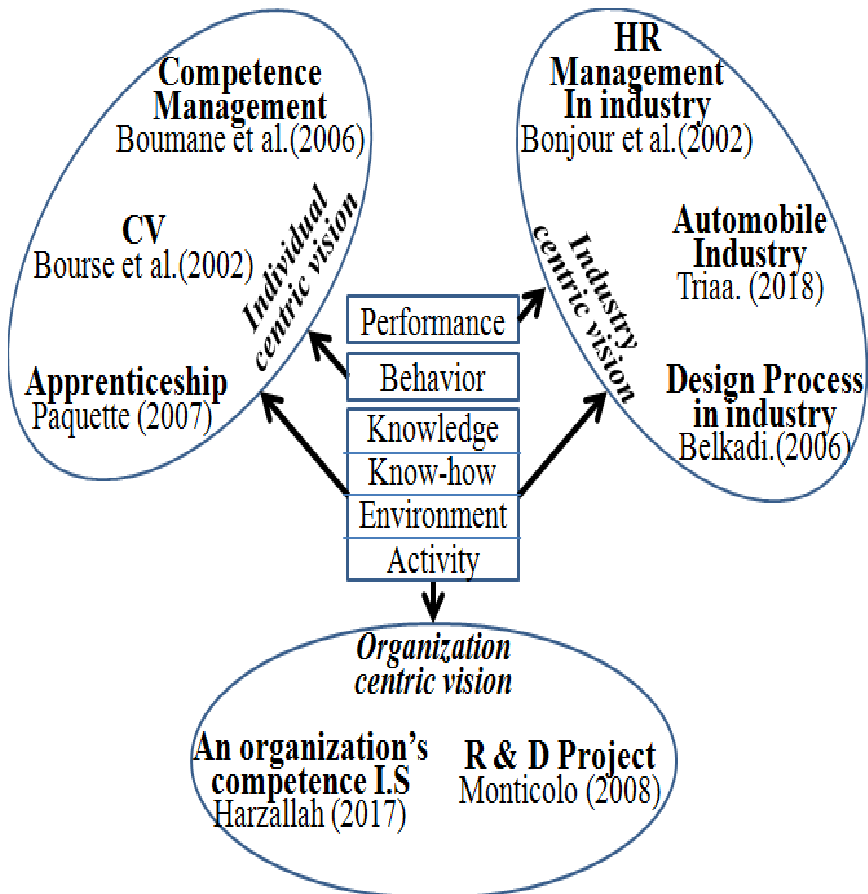 Figure 1: The paper's framework for characterizing competence through Individual, Industrial, and Organizational lenses.
Experiments: Mining the Ubuntu Corpus
The authors tested their method on the Ubuntu Corpus—a massive dataset of Linux-related technical fixes. This is a difficult "zero-identity" environment where users have no formal roles or titles.
Key Findings in a Test Loop:
- The Requester (Kartagis): Initiated the loop with "Can you help me?" and provided the closing "Thanks."
- The Expert (Ikonia): Provided 4 Directive Acts (e.g., "set spot on", "run 'id' on the user") and specific Evaluations (e.g., "that should be fine").
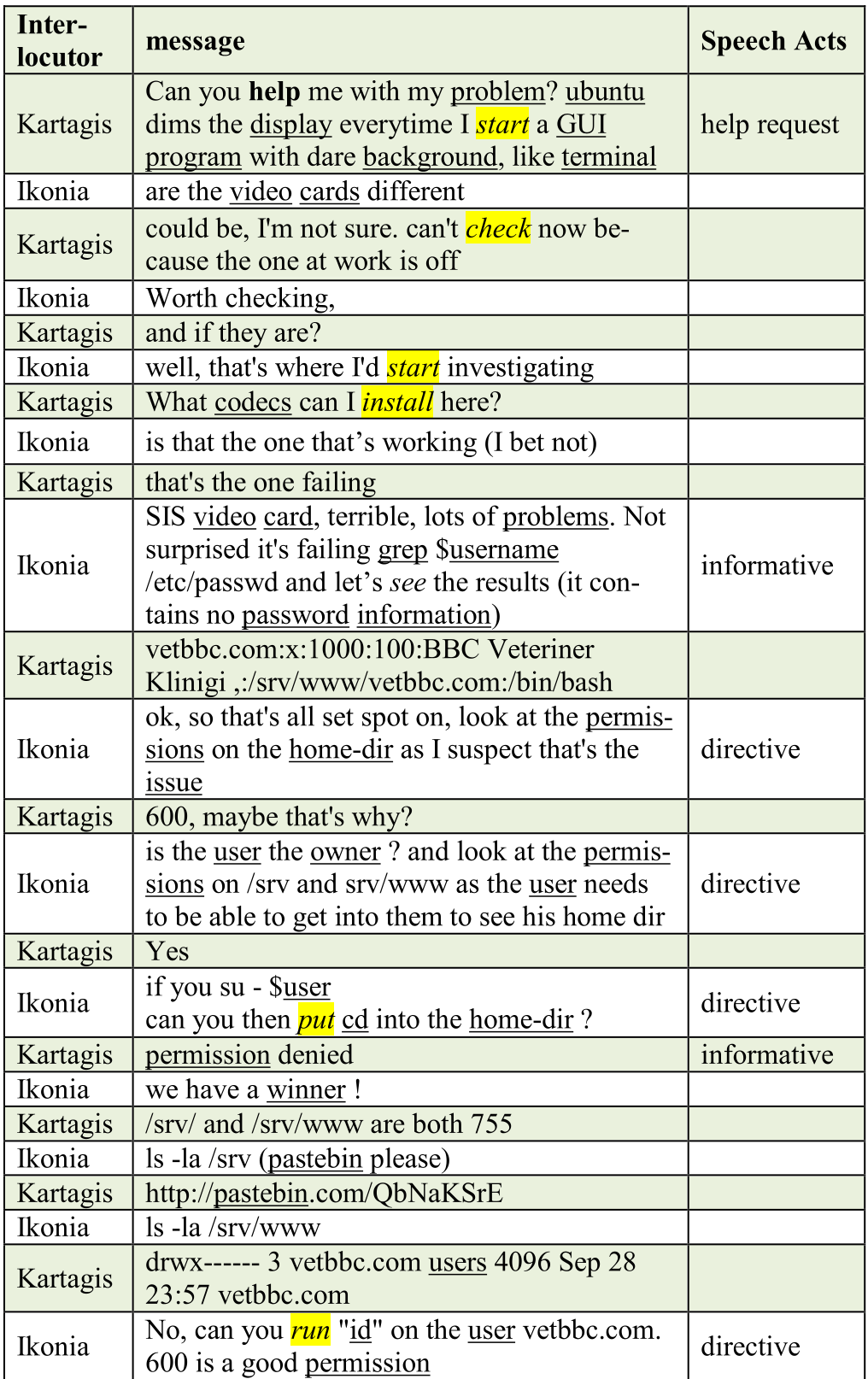 Figure 2: A detailed breakdown of a help-loop where speech acts reveal the expert (Ikonia) through directive language.
The quantitative results (Table VIII in the paper) showed a clear asymmetry: the expert performed nearly all the Directive and Evaluation acts, while the requester stayed within the boundary of information seeking.
Critical Analysis & Conclusion
Takeaway: This work shifts the focus from what people say they can do to what they actually do in practice. It provides a blueprint for "Knowledge Capitalization" by turning ephemeral chat logs into structured competence profiles.
Limitations:
- Complexity of Dialogue: The current model works best on brief, task-oriented forums. In more "noisy" environments (like a casual Slack channel), the help-loops might be harder to isolate.
- Vocabulary Dependence: Relying on the E-DISCO taxonomy requires frequent updates to include modern tech stacks (e.g., Kubernetes, LLM-ops).
Future Outlook: The integration of this pragma-linguistic logic with modern Large Language Models (LLMs) could automate organizational expert-finding at an unprecedented scale, moving companies toward a truly "competence-aware" management style.