
The Seed's Dilemma: Navigating Competition in D2D Crowdsourcing
Competition-Based Participant Recruitment for Delay-Sensitive Crowdsourcing Applications in D2D Networks
The paper investigates a competition-based participant recruitment strategy for delay-sensitive crowdsourcing in Device-to-Device (D2D) networks. It introduces the "Seed dilemma" where initially recruited nodes must decide whom to invite to maximize collective reward while minimizing the risk of being out-competed, proposing a centralized Dynamic Programming approach and two distributed alternatives (Cell-based and Task-Splitting).
TL;DR
In Device-to-Device (D2D) networks, connectivity is a luxury, not a guarantee. This paper tackles a unique problem: how can a small group of "seeds" recruit more participants for a crowdsourcing task without being "robbed" of their rewards by the very people they invite? By utilizing Opportunistic Voronoi Cells and a Task-Splitting algorithm, the researchers provide a way to maximize data collection while keeping the risks of competition under control.
Background: Why D2D Crowdsourcing is a Battlefield
Traditional crowdsourcing assumes a central server can talk to everyone. In D2D (mobile opportunistic networks), nodes communicate only when they physically meet. Imagine a rescue mission in a National Park with no cell service. The ranger (initiator) sends a task to a few nearby visitors (seeds). These seeds want to recruit others to ensure the mission succeeds (and they get paid), but there's a catch: the reward pool is limited. If a seed recruits a "faster" node that reaches the ranger first, the seed might get nothing.
This creates a Stochastic Competitive Environment where the primary enemies are delivery delay and peer competition.
Methodology: From Centralized Logic to Distributed Intuition
1. The Centralized Benchmark (DP)
The authors first define a 0-1 Nonlinear Programming problem. The goal is to maximize the expected number of successful participants (Utility) while keeping the probability of a seed failing (Penalty) below a threshold . They solve this using Dynamic Programming, providing a mathematical "gold standard" for the best possible recruitment strategy.
2. Opportunistic Voronoi Cells
Since global knowledge is impossible in the wild, the authors propose partitioning the network. Unlike traditional Voronoi diagrams based on GPS, Opportunistic Voronoi Cells use "Stochastic Distance"—the inverse probability of meeting within the delay budget.
- Seed as Generator: Each seed becomes the center of a cell.
- Local Optimization: Seeds only worry about recruiting nodes within their probabilistic neighborhood.
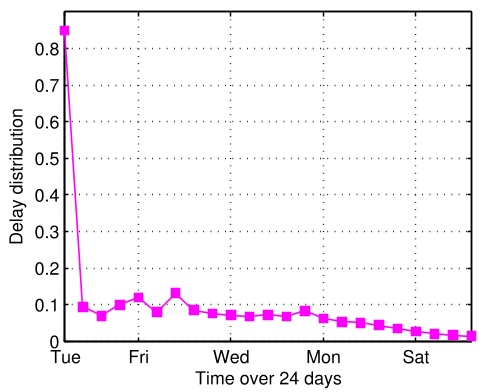 Figure: The concept of Opportunistic Voronoi partitioning where cells are defined by encounter probabilities.
3. Task-Splitting (The Online Approach)
For more dynamic scenarios, the Task-Splitting scheme allows seeds to delegate their "recruitment quota" to others. If a seed meets a "popular" node (one with many contacts), it splits its recruitment task and hands over a portion of the quota. This turns recruitment into a recursive, distributed branching process.
Experimental Validation: Trials in the Real World
The researchers didn't just simulate; they built an Android prototype and ran it on 25 tablets for 24 days.
Key Findings:
- Reliability: The "Cell-Whole" distributed approach achieved a success rate (0.792) incredibly close to the Centralized optimum (0.822).
- The Weekend Effect: Success rates dropped during weekends because human mobility—and thus D2D contact opportunities—decreases, highlighting the "Social" nature of these networks.
- Scalability: As the number of nodes increases, the distributed methods maintain high utility without the exponential communication cost of centralized systems.
 Table: Comparison of success rates and delay across different schemes. Note how "Split" and "Cell-Single" are more aggressive, yielding higher utility but higher risk.
Critical Insight: Who Should We Recruit?
The study reveals a fascinating Inductive Bias in the recruitment strategy:
- If the delay budget is tight, seeds must be selfish and recruit fewer nodes to ensure they reach the initiator first.
- If the budget is generous, seeds should be aggressive, recruiting many nodes because the risk of "losing the race" is dominated by the probability of the group failing the task altogether.
Conclusion & Future Outlook
This paper effectively bridges the gap between game theory and practical networking. The shift from "geographic" to "opportunistic" Voronoi cells accurately captures the reality of mobile life. Future work could integrate Social Trust—not only asking if a node can deliver data, but if it will cooperate without "dropping" packets maliciously.
As we move toward 6G and ubiquitous D2D communication, these competitive recruitment strategies will be vital for decentralized sensing, from environmental monitoring to urban traffic analysis.