
The Hysteresis of Influence: Navigating Content Wars Across Multiple Social Networks
Competition for content spread over multiple social networks
The paper investigates competition between two content creators using multiple social networks to reach consumers. It models information spread via a non-cooperative game, identifying a unique "hysteresis-like" resource allocation behavior where creators saturate primary networks before expanding to secondary ones.
TL;DR
In the fragmented landscape of modern social media, content creators (like CNN vs. BBC) aren't just fighting for eyes—they are fighting for efficiency across platforms. This paper introduces a game-theoretic framework to prove that resource allocation isn't a smooth transition. Instead, it follows a hysteresis pattern: creators saturate the most efficient network and then "pause" before investing in the next, depending on how much their rival spends.
Background: The Multi-Network Dilemma
Content creators today inhabit a "multi-homed" world. Users oscillate between Twitter (high activity, immediate) and Facebook (broader reach, different pace). The fundamental challenge is: How should a creator split their budget when their opponent is doing the same across the same set of platforms?
The Core Insight: Network Efficiency
The authors define network efficiency through two simple yet powerful parameters:
- (Activity Level): How fast does content "meet" a user?
- (Popularity): What is the probability of a user being in that network?
By combining these, they rank networks. If Network A has a higher than Network B, it is objectively "better." The goal then becomes maximizing the fraction of the population () that sees your content first.
Methodology: Fluid Dynamics and Game Theory
To avoid the complexity of individual node interactions in billion-user networks, the authors use Fluid Limits. They model the spread of content like an epidemic, using O.D.E.s to track the growth of "infected" users (those who consumed the content).
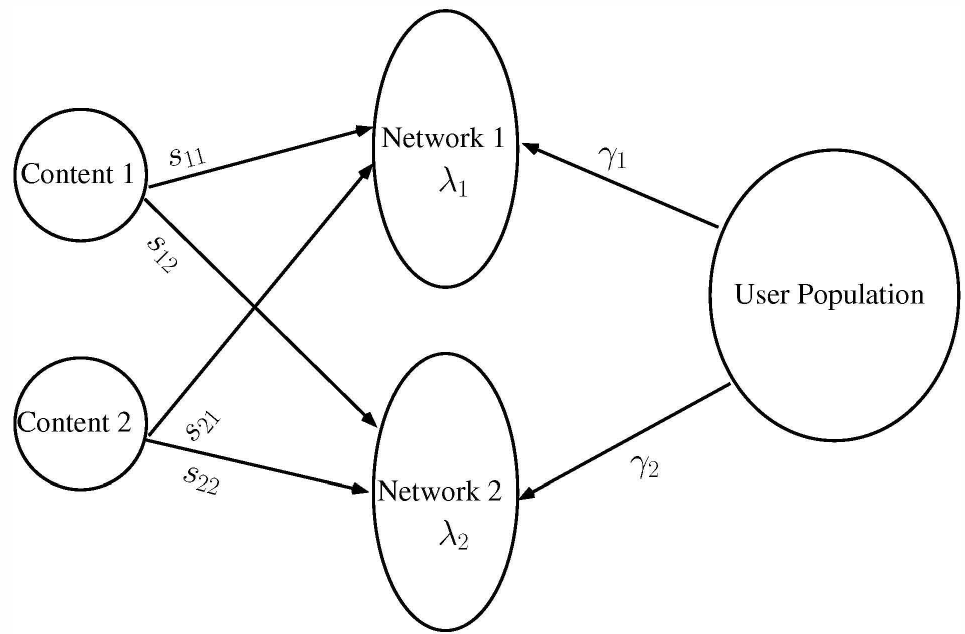 Fig 1: Interaction between content sources, multiple social networks, and the common user pool.
The game is formulated as a non-cooperative struggle for budget (). The utility function balances the reach () against the cost of the promotion accounts ().
The "Hysteresis" Discovery
The most striking finding is the Best Response Function structure. Unlike simple linear models, the transition from Network 1 to Network 2 is a step-function characterized by inertia.
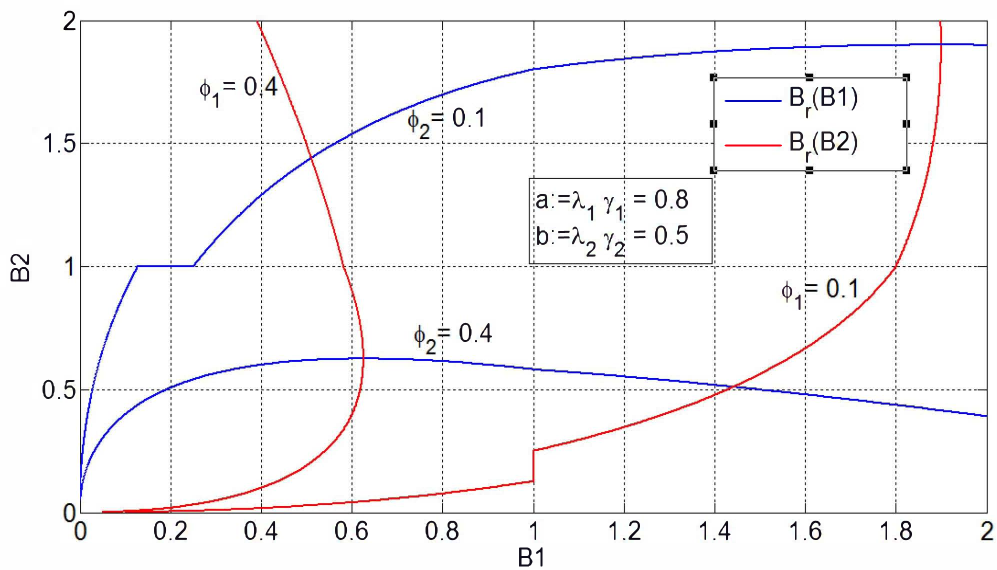 Fig 2: The Best Response Curve showing the "flat" regions where the budget stays at 1 (saturating the first network) before jumping to 2.
Why does this happen?
- Saturation Point: Once you've maxxed out the "Better" network (), the marginal utility of moving to a "Worse" network is initially lower than the cost.
- The Gap: You only start spending on the second network when the competition's pressure on the first network becomes so high that you need the "spillover" reach from the second network to maintain your audience share.
- Inertia: When reducing budget, the reverse happens. You cling to the efficient network longer than you initially did when scaling up.
Experimental Validation: Nash Equilibrium
Through numerical simulations, the authors demonstrate how costs affect market behavior.
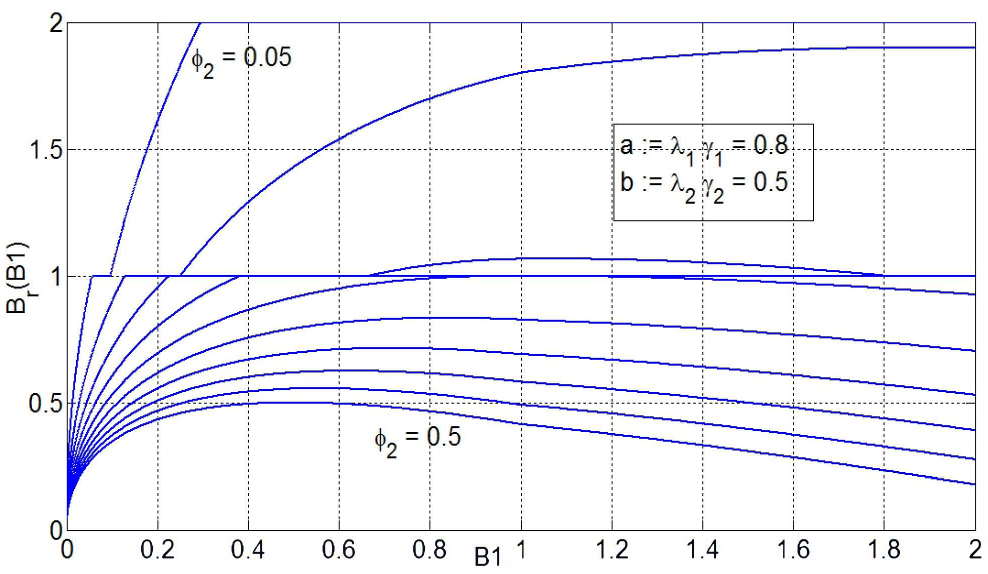 Fig 3: Sensitivity analysis showing that as costs () increase, the creator becomes significantly more conservative.
Key findings from the Nash Equilibrium analysis:
- Cost Dominance: Reducing your own cost per promotion account is more effective for market share than trying to outspend a rival.
- Relative Efficiency: The "Hysteresis Gap" grows larger as the gap between platform efficiencies (e.g., Twitter vs. a niche blog) increases.
Critical Insight & Conclusion
This paper moves beyond the "where to seed" question of viral marketing and addresses the "where to stay" question of long-term competition.
Pros: It provides an elegant mathematical explanation for why brands often seem to stick to one platform even when they have the budget for more—it’s not just lack of creativity, it’s a strategic equilibrium.
Limitations: The model assumes content is "exclusive" (users only consume one). In reality, users might browse multiple sources for the same news. Furthermore, the lack of user-to-user re-sharing (viral growth) means this model is best suited for sponsored/promoted content rather than organic virality.
Future Outlook: Integrating State Space Models (SSM) or more complex graph structures into this multi-network game could yield even more precise predictions for digital marketing spend in the era of TikTok and algorithmic feeds.