
Competition Matters: Reconciling the Self-Efficacy Paradox in Crowdsourcing Teams
Competition matters! Self-efficacy, effort, and performance in crowdsourcing teams
This study investigates the dynamics of crowdsourcing teams using data from the X-Culture platform, focusing on how competition influences the relationship between team self-efficacy, effort, and performance. By comparing competitive rewarding structures with non-competitive settings, the researchers establish a moderated-mediation model where competition acts as a critical switch for team productivity.
TL;DR
Why do some confident teams crush their goals while others start "coasting" and fail? This study reveals that the secret ingredient is Competition. In a massive study of 266 crowdsourcing teams, researchers found that high self-efficacy only leads to higher effort when teams are competing for rewards; without competition, high confidence actually reduces effort.
The Academic Tug-of-War: Why Confidence is Complicated
In organizational psychology, there has been a decades-long debate between two camps:
- Socio-Cognitive Theorists: Argue that high self-efficacy is a superpower—it makes you set harder goals and work longer (Positive Discrepancy).
- Control Theorists: Warn that high self-efficacy can lead to overconfidence. If you feel too sure of success, you reduce your effort to the "minimum required" (Negative Discrepancy).
This paper identifies Crowdsourcing as the perfect laboratory to settle this score, specifically looking at how "Gaming Elements" like leaderboards change the equation.
Methodology: The X-Culture Experiment
The researchers analyzed 1,449 individuals in 266 teams participating in the X-Culture platform—a global crowdsourcing hub.
- Competitive Setting: Top teams won $500 travel stipends and saw their rankings on a weekly public leaderboard.
- Non-Competitive Setting: Teams worked on the same problems but without rewards or public ranking.
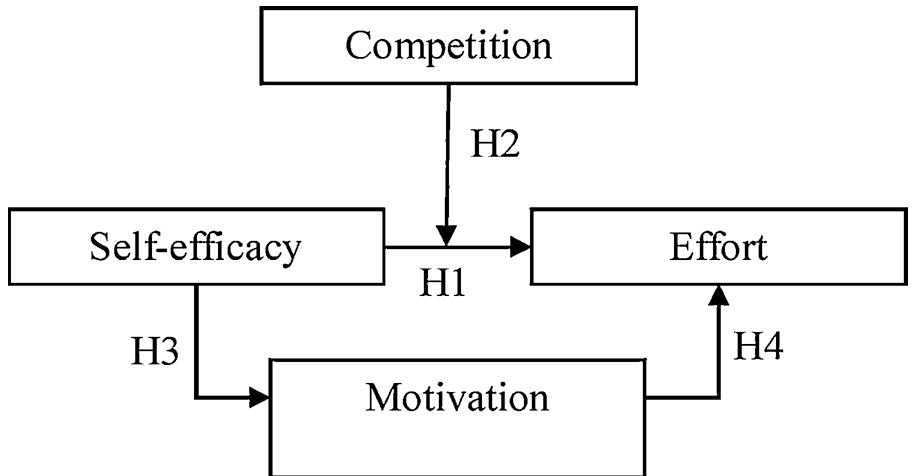
Key Insight 1: The "Switch" of Competition
The most striking finding is the Reversal of the Self-Efficacy Effect.
- With Competition: When a team believes they are capable, they work harder to climb the leaderboard. The leaderboard acts as a "moving target," constantly creating new gaps (discrepancies) to close.
- Without Competition: When a team feels confident and there is no leaderboard to challenge them, they convince themselves they have "done enough" and reduce their effort.
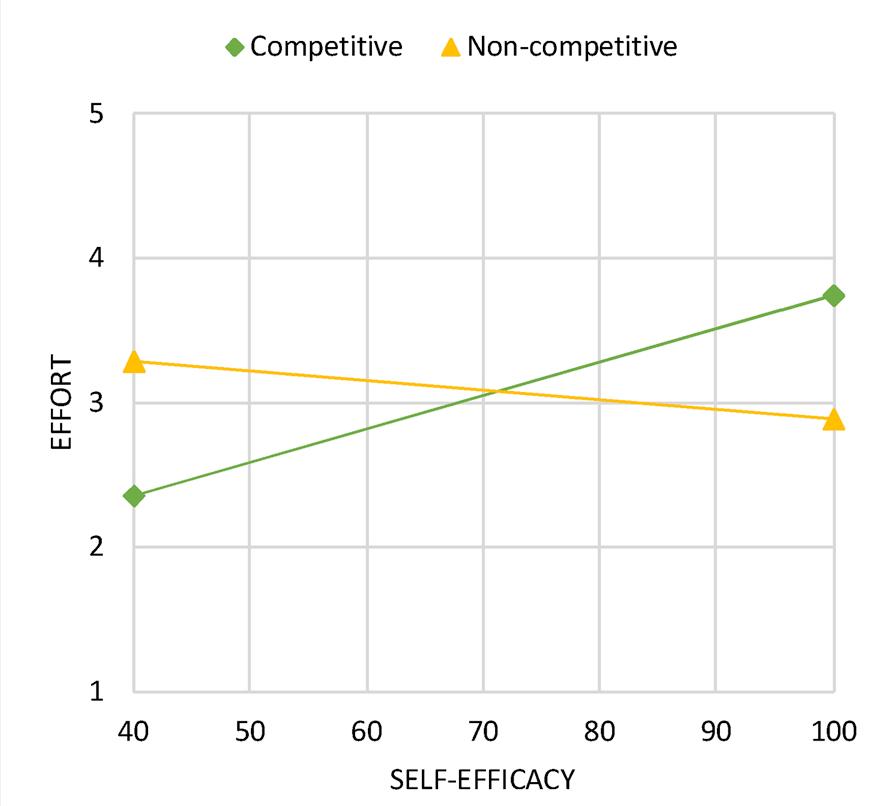 (Visual Proof: Notice how the slope for effort reverses based on the competition dummy.)
Key Insight 2: The Recursive Loop
The study also proves that self-efficacy isn't just a cause of performance; it's a consequence. By using lagged performance data (), the authors show that winning (or ranking high) boosts subsequent self-efficacy, which then fuels more effort—creating a "Virtuous Cycle" of productivity that only exists in the competitive environment.
Critical Analysis & Conclusion
The "Takeaway" for Platform Designers
If you are building a crowdsourcing platform (like Kaggle, TopCoder, or even internal corporate innovation portals), ranking matters more than the prize money. The "Gaming Elements"—specifically interim feedback via leaderboards—are what prevent teams from falling into the "Control Theory Trap" of coasting.
Limitations
While robust, the study used student-centric data from X-Culture. While these students worked on real-world business problems for actual companies (like Mercedes-Benz), the dynamics of professional "gig workers" on platforms like Amazon Mechanical Turk might differ due to extreme financial pressures.
Future Outlook
This research opens the door for AI-driven Incentive Design. Imagine a platform that detects when a team's self-efficacy is leading to "coasting" and dynamically adjusts leaderboard visibility or reward structures to re-ignite competition.
Core Contribution: This work provides a definitive boundary condition for Self-Efficacy Theory: Confidence is only a catalyst for effort when the environment is competitive.